Our Fence Was HOA-Approved — Our New Neighbor Said We’re ‘Not the Kind of People Who Belong Here’
Photo credit: AI-generated image created using ChatGPT. Illustrative only.
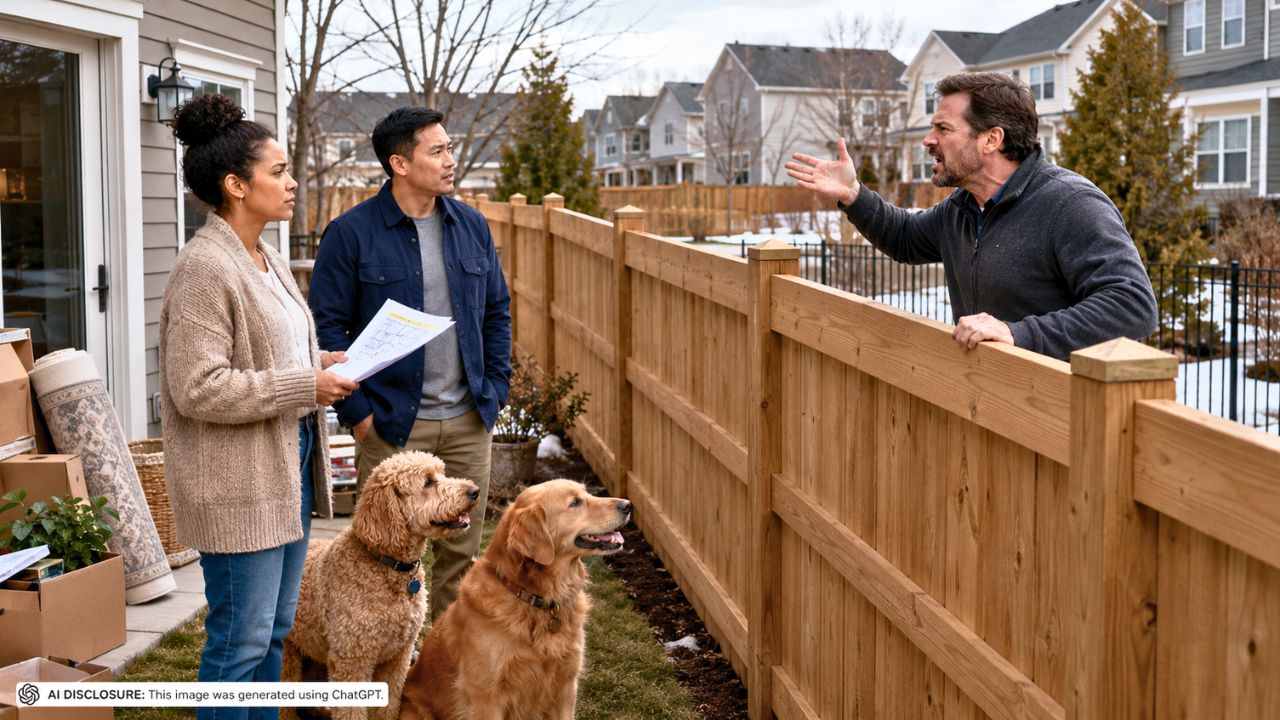
They’d barely finished unpacking when the backyard became a battleground. A couple who moved into their “dream home” in early February thought they were doing the responsible thing: get a survey, follow the HOA rules, then build a fence so their dogs could safely run. Instead, their next-door neighbor treated the project like a personal insult—and eventually told them they didn’t belong.
The homeowner laid out the full timeline in the original post, describing a welcome that never really arrived, followed by a fence dispute that quickly expanded into complaints about their dogs, their routine, and their place in the neighborhood.
They did the homework first: survey, approvals, contractors
The couple moved in February 3 and almost immediately scheduled a property survey. The goal wasn’t cosmetic. They wanted a fence for their dogs, and they wanted it done correctly—on their property, not someone else’s, and not in violation of HOA standards.
They submitted the plans, got HOA approval, and hired contractors. On paper, it was a straightforward project. In real life, it became the first big test of what kind of neighborhood they’d moved into.
The first sign wasn’t loud—it was the silence
The first interaction with the neighbor, whom the poster nicknamed “Nellie,” wasn’t an argument. It was a non-response. The homeowner’s husband waved while checking the mailbox; Nellie stared and didn’t wave back.
That alone could have meant anything—having a bad day, not seeing him, not being chatty. But it became the opening note in a pattern: the couple tried normal neighbor gestures, and Nellie didn’t seem interested in being cordial.
The fence went up, and Nellie tried to stop it mid-install
The temperature changed when the contractors arrived. As the fence was being installed, Nellie came outside and demanded that the workers stop. The contractors told her they had both homeowner and HOA approval and kept working.
That didn’t end it. Nellie contacted the head of the neighborhood committee to complain. But instead of validating her concerns, the committee head later called the homeowner’s husband and reportedly said Nellie was being unreasonable—an early hint that the couple wasn’t dealing with a simple misunderstanding.
By the time the fence was finished, the basic facts were already set: the work was done, the approvals were in place, and the fence was on the couple’s property. The confrontation was no longer about whether the fence could be installed. It was about whether Nellie could pressure them into treating her preferences like rules.
“This fence is not going to work”: the complaint list grows
After the fence was completed, the husband was outside with the dogs when Nellie approached the new fence line and introduced herself. The introduction didn’t come with pleasantries for long. She immediately told him the fence “is not going to work.”
Her objections weren’t about permits or safety. She complained that the fence didn’t match hers, that it was about a foot taller, and that it was close to the property line. She also said the couple should have talked to her before installing it, calling it the “neighborly thing to do,” and said it was disrespectful not to ask first.
The couple’s view was simple: a survey showed the boundary, and the fence was placed a few inches inside their property. They also noted that Nellie’s own fence sits right on the property line, which made her complaint about proximity feel more like a power play than a practical issue.
Then the conversation drifted from lumber and measurements to lifestyle. Nellie complained about the dogs barking around 7 a.m. and criticized the couple for using a dog door rather than walking the dogs. She also said it wasn’t acceptable that the dogs might be outside when she has guests over.
For the homeowners, those weren’t requests so much as demands. They’d moved in weeks earlier, were still settling into the home, and suddenly found themselves being told that their animals—and their daily routine—should revolve around a neighbor’s expectations.
The part that rattled them wasn’t the fence—it was the message
Nellie also told the husband she’s part of the neighborhood committee and said she was going to “see what she can do.” It landed as a warning: even though the fence was approved, she might try to use her position to make the couple’s lives difficult.
She followed that up with a sharper line—saying she doesn’t think they’re a “good fit for the neighborhood,” while emphasizing that she’s lived there for 21 years. The homeowner summed up the underlying message even more bluntly: Nellie said they were “not the kind of people who belong here.”
The husband responded by sticking to documentation. He told her the fence was HOA-approved and based on the survey. He also said they planned to install backyard cameras to monitor whether the dogs were barking excessively, a move aimed at keeping the peace and preventing exaggerated complaints.
Nellie’s reaction wasn’t relief. She told them they were “being too analytical.” In other words: she didn’t want records, she wanted compliance.
At one point Nellie’s husband came outside, and the tone reportedly became more reasonable. He said they are devout Christians and seemed frustrated, but the conversation didn’t produce a resolution. The fence was still there, Nellie still disliked it, and the couple was left wondering what the next escalation might be.
People focused on documentation and keeping the path to the HOA clear
The homeowners’ biggest worry now isn’t aesthetics. It’s retaliation: nuisance complaints, calls to animal control, or ongoing pressure through HOA channels. They’re already thinking a few moves ahead, which is why cameras came up so quickly.
They also took a step that reads like preemptive de-escalation: notifying the HOA chair that they’re fine with the neighbors coming onto their side if access is ever needed for fence maintenance. It’s a small detail, but it matters. When neighbor disputes spiral, access issues are often where people start claiming they’re being “blocked” or “denied,” and the couple is trying to remove that talking point before it shows up in an email thread.
In discussions around disputes like this, people tend to zero in on two practical realities. First, an HOA approval and a survey are only as useful as your ability to produce them quickly, in writing, whenever someone tries to reopen the argument. Second, barking complaints are one of the easiest ways for an angry neighbor to create ongoing stress, because it’s hard to “prove a negative” without timestamps, recordings, or logs.
That’s why the camera plan matters here. If complaints start coming in about nonstop barking at 7 a.m., a homeowner who can check footage and show what actually happened is in a much stronger position than someone trying to defend themselves from memory.
For now, the fence is up, the dogs are home, and the couple is still trying to enjoy the place they worked hard to buy. But with a neighbor hinting she’ll “see what she can do,” the next chapter may depend less on wood and nails and more on who can stay calm, keep records, and refuse to be baited into a bigger fight.

Abbie Clark is the founder and editor of Now Rundown, covering the stories that hit households first—health, politics, insurance, home costs, scams, and the fine print people often learn too late.