Mom Listed Her Wedding Dress on Facebook Marketplace Without Asking — It Had Already Sold
Photo credit: Nowrundown.com
By the time Kara got home from work, her phone was buzzing so hard it felt like it might shake itself off the kitchen counter. First it was her younger cousin, then her best friend from college, then a message from a woman she’d met exactly once at a baby shower two years ago.
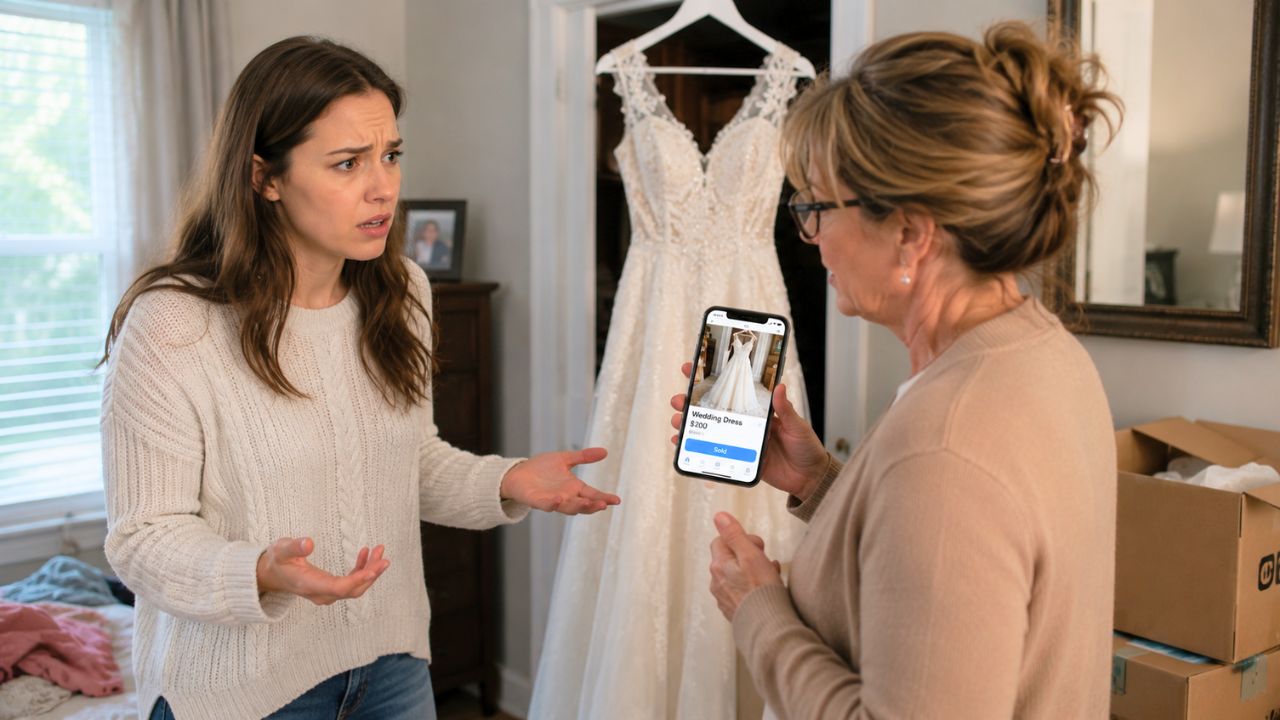
All of them were sending the same screenshot: a Facebook Marketplace listing for a white lace wedding dress, photographed on a hanger against Kara’s childhood bedroom door. The description was cheery and brisk, like someone selling a used stroller. The seller name at the top was her mom’s.
Kara’s stomach dropped in that very specific way it does when you realize something personal has been grabbed and put out in public. She hadn’t even clicked the listing yet and she already knew which dress it was.
The dress wasn’t just fabric, and everyone knew it
Kara had gotten married six years earlier in a dress she saved up for in secret because she didn’t want her mom holding it over her head. It was simple but special to her: fitted at the waist, delicate sleeves, and lace that reminded her of her grandmother’s tablecloths.
After the wedding, she’d had it cleaned and boxed, and she’d kept it at her mom’s house because the box was big and their apartment storage was basically nonexistent. Her mom had offered, insisting she had room, insisting it would be “safer” there.
Even after Kara and her husband bought a small house, the dress stayed behind. Pregnancy, moving, a new job, a toddler who never slept—every time Kara thought about grabbing it, something louder needed her attention. It felt like one of those things that would wait patiently until she had time.
Apparently, it wasn’t waiting. It was being photographed and priced.
The problem started before the big blowup
When Kara called her mom, she tried to keep her voice even. She asked what the listing was and why her dress was on Marketplace. Her mom didn’t hesitate.
She said she was “decluttering,” that she was tired of storing boxes for people who didn’t bother picking them up, and that she assumed Kara didn’t want the dress anymore because she hadn’t asked about it in years. She also mentioned, almost as an afterthought, that she needed extra money for a car repair.
Kara reminded her she’d never given permission to sell it, and that it wasn’t just sitting in a random closet—it was boxed, preserved, clearly kept for a reason. Her mom reacted like Kara was being dramatic, insisting it was “just a dress” and accusing her of acting like her mom had pawned off a family heirloom.
That’s when Kara clicked the screenshot again and noticed something that made her chest go cold: the listing was marked “Sold.”
It had already sold, and the timing made it worse
Kara asked who bought it. Her mom said the buyer was coming by that evening, that it was already paid for, and that the woman was “so excited” because her wedding was in a few weeks and she’d been looking for something exactly like it.
Kara’s first instinct was to drive over and grab the box herself. But she was at home with her three-year-old, her husband was still at work, and her mom lived almost an hour away. Even if she took off immediately, she’d be racing a stranger to her own dress.
She asked her mom to cancel the sale. Her mom said she couldn’t, because she’d already accepted the money and didn’t want to “deal with drama” from the buyer. Kara pointed out that her mom was creating the drama by selling something that didn’t belong to her.
Her mom’s response was sharp: if Kara cared so much, she should have taken it when she moved. Then she went quieter and added something that landed like a slap—Kara “owed” her for all the help she’d gotten over the years.
By the end of the call, Kara was shaking, equal parts furious and embarrassed. There was something humiliating about knowing her mom had posted a part of her life online like it was a spare side table.
The scramble to stop the sale got messy fast
Kara started messaging family members, not because she wanted to involve them, but because she needed someone nearby. Her aunt lived ten minutes from her mom and agreed to swing by. Then Kara sent a message to the Marketplace buyer from her own Facebook account.
She kept it short and polite, explaining the dress belonged to her and had been listed without her consent. She offered to reimburse the buyer immediately and even add extra for the inconvenience, just to get it back without turning the situation into a full scene.
The buyer replied quickly and, to Kara’s surprise, was sympathetic. She said she’d already sent a deposit and had planned to pick it up after work, but she didn’t want a dress that came with a fight attached. She asked for proof it was Kara’s.
Kara sent a photo from her wedding day in the dress, then another of the dress tag and alteration receipt she still had in an email folder. The buyer agreed to back out—if Kara’s mom returned the money.
That’s when the whole thing hit the next wall. Kara’s mom didn’t want to return the payment. She said she’d already used it toward the repair and couldn’t “just pull it out of thin air.” Kara’s aunt, now standing in her mom’s driveway, texted Kara a play-by-play: her mom was defensive, angry, and acting like the dress was household clutter she’d been forced to babysit.
Kara told her aunt to take the dress box and bring it to her. Her mom refused to hand it over. It was still “her house,” she said. The dress might be Kara’s, but it was in her closet, and she was “not being pushed around.”
At that point, it wasn’t only about the dress. Kara realized her mom was digging in because giving it back meant admitting she’d crossed a line.
People around them didn’t focus on the dress, they focused on the control
Once the story got out to the family group chat—because it always does—reactions were split in a way that felt painfully familiar to Kara. Some relatives told her to let it go, to avoid a bigger blowup, to stop “punishing” her mom over something sentimental.
Others were blunt. They said it wasn’t a misunderstanding; it was a decision. They pointed out that Kara’s mom could have called first, or waited, or asked Kara to pick up her things by a deadline. Listing it online, photographing it, pricing it, taking money—those were steps, not an accident.
Kara’s husband came home, read the messages, and drove to her mom’s house himself. He stayed calm, but he didn’t negotiate. He asked for the box, reminded her it wasn’t hers to sell, and told her he’d reimburse the buyer tonight if that’s what it took.
Her mom tried to pivot into tears, then anger, then a speech about respect. Kara sat in the car, watching the porch light flicker on, feeling eight years old again in the worst way.
The outcome didn’t feel like a win
In the end, Kara got the dress back, but it wasn’t tidy. Her husband left with the preservation box, and Kara immediately stored it in their own closet like she was hiding it from being taken again.
The buyer got her deposit back too—after Kara sent the money herself and told her mom she could pay her back later. Her mom didn’t say thank you. She said Kara had embarrassed her and made her look untrustworthy.
For a few days, her mom stopped answering calls. Then she started sending messages like nothing happened, dropping pictures of Kara as a kid and asking when she could take her grandchild for the weekend. Kara didn’t respond right away. She couldn’t.
Because now Kara wasn’t only thinking about lace and a wedding day. She was thinking about the way her mom treated her belongings like leverage, the way she turned a simple question into a power struggle, and how quickly she made herself the victim the second someone pushed back.
The dress is safe, at least for now. But the bigger issue—the one Kara can’t fold up and put in a box—still hangs in the air, waiting for the next time her mom decides permission is optional.
Check out more from Now Rundown:
- A Party of 12 Came Back a Month Later Demanding Their $80 Tip Refunded — My Restaurant Made Me Pay It
- Her Coworker Kept Filing the Same Complaint About Her After Being Warned — Then She Filed a Counter-Report With Every Email Documented
- Siblings Demanded Half of Their Sister’s $11 Million Inheritance — She Refused Because They Never Visited
- The Kid I Bullied in Middle School Just Interviewed for a Job on My Team — He Bombed It and I Didn’t Hire Him

Abbie Clark is the founder and editor of Now Rundown, covering the stories that hit households first—health, politics, insurance, home costs, scams, and the fine print people often learn too late.