Laundry Workers Complained Their Supervisor Mocked Them for Being Old — Management Ignored It, Two Were Fired, and the Care Center Paid $75,000
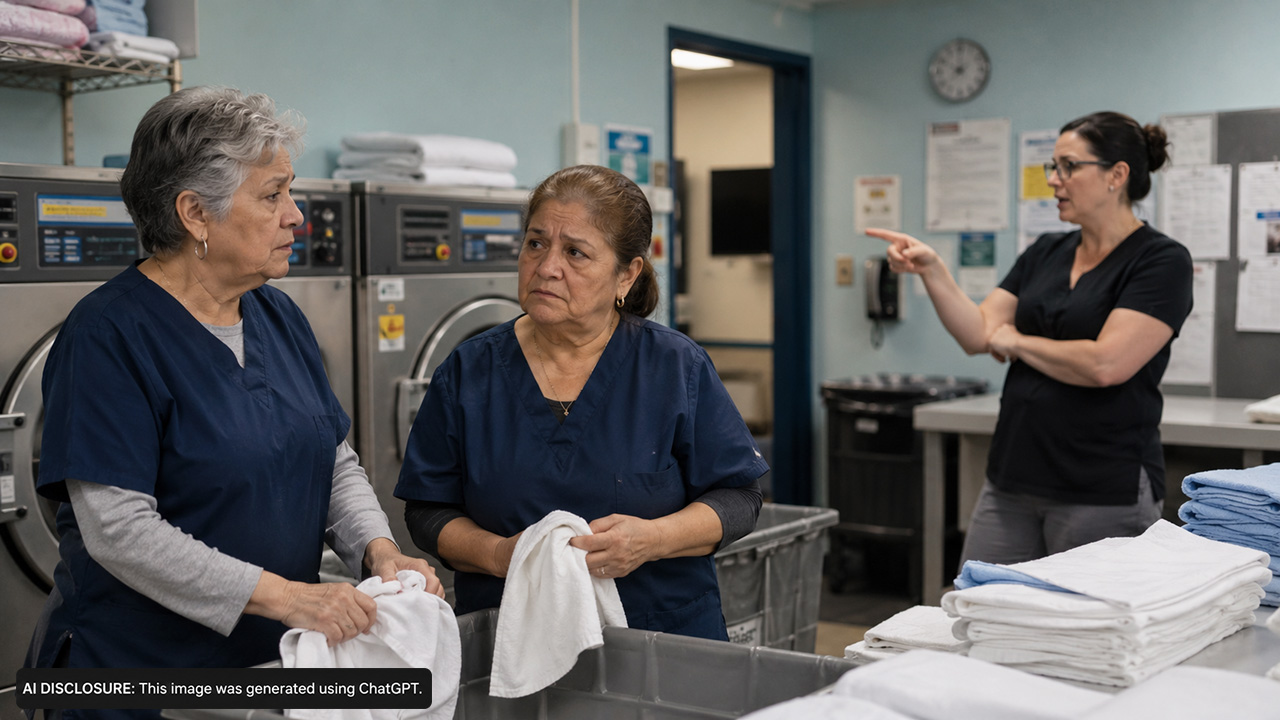
Photo credit: AI-generated image created using ChatGPT. Illustrative only
In the laundry department at an Albuquerque long-term care facility, the work is steady, physical, and usually invisible until something goes wrong. According to the EEOC’s announcement, what went wrong here wasn’t a broken machine—it was the way older workers say they were treated by a supervisor, and what happened after they spoke up.
The U.S. Equal Employment Opportunity Commission says employees complained more than once that they were being mocked for their age and treated worse than younger coworkers. Management allegedly brushed those complaints off. The conflict didn’t fade with time; it escalated, and the EEOC says it ended with at least two workers being fired after they kept complaining.
It started with remarks that didn’t feel like jokes
The EEOC’s lawsuit describes a supervisor in South Valley Care Center’s laundry department who allegedly harassed and mocked older workers because of their ages. This wasn’t framed as a one-time comment or an awkward misunderstanding. The agency says it was persistent enough that workers went to management multiple times.
In workplaces like laundry—fast, repetitive, and demanding—people often rely on routine and teamwork to get through the day. When the person directing the work is also the person taking shots at employees’ age, it changes everything: who gets listened to, who gets pushed aside, and who feels safe challenging unfair treatment.
Management heard the complaints, and the workers say nothing changed
One of the details the EEOC emphasized is that older workers allegedly complained “multiple times” to management. The accusation isn’t just that a supervisor behaved badly; it’s that the facility ignored the warnings.
That’s the moment these stories usually turn. If a company steps in early—separating staff, investigating, documenting, retraining—problems can be contained. The EEOC’s version of events says the opposite happened here: the workers kept raising the issue, and the response they got didn’t stop the alleged harassment.
When employees feel like their complaints disappear into a void, they tend to face a painful choice. They can keep their head down and endure it, or they can keep pushing and risk becoming the “problem employee” in the eyes of management. The EEOC says two workers who continued to complain lost their jobs.
The breaking point came after the workers kept speaking up
According to the EEOC, the harassment “ultimately culminated” in South Valley firing at least two workers in August 2022 after they continued to complain. That’s where the retaliation allegation comes in: the idea that the employees weren’t fired for performance issues, but because they wouldn’t drop their complaints about age-based treatment.
The agency said the conduct violated the Age Discrimination in Employment Act (ADEA) and Title VII of the Civil Rights Act of 1964, pointing to both discrimination/harassment based on age and retaliation for complaining about discrimination.
The EEOC filed the case in U.S. District Court for the District of New Mexico (Case No. 1:25-cv-00569-JMR-KK). Instead of running this all the way through a trial, the case ended in a settlement—one that puts money on the table and forces the employer to make specific changes.
The settlement wasn’t just a check—it came with conditions
South Valley Care Center, LLC agreed to pay $75,000 to settle the lawsuit. The EEOC said the money will be paid as damages to two workers.
But the settlement also includes a three-year consent decree that reads like a blueprint for how the agency expects the workplace to be cleaned up. South Valley must provide letters of apology and reference to the two affected workers. The facility also has to hire an outside consultant to help revise and update its anti-discrimination policies.
On top of that, the consent decree requires comprehensive anti-discrimination training for employees. And it doesn’t end with a one-and-done seminar: South Valley must report to the EEOC on its training, complaints, and policy modifications over that three-year period.
In the real world, those requirements matter because they change what happens the next time someone complains. Training sets expectations, updated policies set procedures, and reporting creates a paper trail—something employees often say they were missing when they first tried to raise concerns.
People tend to focus on the same pressure points: proof, paper trails, and retaliation
The EEOC press release doesn’t include public comments, but this kind of workplace story usually draws attention to a few practical pressure points—especially when it involves a department like laundry, where workers can feel replaceable and where supervisors can control schedules, assignments, and day-to-day treatment.
First: documentation. When workers say they complained repeatedly and nothing happened, the next question is often whether those complaints were made in writing, whether there were witnesses, and whether there’s a record of when the complaints were raised. Second: escalation channels. If direct management ignores it, employees commonly look for HR or a higher-level administrator—anyone who can’t easily pretend they never heard about it.
Third: the retaliation risk. Many workers already know the gut feeling of what it’s like to be labeled “difficult” after raising concerns. This case highlights that fear in a concrete way: the EEOC says the people who continued to complain were fired. Even without extra details, the sequence alone explains why employees in similar jobs worry that speaking up will cost them their paycheck.
For the facility, the price tag is money—and supervision under a microscope
South Valley’s payment is the headline number, but the longer shadow is the three-year oversight built into the consent decree. Having to bring in an outside consultant, rewrite policies, train staff, and report back to a federal agency forces the issue into the open internally. It also signals to managers and supervisors that “that’s just how they talk” isn’t an acceptable excuse.
The EEOC framed the resolution as an early one that provides targeted relief to affected workers and creates “meaningful, lasting changes” to the work environment. For the two workers at the center of the settlement, the agreement includes not only money but also apology and reference letters—tools that can matter when you’re trying to get hired again after being fired.
And for other workers watching, the message is simple and unsettling at the same time: complaints can be ignored for a while, but they don’t disappear. Sometimes they just move from the back office to federal court—and then the workplace has to change in public.
Check out more from Now Rundown:
- A Party of 12 Came Back a Month Later Demanding Their $80 Tip Refunded — My Restaurant Made Me Pay It
- Her Coworker Kept Filing the Same Complaint About Her After Being Warned — Then She Filed a Counter-Report With Every Email Documented
- Siblings Demanded Half of Their Sister’s $11 Million Inheritance — She Refused Because They Never Visited
- The Kid I Bullied in Middle School Just Interviewed for a Job on My Team — He Bombed It and I Didn’t Hire Him

Abbie Clark is the founder and editor of Now Rundown, covering the stories that hit households first—health, politics, insurance, home costs, scams, and the fine print people often learn too late.