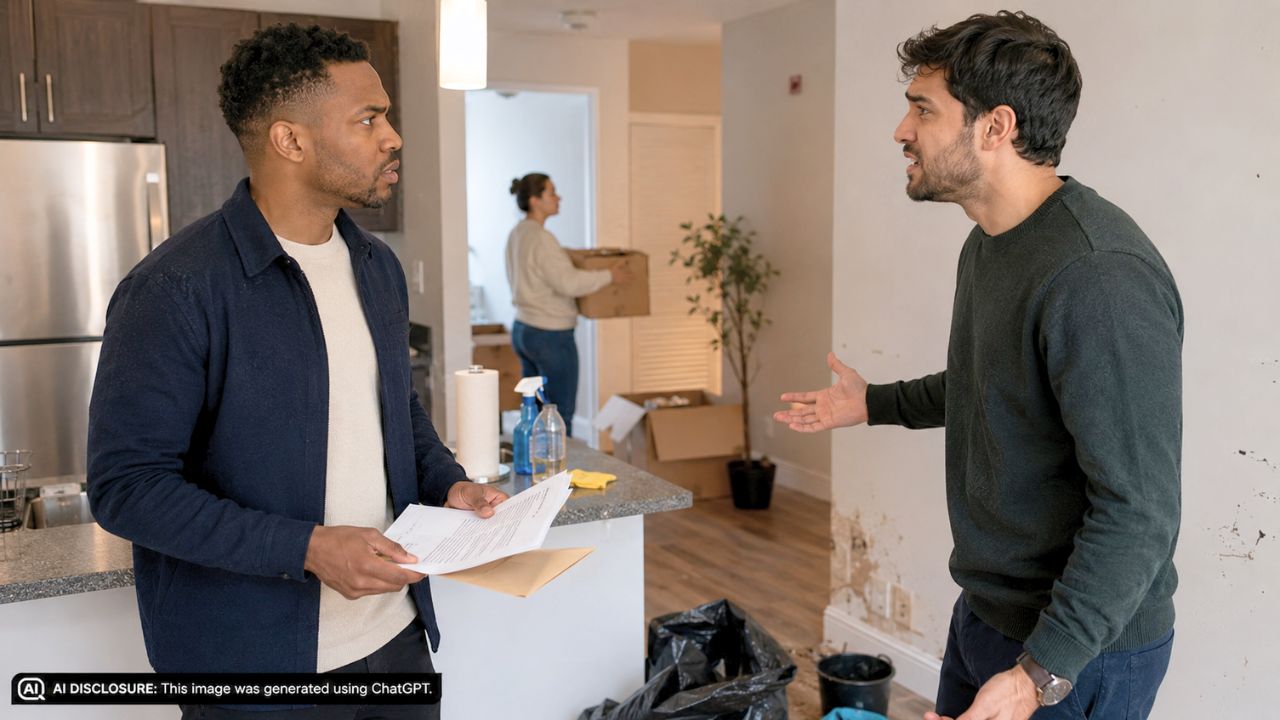
Landlord Withheld a Former Tenant’s $1,750 Deposit Over Damage the Tenant Said Was Already There
Photo credit: AI-generated image created using ChatGPT. Illustrative only.
By the time the keys were handed back, everyone thought the handoff would be simple: one roommate out, the rest staying put, and a new person sliding into the open room. Instead, the move-out turned into a clean-up marathon and a fight over money that none of them technically controlled.
In the original post, a 26-year-old tenant described how his former roommate Adam left their shared rental in what he says was a far worse condition than “normal wear and tear.” The landlord wasn’t returning any deposit yet because the lease was continuing under new names, so the roommates were told to settle the departing roommate’s share among themselves. That’s when the poster decided to hold back part of Adam’s deposit—sparking a blowup.
The move-out looked fine—until someone actually walked into the room
The apartment had been rented for years by four roommates: the poster, Todd, James, and Adam. They’d each paid their portion of a security deposit directly to a property management company when they moved in.
After a few years, Adam decided to move out while the other roommates planned to keep renting. Adam moved most of his belongings out about a week early, then returned on the last day to do what he considered a final clean. That evening, he said he was done, returned his keys, and left.
No one immediately challenged it. The assumption was that he’d left the room and bathroom in the condition he’d received them. The next day, the poster went to move into Adam’s old room to make space for a new tenant to take over his previous room—and that’s when the condition of the space became impossible to ignore.
The cleaning list wasn’t cosmetic—it was time, supplies, and repairs
According to the poster, the room and bathroom weren’t just dusty or lightly messy. He says Adam left “mold all over the walls of the shower,” thick water scum covering the shower glass, and a broken shower door handle.
He also described a toilet seat with a hinge “sheered off,” plus visible grime: shoe prints and dirt on walls near where a desk had been, dried soda stains on the wall, an electrical outlet, and the floor. On top of that were sticky liquids dripped across hardwood floors and personal items left in other parts of the house and basement, which the roommates later boxed up over the following weeks.
The poster says the cleanup took 8 to 10 hours and wasn’t something he could delay. He bought cleaning products and replacement items, including mold cleaning supplies, scrub brushes, glass cleaning products for the shower, and a new toilet seat. The mess also threw off their timing: it delayed his own room switch and pushed back the move-in of the incoming roommate by several days.
The deposit problem: the landlord stayed out of it, so the roommates didn’t
The dispute didn’t start with a typical landlord move-out inspection. Because the lease was continuing—just with names swapped—the property management company told them it wouldn’t be releasing any portion of the security deposit at that time.
Instead, the company recommended a workaround: use the incoming tenant’s security deposit money to reimburse the roommate who was leaving. The security deposit would eventually be refunded in full when the lease fully ended, but the company said that payment would go to one person. Everyone was copied on those emails, the poster said, and the roommates were left to sort out their own accounting.
That setup put the poster in an awkward position. He wasn’t the landlord, but he also wasn’t willing to treat Adam’s move-out like it was clean and complete. So he made a call that immediately turned personal: he withheld $175—about 30% of Adam’s share, in his view—to cover the supplies and the time he spent getting the room and bathroom back to a livable standard.
“You’re not the landlord” versus “you left me the work”
Adam, the poster said, was furious. His argument wasn’t subtle: the poster wasn’t the landlord, and therefore had no right to withhold any portion of a deposit.
Adam also argued it wasn’t fair because he had spent “several hours cleaning up the room,” and he said the roommates didn’t give him a chance to return and fix anything they felt he missed. From Adam’s perspective, he’d done his part, and any complaints should have come through a landlord process—not through a roommate who decided to act like an adjudicator after the fact.
The poster didn’t deny the basic power imbalance—he agreed he wasn’t the landlord. But he rejected the idea that effort mattered more than outcome. In his view, it didn’t matter how long Adam spent cleaning if the space was still left in what he described as a “complete mess.”
And in a house with a new roommate lined up, he said there was no room to negotiate a second round of cleaning on Adam’s schedule. The space needed to be ready. So he cleaned it, replaced what he felt had to be replaced, and reduced the refund accordingly.
What people honed in on: proof, paper trails, and who’s on the hook later
The post was labeled “Not the A-hole,” signaling that many readers sided with the roommate who did the cleaning and kept back part of the money. The general logic was straightforward: if one person creates the mess and someone else has to spend money and hours fixing it, it’s reasonable to offset those costs.
But the details of the deposit arrangement also set off alarms. With the property management company stepping back and telling the tenants to handle refunds internally, the remaining roommates could be left holding the bag later if the property manager eventually makes deductions when the lease ends. If the shower, toilet, floors, or walls are later flagged as damage, the people still on the lease could be the ones paying—long after Adam is gone.
That’s why documentation was such a big undercurrent in the discussion. In roommate handoffs, photos and receipts can be the only way to keep a deposit disagreement from turning into a permanent argument. When one person claims damage was “already there” and another says it was left behind, the most convincing evidence is what was recorded at move-in, at move-out, and during cleanup.
Even without a landlord inspection at the time of departure, clear records can matter if the group later has to explain why a future deposit refund should or shouldn’t be reduced, and who should be responsible for what.
A quick exit can turn into a long hangover for everyone still living there
What makes this kind of roommate dispute so combustible is how quickly it stops being about cleanliness and starts being about control. Adam left, returned keys, and considered the chapter closed. The poster was still living there, still managing the transition, and suddenly dealing with mold, grime, broken fixtures, and delays that affected a new tenant’s move-in.
In the end, the withheld $175 wasn’t just a dollar amount. It was a statement: the poster believed Adam’s departure created real costs, and those costs shouldn’t be redistributed to the roommates who stayed behind.
But Adam’s anger also points to the part that doesn’t resolve neatly. When landlords outsource deposit logistics to tenants mid-lease, roommates end up enforcing standards that usually belong to a third party. And once that happens, a move-out isn’t just packing and leaving—it’s a negotiation over what “clean enough” means, and who gets to decide.
Check out more from Now Rundown:
- A Party of 12 Came Back a Month Later Demanding Their $80 Tip Refunded — My Restaurant Made Me Pay It
- Her Coworker Kept Filing the Same Complaint About Her After Being Warned — Then She Filed a Counter-Report With Every Email Documented
- Siblings Demanded Half of Their Sister’s $11 Million Inheritance — She Refused Because They Never Visited
- The Kid I Bullied in Middle School Just Interviewed for a Job on My Team — He Bombed It and I Didn’t Hire Him

Abbie Clark is the founder and editor of Now Rundown, covering the stories that hit households first—health, politics, insurance, home costs, scams, and the fine print people often learn too late.