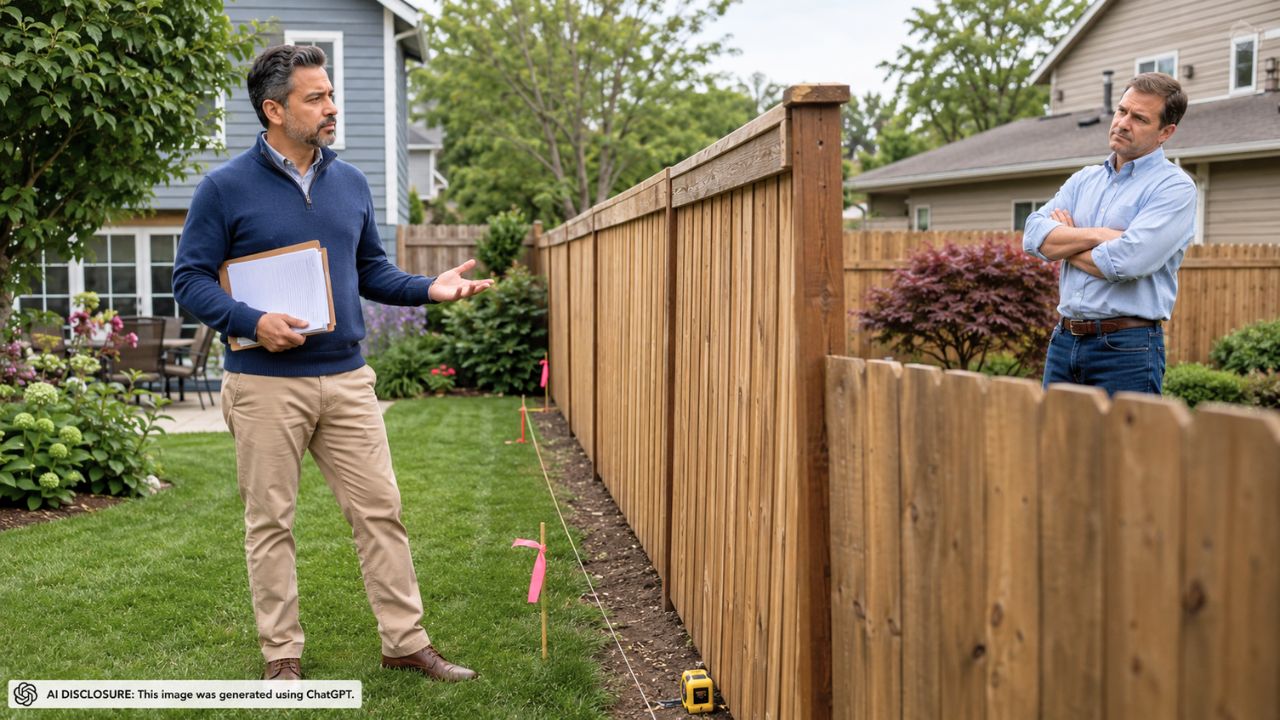
Man Filed a Legal Complaint to Force His Neighbor to Move a Fence That Encroached on His Yard
Photo credit: AI-generated image created using ChatGPT. Illustrative only.
Five years after buying his home, a 35-year-old homeowner thought he’d already done the hard part: replacing a failing backyard fence and putting a little distance between his household and a tense neighbor relationship. Instead, a new fence line turned into a property fight, a dog safety problem, and now a question of whether to bring in lawyers and the county.
In the original post, the homeowner lays out a chain of events that started with a rotting back fence and escalated into a claim that his neighbor’s replacement fence effectively stole four feet of his yard. The latest flare-up involved two dogs getting injured while digging at the base of that shared boundary—followed by an argument over who should pay the vet bills.
A failing fence and dogs that couldn’t stop reacting
When he first moved in, the fence along the back of his property was in bad shape. He says it was rotting to the point that he could see directly into the yard of the neighbor behind him, someone he says he wanted to avoid because of earlier run-ins.
The biggest pressure point was the dogs. He has three large dogs, each around 80 to 90 pounds, and says one can jump high enough that he worried it could clear a short fence. The neighbor has two dogs—a larger dog and a smaller terrier—and he describes all of them as “extremely reactive” to one another, barking and growling along the line.
He didn’t see that behavior as funny or harmless. He says he didn’t want to reinforce it, especially with big dogs involved, but believed the neighbor thought the chaos at the fence was “cute.” After what he describes as four separate dog-related disputes, he decided the answer was a new barrier that stopped sightlines completely.
He tried to do it right—and got called out anyway
His plan was to install a metal fence so neither he nor the dogs could see through it. But the project hit a snag as soon as the posts went in. The neighbor objected and claimed he was building on her property.
After he reviewed the placement with the contractor, he says the neighbor was right—at least in part. The disputed strip wasn’t the neighbor’s private yard, but an alleyway area, meaning the posts were still not on his property. He says he moved the posts and built the fence without complaint.
That should have ended it. Instead, he says it set up the next problem: his neighbor then installed her own fence and used his fence posts to do it.
Then the fence line shifted—four feet at a time
According to the homeowner, the neighbor’s new fence effectively changed the boundary in practice, even if it didn’t change anything on paper. He says his yard is now “4 ft smaller and hers 4 ft bigger,” because her new fence was built in a way that claimed extra space on his side.
That detail matters because it changed the daily reality of the property. A fence isn’t just a divider; it dictates where people walk, where pets run, and what homeowners can maintain. He had already invested in replacing a fence for safety and privacy, and now he felt that investment was being used against him.
It also created a new kind of friction: not just noise and barking, but physical problems at the base of the fence where the yards meet.
A hole under the fence turned into a vet-bill fight
The most recent blowup happened when the neighbor’s dogs dug a hole under the fence. The homeowner says they didn’t get through to his side, partly because he had paved his yard with concrete.
But the digging still triggered a dangerous back-and-forth. He says one of his dogs tried to dig back and ended up slicing its paw after getting stuck between the concrete and the fence. He also says the neighbor’s dog hurt its snout and paws by digging into the pavement and trying to sniff at his dog from beneath the fence.
That might have been a shared “dogs will be dogs” moment—except it quickly became financial. The neighbor, he says, complained that he should pay for her dog’s injuries. He refused, saying he already had his own vet bills and blaming the entire setup on her decision to build off his posts in the first place.
By that point, he says he’d had enough. His next step wasn’t another conversation over the fence line—it was planning to “get legal,” including contacting a lawyer and notifying the county.
He worried it was petty, but others saw a boundary issue
The homeowner’s hesitation wasn’t about whether he was right about the fence. It was about what happens when neighbors start calling authorities on each other. A coworker told him it would kick off a “neighbor war,” and he admitted he might be acting out of anger.
But the responses included in the post were direct: “Not the A-hole.” The tone of that judgment suggests people saw the problem as bigger than a momentary spat—more like an ongoing property encroachment with real costs attached, including repeated dog conflicts and vet expenses.
Even without a full comment thread included, the general practical thrust is familiar in disputes like this: when the boundary itself is in question, casual agreements and verbal promises don’t hold up. A fence line that steals usable space can turn into an everyday headache, and once injuries and bills enter the picture, the pressure to document and escalate ramps up fast.
What he’s really trying to stop before it gets worse
At its core, the homeowner isn’t just trying to win an argument. He’s trying to stop a cycle: reactive dogs meeting at the same spot, digging at the same seam, and getting hurt in the same way, over and over. The more they practice that behavior, the harder it can be to break—and the more likely someone ends up with a worse injury than a scraped paw or snout.
And then there’s the property piece. If his account is accurate, he’s looking at a fence that doesn’t just annoy him but functionally shrinks his yard. That affects how he uses and maintains his property and could become a bigger issue later if he ever tries to sell, renovate, or replace fencing again.
For now, he’s standing at a familiar crossroads: tolerate an encroaching fence and escalating pet drama, or take the formal route and accept that the relationship next door may never recover. Either way, the fence isn’t just a fence anymore—it’s the line where every other conflict in this neighbor relationship keeps piling up.
Check out more from Now Rundown:
- A Party of 12 Came Back a Month Later Demanding Their $80 Tip Refunded — My Restaurant Made Me Pay It
- Her Coworker Kept Filing the Same Complaint About Her After Being Warned — Then She Filed a Counter-Report With Every Email Documented
- Siblings Demanded Half of Their Sister’s $11 Million Inheritance — She Refused Because They Never Visited
- The Kid I Bullied in Middle School Just Interviewed for a Job on My Team — He Bombed It and I Didn’t Hire Him

Abbie Clark is the founder and editor of Now Rundown, covering the stories that hit households first—health, politics, insurance, home costs, scams, and the fine print people often learn too late.