Her Husband Told Her to Stay Home With the Newborn While He Took Their Other Kids on the Family Vacation
Photo credit: AI-generated image created using ChatGPT. Illustrative only
Six months before the usual annual trip to visit her father-in-law, a mother of three thought she was doing the normal, practical thing: locking in flights, figuring out where everyone would sleep, and bracing for another round of travel with little kids. Instead, she says her husband hit her with a plan that felt less like problem-solving and more like being sidelined from her own family time, as she explained in the original post.
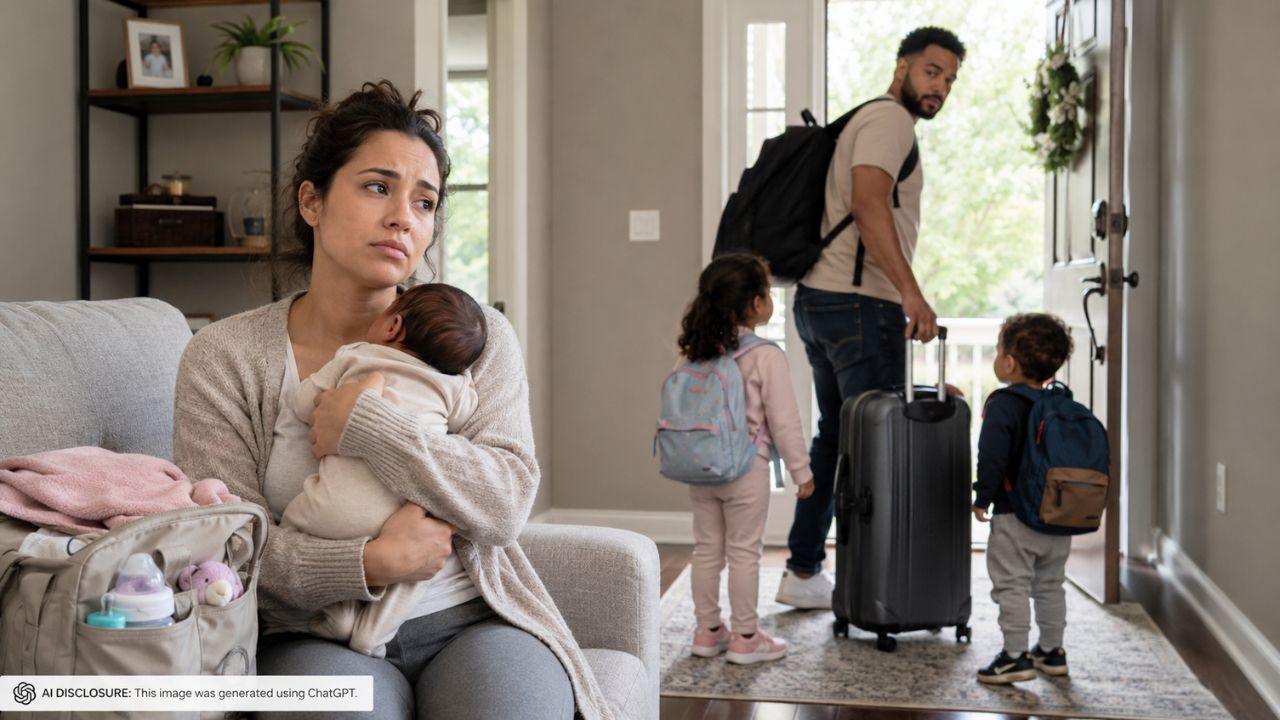
They share three children: a 4.5-year-old, a 2.5-year-old, and a one-month-old newborn. The tradition is to fly to another state every year to visit his father, typically staying in his father’s home. This year, her husband told her to stay back with the baby while he took the two older kids alone.
A familiar trip that was already getting harder to fit
Even before the newest baby arrived, she had been pushing for a change to the usual setup. Staying at her father-in-law’s place was starting to feel cramped and tense, especially as the kids got louder and more energetic.
She said she’d suggested getting a separate place to stay so everyone could have a little breathing room—space for the kids to be kids, and space for her father-in-law not to feel like his home had been turned into a daycare.
That suggestion mattered this year because it’s part of why she was already thinking through logistics ahead of time: flights, a possible rental, a car, the full scope of traveling with three little ones.
Then her husband made it sound like a decision was already made
As she started making arrangements for the trip, she says her husband told her not to come. His reasoning, in her telling, was that bringing her and the baby would be “too hard,” and that the trip would require renting a place and a car.
She noted that money wasn’t the issue. It wasn’t a “we can’t afford it” conversation—it was framed as a convenience and stress conversation, with her husband proposing a streamlined version of the holiday: him and the two older kids traveling without her.
That’s where the emotional stakes spiked. From her perspective, this wasn’t just about managing a newborn’s schedule or minimizing chaos on a flight. It was a “family holiday” she was suddenly being told to sit out.
She said she wanted to go anyway—and got labeled “unreasonable”
She told him she still wanted to go because it’s a family trip. In her mind, the whole point of the tradition was that they go together, even if it takes extra planning and extra patience.
But she says he repeated that it would be easier if she didn’t go. And when she got angry, his message shifted: suddenly she “could come if [she] wanted,” and he framed her reaction as being unreasonable.
That combination—first telling her not to come, then acting like he was doing her a favor, then flipping it into “fine, come if you want” once she pushed back—left her feeling like the bad guy for being hurt.
Her core question was simple: was she wrong for being mad about being excluded?
The real-world impact: what “staying home” actually means
On paper, staying home with a one-month-old might sound like rest. In reality, it can mean something else entirely: being alone for days while recovering postpartum, managing feedings and sleep deprivation without backup, and watching the rest of the family make memories somewhere else.
It also shifts the workload in a way that can feel invisible. He gets to travel with the two older kids—hard, yes, but also a change of scenery and a break from newborn care—while she handles the newborn full-time with none of the “holiday” part.
And there’s another layer: the trip is to see his father. Being told not to come can easily read as, “My family will travel to my side of the family without you,” even if the stated reason is logistics. She had already been sensitive to the dynamic in the father-in-law’s house, worrying the noise wasn’t welcome. Now she was being asked to stay away entirely.
She also emphasized timing. This wasn’t a trip happening next week; it was in six months. That detail matters because it undercuts the idea that there was no room to plan around a baby who will be older by then—and it makes the “don’t come” sound less like an emergency call and more like a preference.
What people focused on: intent versus delivery
In an update, she said the responses helped her see “varying perspectives,” and that the way her husband communicated it was “very poorly done” and made her feel excluded, even if his intent was good.
That framing—good intent, bad execution—gets at why this blew up. If the husband had started with, “This trip will be intense with three kids; what do you want to do?” it becomes a joint decision. Instead, she experienced it as being informed of a plan where she was left behind.
Another practical piece people tend to latch onto in conflicts like this is choice. Real choice isn’t “you can come if you want” after someone is already angry. Real choice is being part of the planning from the beginning, especially when the topic is something as loaded as travel, extended family, and postpartum life.
Her own post also hinted at an underlying issue that doesn’t go away with one decision: she’s been uncomfortable staying in her father-in-law’s home and has tried to adjust the tradition. The new baby didn’t create the friction; it just gave it a new shape.
Her next move: taking a different trip instead
Rather than forcing the argument to keep looping around the same points, she chose a different path. She said she’s going to take the baby overseas on a holiday with extended family instead.
That decision does a few things at once. It gives her a trip that doesn’t come with the same pressure points about staying at her father-in-law’s place. It also prevents her from sitting at home while her husband travels with the older kids.
But it also quietly raises the stakes in the marriage. When one partner’s “solution” to a family vacation becomes two separate vacations—him with the older kids, her with the baby—it can either be a temporary workaround or the beginning of a new normal.
For now, she seems to be treating it as a practical pivot after feeling boxed out. Still, the original issue remains sitting there underneath the travel plans: whether “considerate” means making a unilateral call, and how a couple with three small kids makes decisions without one person feeling left behind.
Check out more from Now Rundown:
- A Party of 12 Came Back a Month Later Demanding Their $80 Tip Refunded — My Restaurant Made Me Pay It
- Her Coworker Kept Filing the Same Complaint About Her After Being Warned — Then She Filed a Counter-Report With Every Email Documented
- Siblings Demanded Half of Their Sister’s $11 Million Inheritance — She Refused Because They Never Visited
- The Kid I Bullied in Middle School Just Interviewed for a Job on My Team — He Bombed It and I Didn’t Hire Him

Abbie Clark is the founder and editor of Now Rundown, covering the stories that hit households first—health, politics, insurance, home costs, scams, and the fine print people often learn too late.