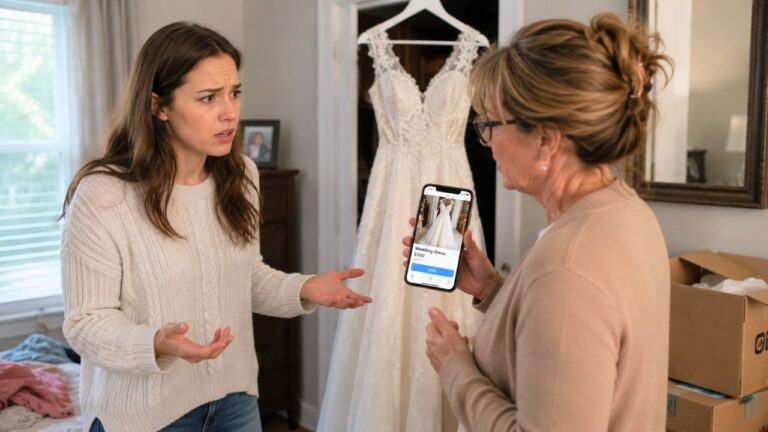
Woman Refused to Take Unpaid Leave From Her New Job to Care for Her Sick Mother After Already Spending Years as Her Unpaid Caregiver
Photo credit: AI-generated image created using ChatGPT.
She’d only been at her new job for a few weeks when the phone call came with a familiar kind of pressure: her mom’s medical team wanted a caregiver to stay with her for the next three weeks, and her family expected her to be the one to drop everything and go. But after more than a year of being the person who did it all—appointments, treatments, emergency room visits in the middle of the night—she said no.
In the original post, the 23-year-old explained that she’d recently started working again after nearly two months unemployed. The timing couldn’t be worse. She’d been in the role for less than a month, and she felt it was “difficult to request time off” so early, especially for several weeks.
She already spent years doing the work no one else would do
Two years earlier, her mother was diagnosed with cancer. For over a year, she said she became the primary caregiver without hesitation. That meant driving her mother to treatments “every single day,” attending every appointment, and handling “every 3am ER visit without fail.”
It wasn’t just medical care. She also described running the household and raising her two siblings during that time. And she says she did it without meaningful help from her mother’s husband, who she called a narcissist and said “did nothing,” despite being the person who, in her view, should have stepped into that role.
What makes her current refusal hit harder is the implied expectation that this isn’t a temporary ask—it’s the default family plan. She had already proven she could carry the load, and now her parents were treating that as the starting point, not a sacrifice she’d already made.
The new request came with a three-hour drive and a three-week commitment
According to her account, her mom had been participating in a medical trial located three hours away from home, and that trial had now ended. The next step, though, came with a new demand: her treatment team wanted a caregiver to be physically with her for three weeks.
The post frames it as an outside requirement—something the medical team requested, not just a family preference. But the impact was still personal and immediate: someone needed to be available, and her parents turned to her like it was already settled.
For a new employee, “three weeks” isn’t just a schedule problem. It can mean losing credibility, being labeled unreliable, or even being replaced. And for someone who had just come off unemployment, the stakes around income and stability weren’t abstract. This job was her foothold back into her own life.
Her parents framed it as loyalty: “my job or my mom?”
When she told her parents she couldn’t take the time off, she says they responded with a guilt-laced ultimatum: she needed to be “more dedicated” and ask herself what mattered more, “my job or my mom?”
It’s a brutal question because it turns caregiving into a measure of love. In her telling, it also erases the year-plus she’d already given—when she didn’t miss appointments, didn’t skip the emergency room runs, and didn’t have backup at home.
Her parents didn’t stop at asking her to request time away. She said they told her to quit her job entirely so she could continue as the primary caregiver. That escalation is what pushed her to ask outsiders if she was wrong for wanting to keep her career moving.
When caregiving becomes a permanent assignment, the costs pile up
Even without getting into dollar amounts, the consequences she’s describing are concrete: disrupted employment, stalled career progress, and the risk of becoming trapped in a role that no one else will step into. Caregiving is exhausting on its own; caregiving while being treated as the only option can hollow out everything else.
There’s also the physical and logistical toll. A three-hour distance from home means the caregiver isn’t just “helping out”—they’re effectively relocating or living on the road. If she’s also been functioning as a stand-in parent for her siblings, leaving for weeks could create another crisis at home, especially if the adults who should be coordinating support aren’t doing it.
And then there’s the emotional math she’s being forced to do. She doesn’t describe refusing to help at all; she describes refusing a specific demand that would derail a brand-new job. The gap between those two things is where a lot of caregiver burnout lives.
Reactions centered on fairness, boundaries, and who should step up
The post itself labels the judgment as “Not the A-hole,” signaling that many readers sided with her. The heart of that reaction is easy to understand: she already showed up, daily, for more than a year. Asking her to abandon a new job to do it again—while the parent who could share the load supposedly doesn’t—reads less like family support and more like family convenience.
People also tended to focus on the father’s absence in her story. If he’s present in the home but not participating, it raises the question of why the responsibility keeps landing on the 23-year-old daughter. The way she describes it, she wasn’t refusing to care about her mom; she was refusing to be volunteered as the only solution.
Another practical theme in supportive reactions is that work protections and time off aren’t always available, especially in the first month of employment. Quitting might satisfy the immediate demand, but it could create a longer-term financial emergency—one that would ultimately make it harder to help anyone, including her mother.
The hardest part is that the medical need is real, even if the expectations aren’t
Nothing in her account suggests her mother doesn’t need support. The medical team’s request for a caregiver signals vulnerability and the kind of day-to-day help that can make treatment safer and less frightening. That’s what makes this so painful: the need is legitimate, but the plan seems to rely on one person sacrificing everything again.
Her post ends with the question she can’t shake—whether she’s wrong for choosing to protect her job and her future. It’s also a question about roles: daughter versus caregiver, employee versus emergency contact, young adult trying to build a life versus the person everyone calls when the system fails.
For now, she’s holding the line. The tension is that three weeks is a short timeframe on paper, but in a family where expectations have already been set, giving in once can feel like signing up indefinitely. And after everything she says she already carried, she’s no longer willing to let “dedication” be measured by how much of herself she’s willing to give away.
Check out more from Now Rundown:
- A Party of 12 Came Back a Month Later Demanding Their $80 Tip Refunded — My Restaurant Made Me Pay It
- Her Coworker Kept Filing the Same Complaint About Her After Being Warned — Then She Filed a Counter-Report With Every Email Documented
- Siblings Demanded Half of Their Sister’s $11 Million Inheritance — She Refused Because They Never Visited
- The Kid I Bullied in Middle School Just Interviewed for a Job on My Team — He Bombed It and I Didn’t Hire Him

Abbie Clark is the founder and editor of Now Rundown, covering the stories that hit households first—health, politics, insurance, home costs, scams, and the fine print people often learn too late.