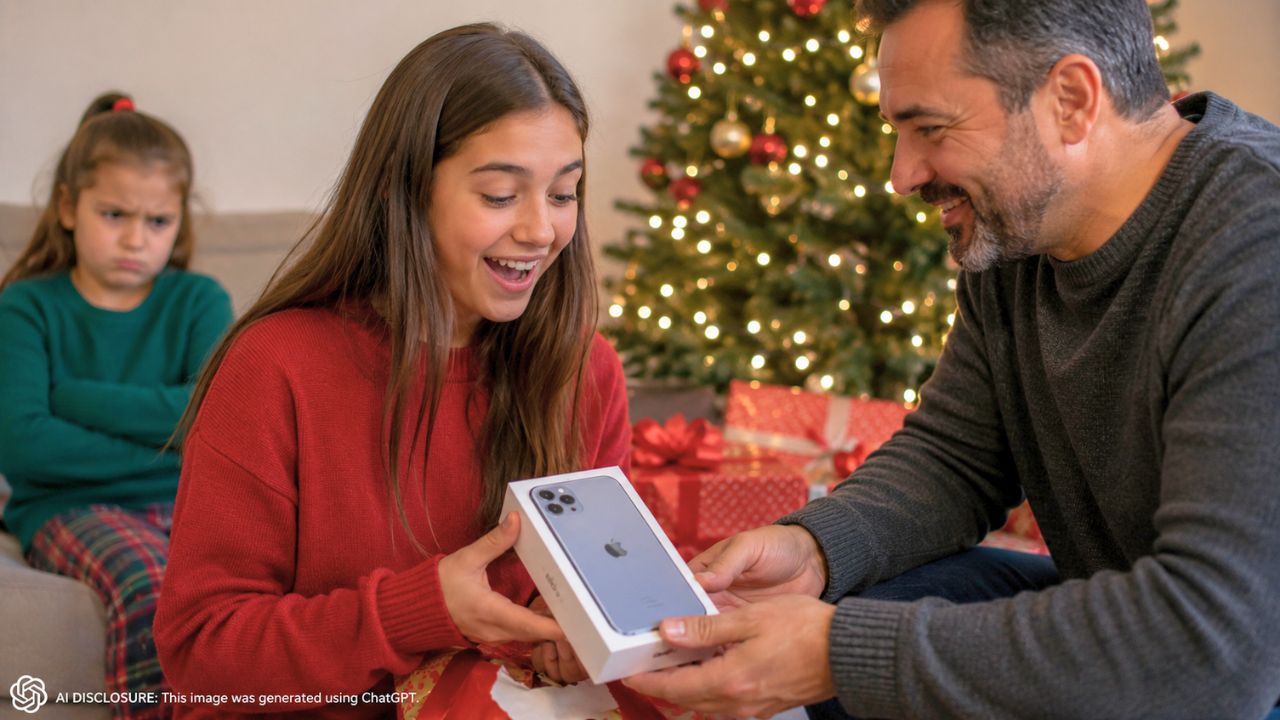
Godfather Bought His Late Best Friend’s 16-Year-Old Daughter an iPhone for Christmas — Her Mother’s New Partner’s Kids Called It Unfair
Photo credit: AI-generated image created using ChatGPT. Illustrative only.
A longtime godfather thought he was doing something simple: replacing a broken phone for the teenager he’s treated like family since she was born. Instead, one Christmas gift turned into a blowup inside her newly blended household, with her stepfather demanding the gifts stop altogether.
In the original post, the man explains that his best friend died four years ago, leaving behind a daughter who is now 16. He’s been in her life since day one—there at the hospital when she was born—and says that after his friend’s death, he “stepped up a lot” and became even closer to her, with her mother’s permission.
She wasn’t just a family friend—she was the “bonus daughter”
The man describes having three sons and always wanting a daughter, which made his bond with his goddaughter feel even more personal. Over the years, she became woven into his household: vacations with his family, regular time together, and a relationship where his wife welcomed her and his boys saw her as an older sister.
Gift-giving was also part of that long-running connection. Even before his best friend died, the two families exchanged birthday and Christmas presents—his friend would buy for the man’s sons, and he would buy for the daughter. After the death, that tradition shifted in a way that still stings: he continued buying for his goddaughter, but says her mother stopped getting anything for his kids.
He didn’t take that as a reason to pull back. In his mind, the teen shouldn’t lose out because adults changed what they were doing. He kept the relationship steady, and the gifts were one piece of that.
The house changed, and suddenly the gift did too
This year was different because it was the girl’s first Christmas in a new home. Her mother remarried earlier in the year, and the family moved in with her new husband—bringing step-siblings into the picture for the first time.
That’s where the iPhone came in. The godfather says the teen’s phone was old and broken, and her mother had been telling her to wait until she saved enough to replace it herself. He decided to solve the problem and bought her a brand-new iPhone 17 for Christmas.
To him, it wasn’t an extravagant flex as much as it was a practical upgrade for a kid he views as his own. He also notes that he and his wife are financially comfortable, with good jobs and inherited money, and that his wife has never objected to him supporting the girl.
But inside the new household, the phone didn’t read as practical—it read as unequal.
Stepdad’s response: “You shouldn’t get her anything again”
According to the post, the stepfather got angry that the godfather bought a present for the 16-year-old but didn’t buy anything for his children. The godfather says he barely knows the stepfather’s kids and doesn’t even know their names, much less have a relationship that would make gift-giving feel natural or expected.
The stepfather’s complaint wasn’t just that it was awkward or that it caused jealousy. The message escalated into a demand: the godfather claims the man told him he shouldn’t buy the girl gifts anymore.
The mother, described as non-confrontational, didn’t firmly back the godfather in the moment. That left the teen in the middle, and she apparently refused to let it slide. The post says she defended the relationship and had a huge fight with her stepfather, telling him it wasn’t his business.
That fight then spread outward. The godfather says he confronted the stepfather directly, told him to back off, and insisted the teen is his “daughter” even if not biologically. In the heat of it, he also made it clear he did not consider the stepfather’s children his responsibility.
A gift becomes a power struggle over who “gets” to be family
At the center of the argument isn’t just an expensive phone. It’s the fear that the stepfather is trying to control access—who can provide, who can be close to the teen, and what role the godfather is allowed to play now that there’s a new husband in the home.
From the stepfather’s side, the optics are combustible: one kid in the house receives a high-end present from an outside adult, while the other kids watch. Even if the godfather has no relationship with them, the jealousy and resentment can land on the teen, especially if the adults frame it as favoritism she didn’t “earn.”
From the godfather’s side, the demand to stop giving gifts sounds like erasing a bond built over 16 years—and one that deepened after a death. He isn’t describing a casual family friend relationship. He’s describing a standing commitment, emotionally and financially, that he sees as part of honoring his late best friend.
That’s why the iPhone argument escalated so fast. It’s not just about fairness. It’s about authority and identity: who counts as a parent figure, and who gets to decide what the girl is allowed to receive.
What outside reactions tended to focus on
While the post itself centers on whether buying the iPhone was “wrong,” many reactions to stories like this tend to zoom in on the practical risks: the teen becoming the target inside the home, and the godfather unintentionally giving the stepfather a reason to tighten restrictions.
The biggest concern is that this kind of “unfair” argument can morph into punishment—limits on seeing the godfather, pressure on the mother to cut contact, or rules about what gifts the teen can keep in the house. If the stepfather is already trying to dictate what the godfather can do, a new phone could become a symbol he tries to confiscate or leverage.
People also tend to point out that blended-family jealousy doesn’t get solved by outsiders buying more gifts for the other children. That can turn a personal bond into an ongoing competition, with every holiday becoming a negotiation. Just as importantly, it can shift the emotional burden onto the teen, who didn’t ask to be the “reason” other kids feel slighted.
And then there’s the escalation itself. Trading insults and having a direct blowup with the stepfather may feel satisfying in the moment, but it can harden the stepfather’s stance and make the mother more likely to retreat rather than mediate.
Where it leaves them now
The godfather says he was traveling with his own family and wasn’t returning until January 4, but he expects the conflict to still be waiting when he gets home. His wife believes he handled it poorly—not because she objects to supporting the teen, but because the new household includes younger step-siblings who might act out, and because the fallout could make life harder for the girl day-to-day.
For now, the phone is bought and the lines have been drawn. The stepfather appears to want control over the relationship and the gifts. The godfather refuses to be pushed out of a role he’s held since birth. And the teen—caught between a household she has to live in and a bond she doesn’t want minimized—has already shown she’s willing to fight about it.
The next move, by everyone involved, will likely determine whether this stays a tense holiday argument or becomes a long-term fracture in a newly formed family.
Check out more from Now Rundown:
- A Party of 12 Came Back a Month Later Demanding Their $80 Tip Refunded — My Restaurant Made Me Pay It
- Her Coworker Kept Filing the Same Complaint About Her After Being Warned — Then She Filed a Counter-Report With Every Email Documented
- Siblings Demanded Half of Their Sister’s $11 Million Inheritance — She Refused Because They Never Visited
- The Kid I Bullied in Middle School Just Interviewed for a Job on My Team — He Bombed It and I Didn’t Hire Him

Abbie Clark is the founder and editor of Now Rundown, covering the stories that hit households first—health, politics, insurance, home costs, scams, and the fine print people often learn too late.