Man Ignored His Ex’s Request for a Sit-Down Meeting With Her New Husband — She Accused Him of Not Putting Their Kids First
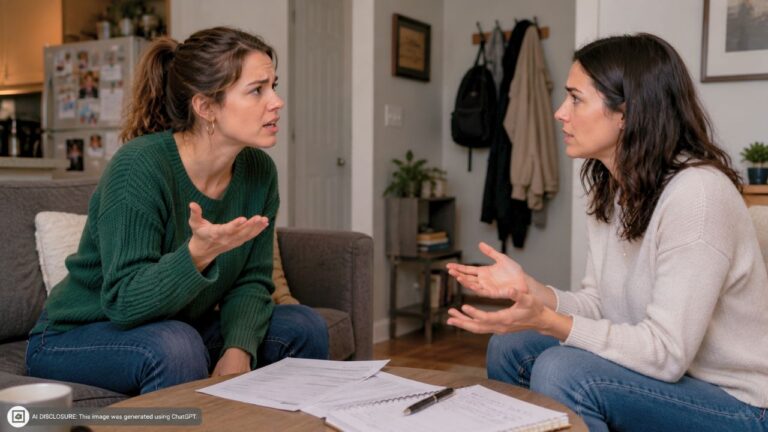
Photo credit: AI-generated image created using ChatGPT. Illustrative only.
For years, a 31-year-old mom says she has tried to keep her co-parenting relationship as controlled and documented as possible. But when her ex pushed for an in-person “sit-down” meeting involving his wife, she refused—and then stopped responding altogether. Now, he’s accusing her of not putting their two kids first.
In the original post, the mother lays out a long-running, volatile dynamic with her ex (33) and his wife (32) that she says has repeatedly crossed lines, triggered court involvement, and recently raised safety concerns inside the other household.
It started with a breakup—and a power play over “mom”
The couple was never married, and she says the relationship “was never very good,” so the split wasn’t shocking. What did surprise her was how quickly her ex moved on and how fast his new relationship became part of the parenting arrangement.
Less than five months after the breakup, she says her ex and his new partner told her they were “a team” and that everything involving the kids would now include the new wife. According to the mom, they also insisted the children would know the new wife as a “second mom,” and she was told to get used to hearing her called “mom” because they would encourage it.
That demand didn’t stay a private argument. The mother says she took the issue to court, and a judge added a clause addressing whether a stepparent or partner could be called “mom” or “dad.” She says the ruling angered them—yet didn’t stop the pressure.
Co-parenting messages turned into a years-long paper trail
After the court involvement, the mother says her ex and his wife continued pushing the same themes in other ways: that their household could provide what she couldn’t as a single parent, and that the wife would ultimately become the “preferred” maternal figure.
One claim stung in particular. The mother says her ex’s wife told her she planned to have “a bunch of babies,” suggesting that giving the kids more siblings would make the children favor her over their biological mom—whether or not they were allowed to call her “mom.”
Instead of taking the bait in real time, the mother says she spent years documenting exchanges and trying to stay calm for the kids’ sake. The adults used a co-parenting app, and she says even there the messages included remarks about being favored and replacing her. She says they were “scolded a number of times” over the content of those messages.
Eventually, the tension wasn’t just adult-to-adult. A few years ago, she put the children—now 11 and 9—into therapy because she believed they were picking up on the hostility and the constant competition between households.
A mental health crisis changed the custody balance overnight
The story takes a darker turn last summer. The mother says her ex suddenly announced the kids would be staying with her longer than planned and promised to “work out a make up schedule later.” She didn’t learn the reason until weeks afterward.
About six weeks later, she found out her ex’s wife had attempted to take her own life and was hospitalized. The mother says it was triggered by learning she could not have biological children. She also says her ex and his wife told people the crisis was worsened by a moment that same day at summer camp, when her son drew a “picture of his family” and did not include the stepmother.
With the children repeatedly brought up as part of the explanation, the mother says she went back to court and requested a temporary custody change. It was granted. The wife had to complete certain steps before the kids could return to a home where she lived.
According to the mom, the steps were completed and custody returned to a 50-50 schedule in February. But the episode left a permanent mark: she now views the other home not just as tense, but potentially unstable if the adults’ unresolved feelings spiral again.
Then came the push for a “sit-down”—and pressure to relax court boundaries
By June, her ex was asking for a meeting with all three adults. The mother says he wanted them to sit down in person, rather than message through the co-parenting app, because “face to face was better.”
She refused, telling him anything that needed to be said could be said in writing through the app. That’s when the purpose of the meeting became clearer. She says both her ex and his wife started “info dumping” about the wife’s inability to have biological children and how painful it was that the kids didn’t see her as family.
The meeting, as described, wasn’t just about smoother scheduling or communication. The mother says they framed it as a way to improve relationships so the wife could be “an equal parent and family member” to the children. She also says they acknowledged the wife’s hostility toward her, including that the wife “hates my guts and wishes I would give the kids to her.”
At that point, the mother stopped engaging. After initially saying no, she began ignoring the requests entirely. She says she doesn’t trust them, and she doesn’t think an in-person meeting would be productive or safe—especially when she already has written records of what they’re asking for.
She also notes something that made her even more cautious: in the co-parenting app, she says there were “concerning comments” about wanting her to drop the court rule around calling a stepparent “mom” or “dad.” To her, it sounded less like healing and more like trying to renegotiate boundaries that had already been litigated.
He says she’s failing the kids; she says she’s protecting them
With no meeting scheduled, the ex allegedly shifted to accusation. The mother says he told her she wasn’t putting the children first and that she needed to stop “using everything against them in court.”
But from her perspective, the court history is exactly why she’s sticking to written communication. She describes years of provocative messaging, pressure campaigns about being replaced, and then a crisis in the other household where the kids were invoked as part of the emotional trigger.
Her position is straightforward: if the goal is stable co-parenting, then the app is the safest channel because it keeps things factual and recorded. An in-person meeting, she believes, would only give the other two adults a chance to reframe old disputes, push for changes, and later argue about what was “really” said.
What readers zeroed in on: documentation, boundaries, and avoiding a three-on-one
While the post itself is written as a moral question—whether she’s wrong for refusing the sit-down—the key details naturally steer attention toward risk management. The mother has already been through custody modifications, court orders, and repeated app messages that required outside scolding.
The practical through-line is that she’s treating communication like evidence, not conversation. Readers tend to focus on the same idea in these disputes: keep everything in writing, don’t walk into a three-person meeting where you’re outnumbered, and don’t let anyone pressure you into relaxing rules a judge had to spell out in the first place.
Just as importantly, the mother’s refusal isn’t presented as cutting off co-parenting. She’s still offering a channel—she’s just insisting it be the one that already exists and has been used for years.
For now, the standoff remains unresolved. The ex wants a face-to-face reset that would elevate his wife’s role and, potentially, reopen old boundaries. The mother is holding tight to the paper trail she’s built—because when kids are caught between adult emotions, she’s betting clarity and documentation matter more than a “sit-down” that could quickly turn into another fight.
Check out more from Now Rundown:
- A Party of 12 Came Back a Month Later Demanding Their $80 Tip Refunded — My Restaurant Made Me Pay It
- Her Coworker Kept Filing the Same Complaint About Her After Being Warned — Then She Filed a Counter-Report With Every Email Documented
- Siblings Demanded Half of Their Sister’s $11 Million Inheritance — She Refused Because They Never Visited
- The Kid I Bullied in Middle School Just Interviewed for a Job on My Team — He Bombed It and I Didn’t Hire Him

Abbie Clark is the founder and editor of Now Rundown, covering the stories that hit households first—health, politics, insurance, home costs, scams, and the fine print people often learn too late.