Family Refused to Split Up a Late Grandfather’s Gun and Sword Collection Left to an In-Law — The Fight Ended When a Relative Apologized
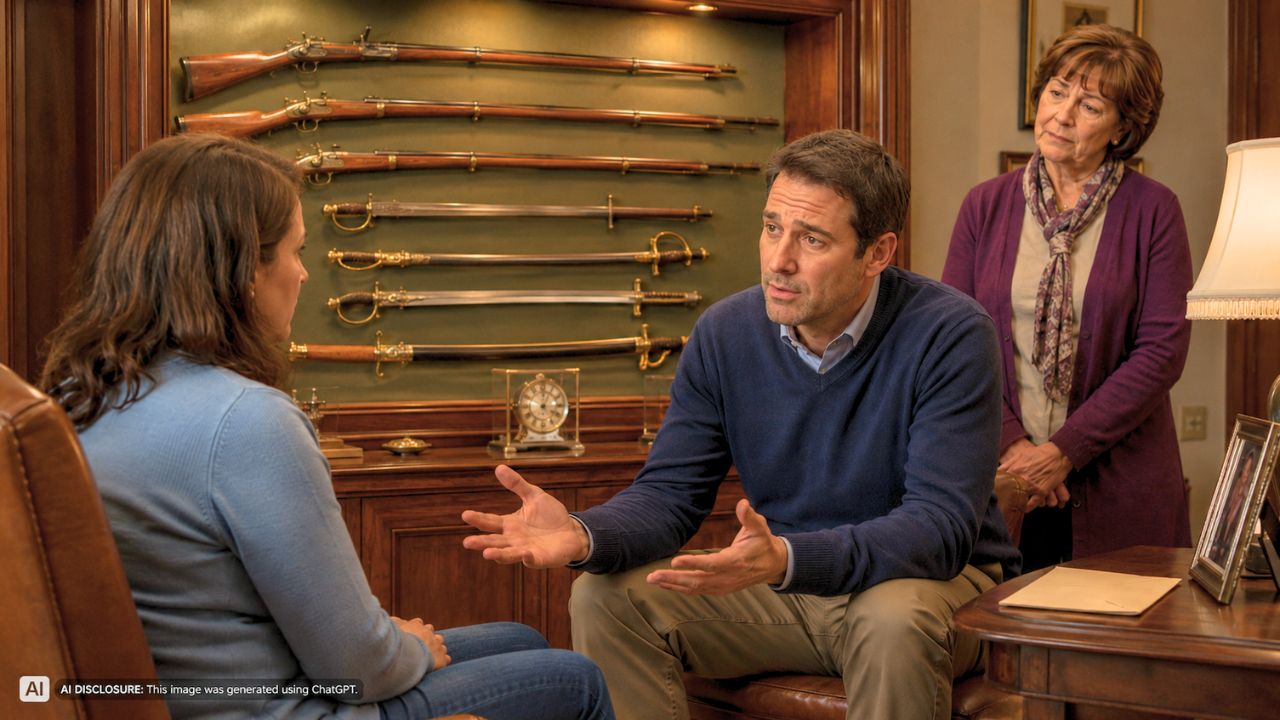
Photo credit: AI-generated image created using ChatGPT. Illustrative only.
A family’s decades-old gift has turned into a late-in-life inheritance fight, after relatives suddenly demanded that a collection of guns and swords be divided up—despite the items being given away almost half a century earlier. The dispute, described in the original post, left one adult child stepping in to defend their parents and calm down a group of older siblings who were accusing their sister of “stealing” what they believed belonged to them.
The poster says the collection was handed over roughly 45 years ago, when their maternal grandfather was still alive. The grandfather, who had brought the items back from WWII-era Germany, chose to give them to his son-in-law—an in-law who was also a veteran and, in the family’s view, the person most likely to value and preserve them.
A gift made long before any estate existed
According to the account, everyone in the family knew about the transfer at the time. No one objected, and no one raised the idea that the collection should be kept for later distribution.
The poster says their father wrapped everything carefully and stored it for decades, keeping the guns and swords in strong condition. Their grandfather later died about 30 years ago, and the collection remained with the poster’s parents—still treated as what it had been from the start: a direct gift.
That history is a key point in the family’s argument now. From the poster’s perspective, the items were never part of an estate because they were given away while the grandfather was alive, and because the parents have shouldered the practical responsibility of storing and maintaining them ever since.
Then the calls started: “split it up”
The surprise came decades later. Out of nowhere, some of the poster’s mother’s siblings began insisting the collection should be split as part of their inheritance, despite the grandfather having died years earlier and the collection having been out of his possession for even longer.
The poster describes the tone as aggressive—relatives calling and yelling, directing their anger at the poster’s mother. The accusation wasn’t subtle: they implied she was taking something that belonged to everyone.
That detail matters because the father is the one who physically has the collection, but he’s also the in-law. The poster clarified in an edit that this was their mom’s father, meaning the siblings were treating the items like “their dad’s property,” even though the grandfather gave them to his daughter’s husband while he was alive.
It also meant the mother, not the father, was getting the brunt of the family pressure. The father was described as “caught in the crossfire,” targeted largely because he isn’t a descendant, even though he’s the person who received the items and has preserved them for decades.
An email tried to draw a line—and opened a door
With the conflict escalating, the poster stepped in directly, emailing family members to restate what their parents believed was the obvious boundary: the guns and swords were a gift, not a shared inheritance.
The message, as described, leaned on practical reality as much as principle. The parents stored everything carefully for 45 years, and no other relative contributed to that upkeep or raised concerns when the gift happened. The poster’s argument was that a sudden demand decades later shouldn’t rewrite what was already settled in real time.
But one of the siblings followed up with a calmer email that shifted the fight from “property” to something harder to argue with: regret and sentimentality. The relative said they hadn’t meant to start a family war, but got emotional. They admitted they wanted something of their father’s to remember him by—and said they didn’t have anything of his now.
The ages added another layer. The poster noted that the siblings involved are in their late 70s and early 80s, framing the blowup as both surprising and painful: the kind of conflict that can harden quickly when time feels short and old family dynamics resurface.
The “keep the peace” option comes with a price
That calmer message didn’t change the poster’s stance, but it did complicate it. The poster said they understood the desire for a keepsake. They just didn’t believe it was fair to make claims on an item that was clearly given away long before any estate questions should apply.
Behind the scenes, the parents considered a compromise anyway—talking about getting the collection appraised and possibly offering something to reduce the tension. But they were wary of what that would signal.
The concern wasn’t just money. It was precedent. If they offered something, would the relatives treat it like an admission that the siblings were entitled to the guns and swords in the first place? Would it invite more demands, or new arguments about what the collection is “really worth” now?
In families, especially in later years, “keeping the peace” can sometimes mean paying for it—financially, emotionally, or both. The poster’s parents seemed to be weighing whether a goodwill gesture would end the problem or extend it by giving the loudest voices a new opening.
What outside readers tended to focus on
While the post itself centers on the family’s messages and emotions, the practical stakes are easy to spot: the items are weapons, they’re old, and they may be valuable. That combination tends to push people toward documentation and careful handling rather than handshakes and informal promises.
In scenarios like this, many outside observers typically urge families to keep communication in writing, avoid heated calls, and treat the ownership question as something that should be backed by records—anything showing the collection was gifted long ago and continuously held by the same person.
There’s also a real-world safety and liability dimension when firearms are involved. Even when everyone’s intentions are decent, passing guns around within a family can raise storage, transfer, and responsibility questions that are very different from splitting up furniture or photo albums.
And on the sentimental side, readers often point out a path that doesn’t require breaking up the central collection: offering alternative mementos, copies of photos, or other items tied to the grandfather’s life, if any exist, so the emotional need is acknowledged without rewriting history.
The fight cooled when someone reached back out
After the poster sought input, the story took a small turn toward repair. In an update, the poster said one family member sent flowers and apologized.
It didn’t resolve the underlying question of the collection, and it didn’t guarantee that other siblings would drop the demand. But it did change the temperature—an acknowledgment that the yelling and accusations had gone too far, and that the relationships mattered more than “winning” a decades-late argument.
For now, the family appears to be in the fragile space between standing firm and trying to reconnect. The collection remains where it has been for 45 years, but the bigger issue—how a family handles memory, fairness, and old choices when everyone is aging—still sits right under the surface.
Check out more from Now Rundown:
- A Party of 12 Came Back a Month Later Demanding Their $80 Tip Refunded — My Restaurant Made Me Pay It
- Her Coworker Kept Filing the Same Complaint About Her After Being Warned — Then She Filed a Counter-Report With Every Email Documented
- Siblings Demanded Half of Their Sister’s $11 Million Inheritance — She Refused Because They Never Visited
- The Kid I Bullied in Middle School Just Interviewed for a Job on My Team — He Bombed It and I Didn’t Hire Him

Abbie Clark is the founder and editor of Now Rundown, covering the stories that hit households first—health, politics, insurance, home costs, scams, and the fine print people often learn too late.