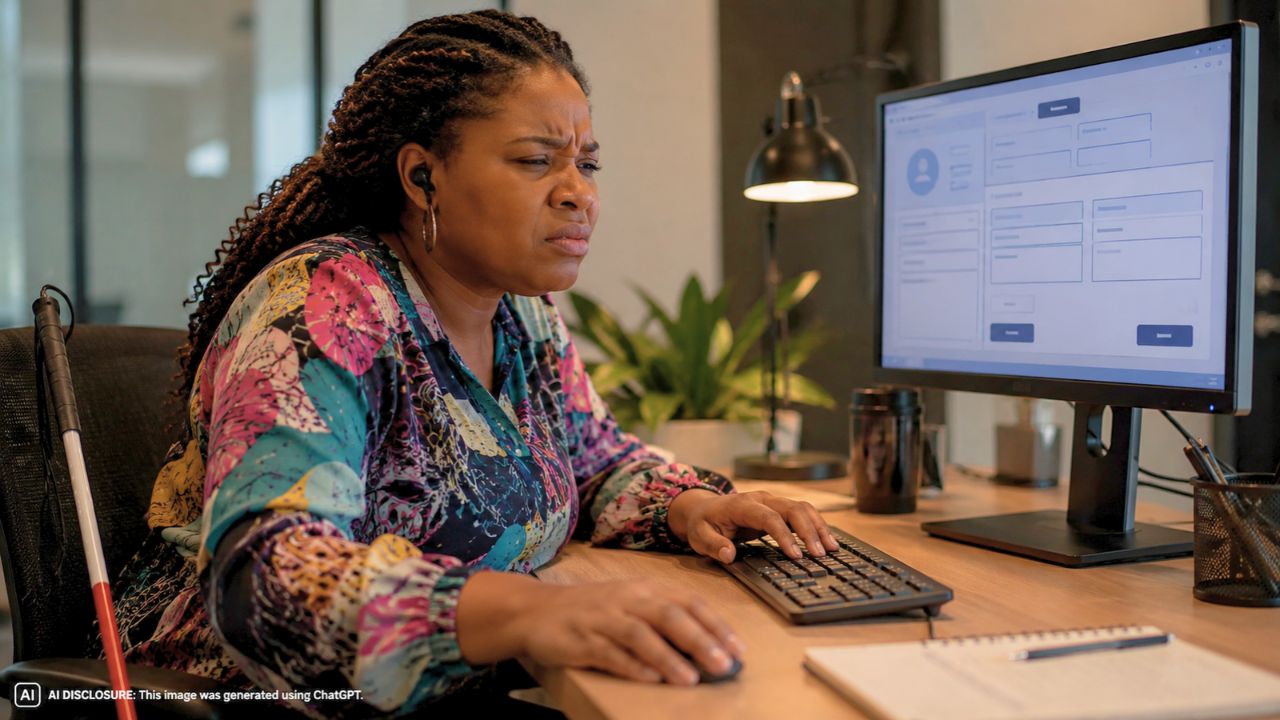
Blind Employees Could Not Open Their Own Benefits Portal With Screen Readers — Their Publisher Paid $150,000 and Agreed to an Accessibility Audit
Photo credit: AI-generated image created using ChatGPT. Illustrative only.
For some employees, “check the portal” is just another line in an email. For blind and visually impaired workers at Pearson Education, it became a wall: the online systems they were required to use to manage benefits, leave, and training allegedly couldn’t be reliably accessed with screen readers, turning basic workplace tasks into a recurring scramble.
That breakdown is at the center of a federal disability discrimination lawsuit brought by the U.S. Equal Employment Opportunity Commission, which Pearson has now agreed to settle. In the agency’s announcement, the EEOC said the educational publishing company will pay $150,000 and accept a set of policy-and-technology fixes meant to prevent the same problem from happening again.
“Use the online platform” only works if everyone can actually use it
The EEOC’s case describes a workplace where essential employment functions had moved online. Pearson allegedly required employees to use web-based platforms for benefits information, leave management, and workplace training.
The problem, the EEOC says, was that these platforms had “technical issues” and weren’t accessible to workers with visual impairments—particularly employees who rely on screen reading software to navigate digital tools. In plain terms: the employer allegedly built a system employees had to use, and then left some employees unable to use it.
When access to benefits and leave runs through a portal, accessibility isn’t a “nice to have.” It’s the difference between handling your own healthcare elections, tracking time off, or completing required training independently—versus having to ask for help, wait for workarounds, or risk missing something important.
The accommodation request wasn’t the finish line
The EEOC also alleges Pearson failed to provide the reasonable accommodations needed to give visually impaired employees equal access to those platforms and trainings “on par with” employees who are not visually impaired.
This is where workplace tech problems turn into a legal issue. Under the Americans with Disabilities Act, employers are required to provide accommodations that allow employees with disabilities equal access to benefits and training, unless doing so would create an undue hardship.
In the EEOC’s telling, the platforms weren’t just inconvenient. They allegedly shut people out of core HR functions, and the company didn’t bridge the gap with effective accommodations.
How it escalated into a federal lawsuit
The case didn’t jump straight to court. The EEOC said it first attempted to resolve the matter through its conciliation process, which is basically the agency’s effort to reach a pre-litigation settlement.
When that didn’t resolve the dispute, the EEOC filed suit in the U.S. District Court for the District of New Jersey. The case is listed as Civil Action No. 2:25-cv-12214-CCC-JBC.
In the agency’s statement, EEOC Regional Attorney Kimberly A. Cruz framed the issue in blunt, practical terms: “Ensuring that blind and other visually impaired employees can access the same benefits and workplace training as their peers is not optional—it is a fundamental obligation under federal law, absent undue hardship.” She also warned that when employers rely on online systems for benefits, leave, or training, “accessibility cannot be an afterthought.”
Arlean Nieto, acting director of the EEOC’s New York District, added that the agency is committed to enforcing the ADA and holding employers accountable when employees with disabilities aren’t given equal access and reasonable accommodations.
The settlement isn’t just about money—it’s about the systems
Pearson agreed to pay $150,000 in monetary relief, but the consent decree goes beyond a check. The settlement lasts three years and requires Pearson to bring in a web accessibility consultant to audit the online benefit platforms and training modules used by employees.
After the audit, Pearson must make modifications and fixes aimed at ensuring those platforms and trainings are accessible to employees with vision-related impairments. It also has to provide annual training for human resources personnel focused on web accessibility issues and accommodations.
The decree includes compliance reporting to the EEOC, plus a workplace posting that informs employees about the settlement and their rights under federal anti-discrimination law. The structure of the deal sends a clear message: the remedy isn’t only retroactive; it’s built to force day-to-day change in the tools employees depend on.
What people fixate on in accessibility disputes like this
Even without a public comment thread attached to the EEOC release, the pressure points are familiar in workplace accessibility fights. People tend to zoom in on the same practical questions: If the portal is the gatekeeper to benefits and leave, what happens when you can’t open that gate? How long can an employer lean on “technical issues” before it becomes a systemic barrier?
Another common focus is documentation—because these problems are rarely one dramatic denial. They often show up as repeated dead-ends: a training module that won’t play nicely with a screen reader, a benefits page that can’t be navigated by keyboard, a form that can’t be submitted without visual cues.
And then there’s the accountability angle. A settlement that requires an outside accessibility consultant and ongoing HR training is the kind of remedy that signals the issue wasn’t solved by a quick patch or an ad hoc workaround. It suggests the fix has to be baked into how the company chooses, maintains, and tests its internal systems.
Pearson has three years to prove the fix sticks
Pearson Education, part of London-headquartered Pearson, has locations across North America. For employees, that kind of footprint can mean standardized systems—one portal, one training platform, one workflow—used widely and relied on heavily. When those systems aren’t accessible, the impact can spread.
The consent decree’s timeline matters because workplace technology changes constantly. Platforms get updated, modules are replaced, and vendors rotate in and out. The three-year window, the required audit, the training, and the reporting are meant to keep accessibility from drifting back into “we’ll handle it later.”
For workers who depend on screen readers, the core ask is simple: the same independence everyone else takes for granted when HR says, “Just log in.” This settlement puts money on the table, but more importantly, it puts the technology itself under a spotlight—and keeps it there long enough that the fixes have to survive real-world use.
Check out more from Now Rundown:
- A Party of 12 Came Back a Month Later Demanding Their $80 Tip Refunded — My Restaurant Made Me Pay It
- Her Coworker Kept Filing the Same Complaint About Her After Being Warned — Then She Filed a Counter-Report With Every Email Documented
- Siblings Demanded Half of Their Sister’s $11 Million Inheritance — She Refused Because They Never Visited
- The Kid I Bullied in Middle School Just Interviewed for a Job on My Team — He Bombed It and I Didn’t Hire Him

Abbie Clark is the founder and editor of Now Rundown, covering the stories that hit households first—health, politics, insurance, home costs, scams, and the fine print people often learn too late.