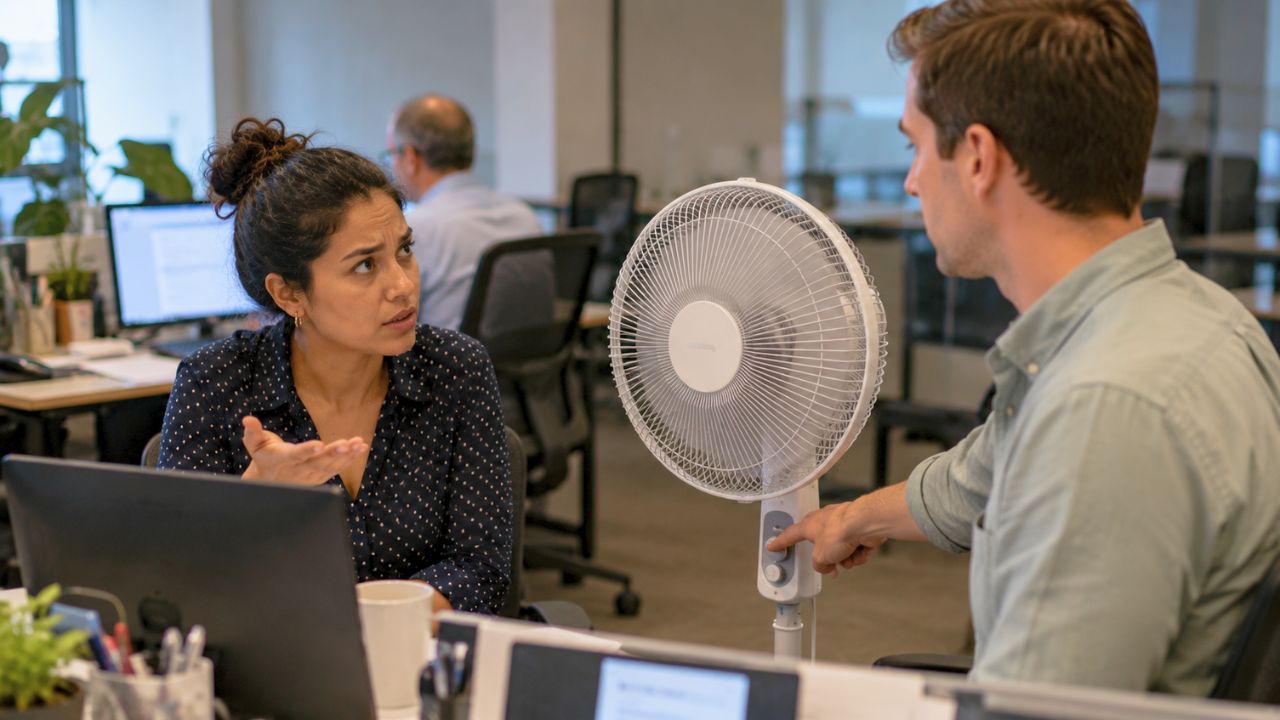
Coworker Filed an HR Complaint After She Asked Him to Stop Turning Off the Fan Near Her Desk
By the time Maya sat down on Monday, the air near her desk already felt thick. The office had that familiar hum of computers and soft phone calls, but her corner of the open floor plan was unusually still—no airflow, no white noise, just the heavy quiet that made every cough and keyboard clack feel louder.
She reached under her sit-stand desk, flicked on the small fan she kept tucked against a filing cabinet, and felt that first hit of relief. It wasn’t a luxury thing. She ran warm, the building’s AC was inconsistent, and she got headaches when the air felt stagnant.
Ten minutes later, she heard footsteps behind her, then the fan went silent.
The problem started before the big blowup
Maya worked on a client support team for a mid-sized company—busy, deadline-heavy, and seated in one long bank of desks that made privacy basically impossible. Her fan had been there for months, aimed at her chair, low setting, nothing dramatic. A few coworkers even liked the faint whoosh because it drowned out the constant Slack pings.
The issue wasn’t the fan itself. It was Nolan, the coworker who sat two seats over on the opposite side of the aisle. He’d started making comments in passing about “drafts” and “people needing to toughen up,” usually with a half-smile like it was a joke. He didn’t ask her to turn it down. He didn’t move it. He’d just reach over when she stepped away—bathroom, printer, a quick chat in the break room—and switch it off.
At first Maya assumed it was a misunderstanding. Maybe the cord was in the way. Maybe he thought it was shared. So she moved it farther under her desk and taped the cord down. The next day it still ended up off.
She started noticing a pattern: the fan was on when she arrived, off after her first trip to refill her water, on again after lunch, off again when she got pulled into a quick huddle. It was small enough to sound petty, but frequent enough to make her feel watched.
She tried handling it quietly
Maya didn’t want to be the person who made a huge thing out of a desk fan. The team was already on edge—new manager, new metrics, the kind of workplace where everyone felt like they were one bad month away from a “reorg.”
So she did what most people do when they’re trying to keep the peace. She asked casually. The next time she caught Nolan walking back from the coffee machine, she mentioned that someone kept turning her fan off and asked if it was bothering him.
Nolan didn’t say yes. He didn’t say no. He shrugged and implied it was “distracting,” then added that the office was cold enough already. Maya pointed out that it was aimed at her and barely even cleared the edge of her desk. She offered to angle it lower. She offered to switch it to the lowest setting.
He told her it was “fine,” but the next day her fan was off again before 9:30 a.m.
That’s when Maya stopped making it casual. She waited until she saw him near her desk and said plainly that she needed him to stop touching her things. She kept her voice low, but her face was hot with the kind of anger that comes from being forced to ask for basic respect.
Nolan didn’t apologize. He told her she was overreacting and said he had a right to be comfortable at work too.
The request that flipped the whole power dynamic
After that conversation, Maya did what she thought would settle it: she sent a short message through the company chat so there was a record. Nothing dramatic. Just a note that she’d noticed her personal fan being switched off and that she needed it left alone.
Nolan replied with a thumbs-up. For the rest of that day, the fan stayed on.
Then the next morning, her manager asked Maya if she had a minute for a “quick check-in.” The manager’s tone was polite, but the closed conference room and the presence of an HR generalist at the table made Maya’s stomach drop.
HR explained that a complaint had been filed about the fan issue. The complaint wasn’t that the fan was loud. It wasn’t that it was blowing papers around. It was that Maya had “created an uncomfortable environment” by “confronting” a coworker and “implying wrongdoing.”
Maya sat there blinking, trying to process how she’d ended up in a formal meeting for asking someone to stop turning off her fan.
When she tried to explain the pattern—how it happened only when she stepped away, how she’d tried to resolve it directly, how she’d moved the fan to be less noticeable—HR interrupted to say they weren’t there to “determine intent,” only to address “impact.”
That phrasing made her feel like she’d stepped into a different reality. Nolan’s impact didn’t count, but hers did.
Suddenly it wasn’t about air—it was about control
After the HR meeting, Maya went back to her desk and realized she’d been set up for a lose-lose. If she kept the fan on, she risked being labeled difficult. If she turned it off, she’d spend her day sweaty and tense, waiting for the next small humiliation.
The worst part was how Nolan acted afterward. He didn’t gloat openly. He didn’t say anything that would get him in trouble. He just carried himself like someone who’d won a private game.
He’d sit with his hoodie pulled tight even when the office was warm, making a show of shivering if Maya’s fan was on. If she stood to grab a printout, he’d glance toward her desk in a way that made her feel like she had to rush back, just to protect a cheap appliance.
Other coworkers noticed. Not everyone, but enough. A teammate asked quietly if she was okay. Another person joked that the office should install a “fan security camera,” then looked immediately guilty for laughing.
It wasn’t funny to Maya. It was exhausting.
She started documenting everything—dates, times, when the fan was on, when it was off, whether Nolan was at his desk or away. She hated that she had to. It felt ridiculous to keep a log like she was building a case over a breeze. But it also felt necessary because the first formal move had already been made against her.
People around them picked sides in subtle ways
The manager tried to “solve” it by suggesting Maya move her desk fan to a different spot, farther from the aisle. That didn’t address the real problem, which was someone touching her things and then using HR like a weapon when she objected.
Another supervisor, someone who’d been around longer, gave Maya a quiet heads-up in the kitchenette. The company had a habit of treating anything interpersonal as a “two-way issue,” even when one person was clearly doing something inappropriate. The advice was simple: stay calm, keep records, and don’t let yourself get baited into sounding emotional.
Meanwhile, Nolan acted like the office victim. He started talking about “workplace hostility” in a loud enough voice for people to hear, but never loud enough to get called out. He’d mention that “some people” were too aggressive in emails and that he “just wanted to do his job.”
It worked on a few people. There’s always a certain kind of coworker who believes the person who complains first must be right.
But others saw it for what it was: a petty power play dressed up as policy. Maya’s closest teammate began walking with her to the printer and back, like a quiet way of saying, you’re not alone in this. Someone else offered her a spare desk fan—bigger, louder, clearly a joke, but it made Maya smile for the first time in days.
The company’s “solution” left a bitter aftertaste
Within a week, HR circled back with a compromise: Maya could keep the fan, but it needed to be placed in a way that “minimized impact” on others. Nolan was reminded not to touch other employees’ belongings.
On paper, it looked fair. In practice, it felt like a warning directed at Maya, because she was the one who’d been pulled into the first formal meeting. Nolan got a gentle reminder. Maya got a file note.
She moved the fan anyway, angling it tightly toward her chair and wedging it in a way that made it harder to reach. The turning-off stopped—at least the obvious part. But the damage lingered.
Maya started taking her breaks away from her desk, not because she needed a walk, but because she couldn’t stand the feeling of being monitored. She kept her conversations short. She stopped chatting in the mornings. Work became something she endured instead of something she moved through.
And Nolan? He went back to normal, which was almost the point. He’d gotten to disrupt her comfort and then make her look like the problem for asking him to stop.
Maya didn’t quit. Not yet. But she did update her resume, and she did start applying quietly, mostly at night when the whole fan thing replayed in her head like a tiny, relentless loop. The office returned to its usual noise, but her corner never felt the same.
Sometimes it’s not the fan. It’s the message underneath it: someone decided your comfort is optional, and your objection is the real offense.

Abbie Clark is the founder and editor of Now Rundown, covering the stories that hit households first—health, politics, insurance, home costs, scams, and the fine print people often learn too late.