Woman Took Away a Toy From Her Visiting Nephew After He Punched Her 11-Month-Old Daughter Twice
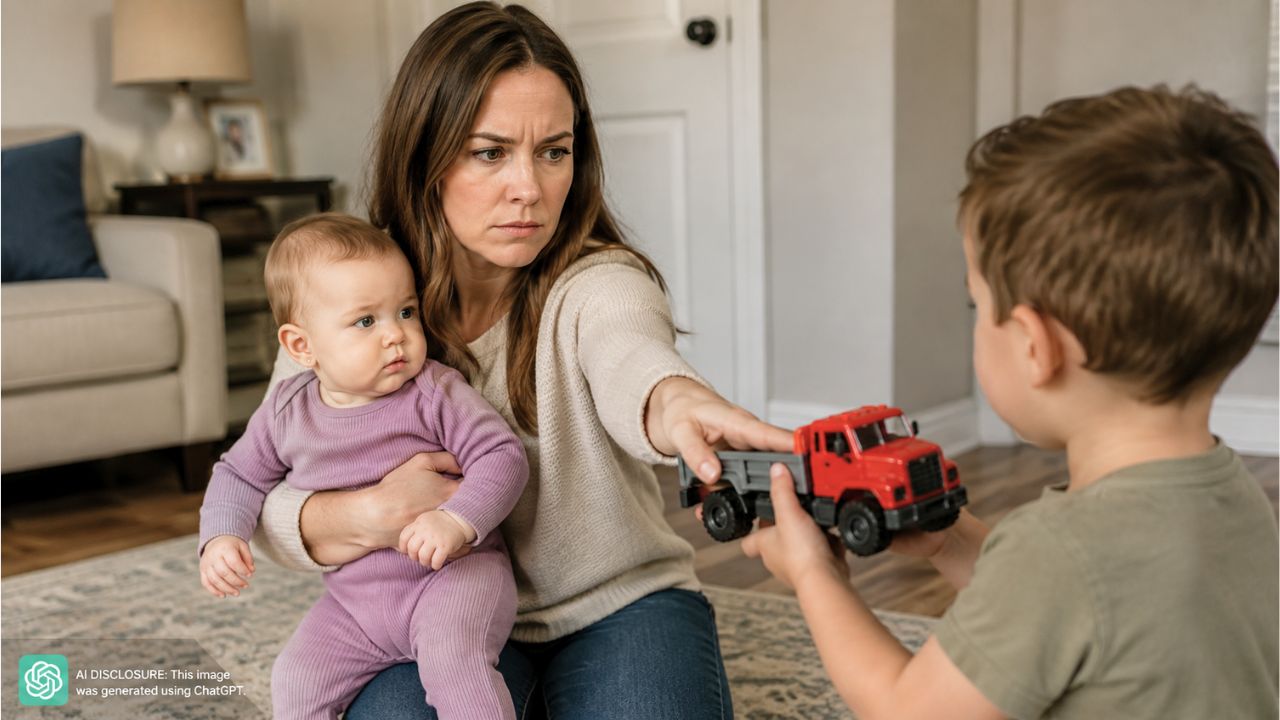
Photo credit: AI-generated image created using ChatGPT. Illustrative only.
A family visit that was supposed to last six weeks quickly turned into a daily stress test inside one home. A parent described watching a toddler repeatedly hit their baby, then feeling like the only adult willing to draw a hard line when the behavior didn’t stop.
In the original post, the writer explained that his wife’s sister and her husband traveled from Korea for a 1.5-month stay, bringing their two young children. Almost immediately, he says, their 3-year-old son’s behavior stood out—loud, impulsive, and seemingly untouched by the word “no.”
The visit wasn’t just crowded—it came with a parenting clash
From the start, the writer described the boy as “uncontrollable,” the kind of toddler who does what he wants and ignores attempts to redirect him. He said the child’s parents would try to talk him down when he did something wrong, but the boy would laugh, brush it off, or keep going.
The frustration wasn’t just about noise or mess. The writer believed the child wasn’t learning consequences, and he worried that without them, the behavior would escalate—especially around his own child, an 11-month-old daughter who is still crawling and too young to defend herself.
He also hinted at an uncomfortable dynamic that can happen in extended family situations: everyone is in the same space, everyone sees what’s happening, but nobody wants to be the one who calls it out. That works until it doesn’t.
The first punch came out of nowhere—and the response surprised him
The moment that changed things, he said, happened when he was the only adult nearby. His baby crawled over to her cousin and sat in front of him. Then, without warning, the 3-year-old punched her in the face.
What stuck with the writer wasn’t just the hit—it was what happened next. Instead of what he viewed as a consequence, he said the boy ended up upstairs with his mother reading him a book. He acknowledged she explained the baby was small and that hitting was bad, but to him it felt like the child got comfort and attention after hurting someone.
That response seemed to confirm a suspicion he already had: that the adults around the boy were trying to reason their way out of dangerous behavior, but the child wasn’t absorbing it. And now the stakes were higher than spilled juice or broken toys.
A second hit happened over a toy, and he stepped in immediately
After that, the household tried to settle back into normal routines. The boy gravitated toward an old toy kitchen that belonged to the writer’s 9-year-old and was kept in a bedroom. At some point, the adults brought it down into the living room so the visiting child could play with it more easily.
That’s where the pattern repeated. The 11-month-old crawled up and started to play too. This time, the writer said he could see the toddler didn’t want to share, and then the child punched the baby again.
The writer didn’t wait for a conversation or a gentle redirect. He walked over, took the toy kitchen away, and told the boy, “No more kitchen for you.” The toddler cried, and the child’s parents took him to the playground to calm him down.
In the writer’s mind, it was a simple equation: hurt the baby, lose access to the toy involved. In the bigger family dynamic, though, it was a line being drawn in front of everyone.
The real blowup was between the adults
The toy being removed didn’t end the tension—it redirected it. The writer said his wife confronted him and appeared visibly frustrated. Her message was blunt: the boy is “just a boy,” and she argued he didn’t understand what it’s like to raise two young siblings close in age.
He didn’t claim he was an expert. But he pushed back hard on the idea that this wasn’t his business. According to the post, he told her that it was “exactly” his place to intervene because it was his house, the toy belonged to his family, and it was the second time their daughter had been punched.
He also said the argument happened within earshot of others, creating an uncomfortable atmosphere. He seemed to know that calling it out publicly made things awkward, but he also felt that staying quiet would mean accepting a situation where his baby’s safety depended on adults who, in his view, weren’t stopping the behavior.
That’s the kind of moment that can permanently change a family visit. The baby can’t advocate for herself. The visiting parents may feel criticized and embarrassed. And the couple hosting the visit has to decide whether peace is worth the risk of another hit.
What people zeroed in on: safety first, then boundaries
The writer framed his choice as discipline and consequences, but the practical issue running underneath is supervision and safety. An 11-month-old is at face level with a toddler’s fists, and repeated punching suggests the problem isn’t theoretical.
In these kinds of family standoffs, people tend to focus less on whether a toddler is “bad” and more on what adults can control right now. That usually means separating kids when play turns tense, limiting access to shared toys that trigger conflict, and making it clear that hitting ends the interaction immediately—every time.
There’s also the question of whose rules apply inside someone else’s home. Even if the visiting parents prefer a softer approach, the host parent is still responsible for his own child’s well-being and for what happens around his older child’s belongings. The writer’s stance was that if the child’s parents wouldn’t enforce consequences, he would.
At the same time, the post showed how quickly a safety decision can become a relationship rupture. Taking a toy away is minor. Doing it in a way that signals “I don’t trust your parenting” is what turns a stressful afternoon into a family feud.
The visit wasn’t over, and neither was the tension
The hardest part is that nothing in the story suggested the visit was close to ending. A 1.5-month stay is long enough for small resentments to become routines—and for routines to become a new normal.
The writer seemed stuck between two outcomes he didn’t want: tolerating repeated aggression toward his baby, or escalating the conflict with his wife and in-laws by enforcing stricter boundaries. He’d already taken one step—removing the toy after the second punch—and discovered that even that sparked blowback at home.
For now, the immediate consequence landed on the toddler, not the adults: the toy was gone, and he was taken out to cool off. The bigger consequence may be what comes next—whether the family tightens supervision, whether the couple agrees on rules in their own living room, and whether the rest of the visit is spent walking on eggshells or finally setting expectations that stick.
Check out more from Now Rundown:
- A Party of 12 Came Back a Month Later Demanding Their $80 Tip Refunded — My Restaurant Made Me Pay It
- Her Coworker Kept Filing the Same Complaint About Her After Being Warned — Then She Filed a Counter-Report With Every Email Documented
- Siblings Demanded Half of Their Sister’s $11 Million Inheritance — She Refused Because They Never Visited
- The Kid I Bullied in Middle School Just Interviewed for a Job on My Team — He Bombed It and I Didn’t Hire Him

Abbie Clark is the founder and editor of Now Rundown, covering the stories that hit households first—health, politics, insurance, home costs, scams, and the fine print people often learn too late.