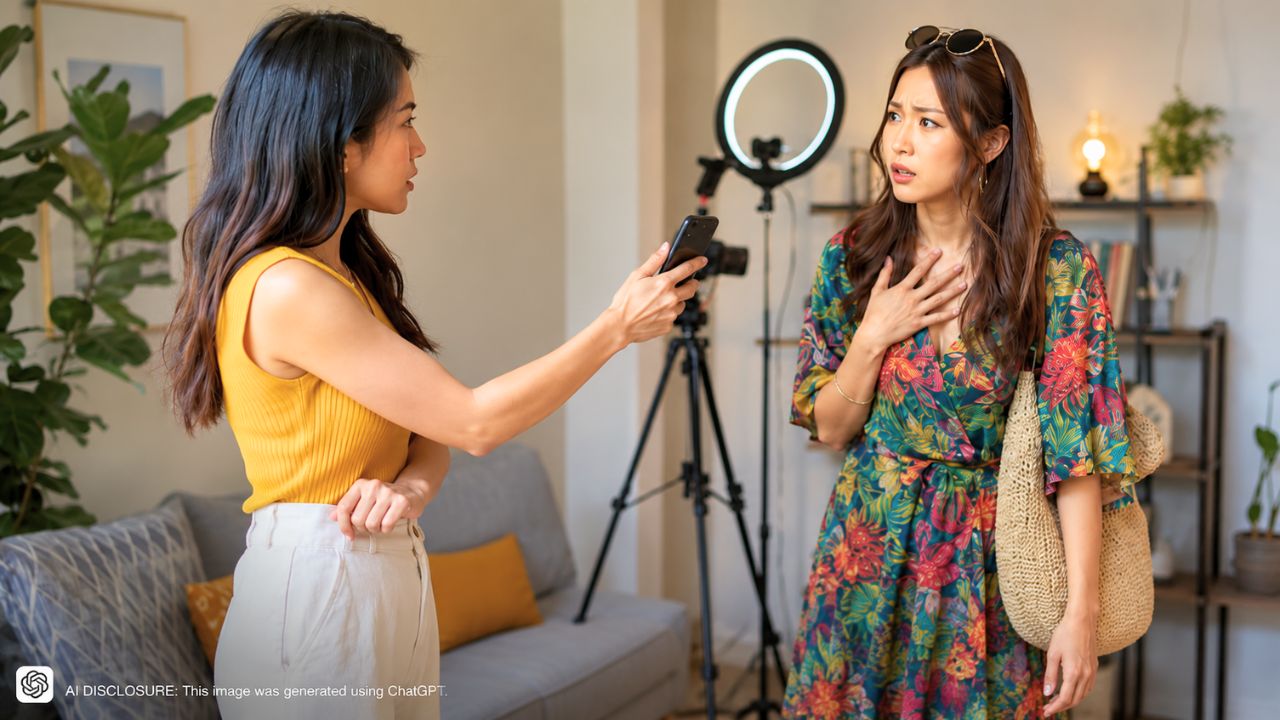
Woman Exposed Her Friend’s Fake “Solo Travel” Influencer Page After Every Photo Turned Out to Be Taken With Someone Else
Photo credit: AI-generated image created using ChatGPT. Illustrative only.
It started as a familiar friend-group eye roll: one person chasing the next “side hustle,” the others watching it happen in real time. But when a “solo travel” Instagram persona began pulling in followers and pitching trips with too-good-to-be-true price tags, one friend finally called it out publicly—then got blocked within the hour.
In the original post, the writer explains they work in the travel industry and say they’ve watched a friend build a travel-influencer brand around affordable solo getaways while quietly using photos from trips she actually took with family, friends, and exes. The friend’s captions sold the idea of eating alone, traveling alone, and budgeting like a solo traveler—despite what the photos and real costs suggested.
The “solo” brand didn’t match the photos people recognized
The friend’s latest project was presenting herself as a travel expert who could also act like an agent for itineraries, tied to a travel MLM. Her niche: affordable solo travel, framed as accessible and empowering. She posted nearly a hundred Instagram posts from destinations “all around the world,” consistently positioning each one as a perfect solo experience.
But the writer says every single location came from a trip the friend took with someone else—family holidays, trips with friends, or vacations with a past boyfriend. Sometimes it was subtle, like captions about dining alone while a table clearly had settings for two meals. Sometimes it sounded blatant, like selfies where it looked like someone had been cropped out.
The writer’s frustration wasn’t just about the optics. They believed the page was building an audience based on a premise that wasn’t true, at a time when solo travel is becoming more popular and people are hungry for realistic, safe, budget-friendly planning.
Then the pricing claims started hitting people’s wallets
The bigger problem, according to the writer, was the money. The friend didn’t just sell a “solo” vibe—she sold specific numbers. She’d describe trips as costing “only” a certain amount for flights and accommodation, presenting them as proof that solo travel could be done cheaply.
But the writer says those numbers were created by splitting group expenses into a single-person “share” and then presenting that share as the full, standalone cost of traveling alone. One example they gave: a weekend in the south of France that the influencer claimed was about £200 for flights and accommodation. The writer says the hotel alone cost £300—when the friend went with her then-boyfriend.
In the writer’s day job, that kind of math apparently has consequences. They claim they “keep on dealing with people” who come in with itineraries inspired by posts like these and then feel shocked when the real price is more than double. It doesn’t just disappoint people; it can knock entire trips out of their budget.
The comment that blew up the friendship
The breaking point came when the friend posted about a trip the writer actually took with her—Croatia, with two other friends. The influencer framing, the writer says, was familiar: “spend a week in Croatia with me for only £350!”
The writer couldn’t let that one slide because they knew the real figures. They commented publicly that the Airbnbs they stayed in were at least £100 a night, and that the friend was dividing the nightly price down to around £25 a night as her “share.” The writer’s point was simple: £25 a night wasn’t a realistic budget for a private room in the places they visited, let alone an accurate portrayal of what a solo traveler would pay.
Within an hour, the writer says, they were blocked from the travel account. The friend followed up with a voice note accusing them of being jealous and trying to disrupt her “business.” The writer pushed back, saying she’d likely do just as well if she was honest. After that, the communication stopped.
Private warnings didn’t work, and that’s why it went public
The writer anticipated one obvious criticism: Why not address it privately? They say they did—multiple times, along with other friends, back when the first couple of posts went up.
According to the writer, the friend’s response was that if anyone asked, she would tell them the total cost in a DM. That explanation apparently held—until it didn’t. The writer says they learned a couple days before the blow-up that the friend had told a customer she paid the “public” price for a trip she actually took as part of her brother’s family (two adults and two kids).
That detail mattered because it suggested the misleading numbers weren’t just social-media shorthand. The friend was allegedly using the reduced “share” price in direct communication with someone considering booking—crossing from influencer exaggeration into sales talk that could mislead a buyer.
Friends had receipts, but not everyone wanted the fight
The aftermath split their social circle. Some friends admitted they were close to anonymously exposing the influencer themselves, especially because they had “full photos” where they’d been cropped out of the supposed solo shots. Others urged the writer to apologize just to keep the peace.
The writer sounded torn. They wanted to keep the friendship, but they also didn’t want to pretend the page was harmless. The travel-MLM angle and the “agent” positioning raised the stakes, because people could rely on that advice for budgeting and planning. And in travel, a bad number doesn’t just hurt feelings—it can derail a trip or push someone into a financial stretch they didn’t anticipate.
They also tried to head off another assumption: that this was professional jealousy. The writer said they work in a brick-and-mortar travel agency, while their friend’s activity was mostly influencer content with commission-style extras through an MLM structure. They weren’t trying to build a competing page; they just felt “acutely aware” of how far off the pricing was.
What people focused on: honesty, screenshots, and the business line
Even within the writer’s own circle, the strongest reactions weren’t about aesthetics or social clout. They were about proof and the point where a personal brand turns into a business claim.
Friends who wanted accountability seemed to be thinking in practical terms: they had the uncropped photos, they knew which trips were group trips, and they could document the pattern. The writer’s comments also show a practical motive: they were watching clients walk in with unrealistic expectations that trace back to “solo” budgets that were actually split costs.
On the other side, the “keep the peace” crowd treated it like a personal dispute—something that should stay off a public comment section even if the underlying content was misleading. That pressure creates an awkward dynamic: a friend asking for an apology not for being wrong, but for making the wrongness visible.
The writer is now stuck in the space between two bad options: back down and smooth it over, or hold the line and risk the friendship ending for good. And meanwhile, the influencer page they described can keep posting—cropped photos, “solo” captions, and prices that only work when someone else is quietly sharing the bill.
Check out more from Now Rundown:
- A Party of 12 Came Back a Month Later Demanding Their $80 Tip Refunded — My Restaurant Made Me Pay It
- Her Coworker Kept Filing the Same Complaint About Her After Being Warned — Then She Filed a Counter-Report With Every Email Documented
- Siblings Demanded Half of Their Sister’s $11 Million Inheritance — She Refused Because They Never Visited
- The Kid I Bullied in Middle School Just Interviewed for a Job on My Team — He Bombed It and I Didn’t Hire Him

Abbie Clark is the founder and editor of Now Rundown, covering the stories that hit households first—health, politics, insurance, home costs, scams, and the fine print people often learn too late.