
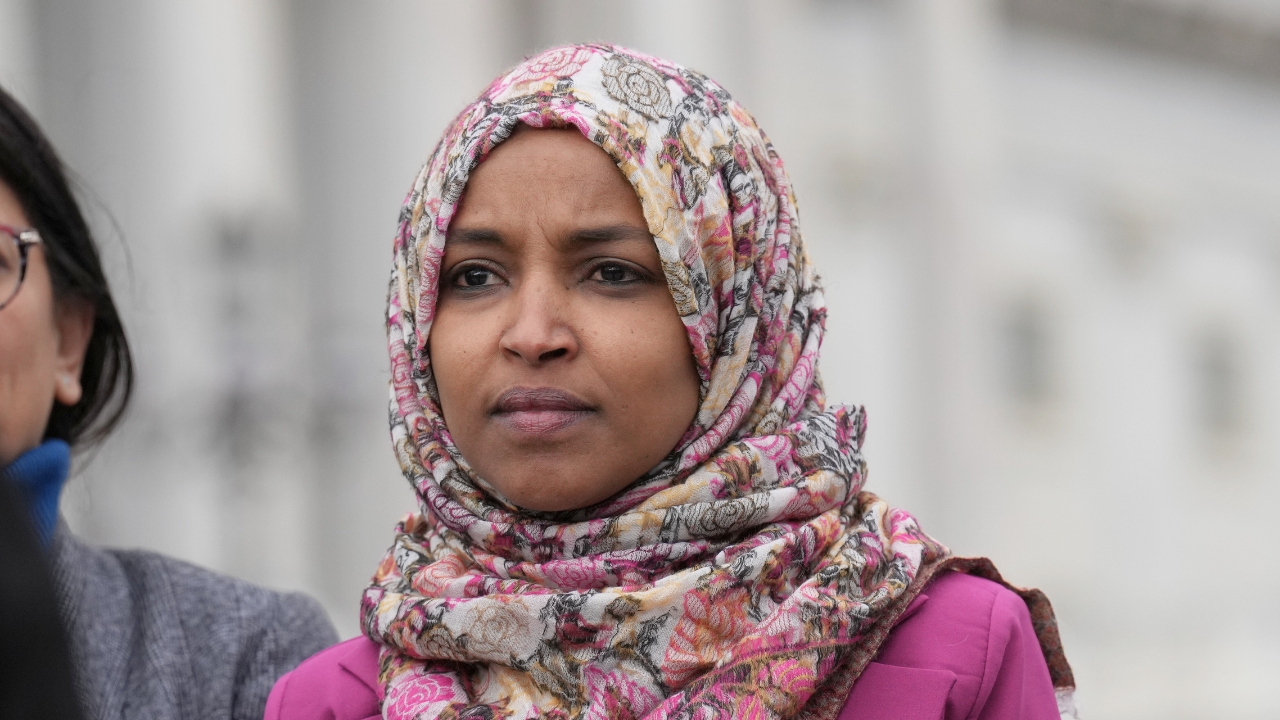
“The American people do not want this,” Omar says as Trump’s Iran strikes spark war powers showdown
Photo credit: Phil Pasquini/Shutterstock.com
Rep. Ilhan Omar said “the American people are exhausted by endless wars built on false promises and paid for with American and foreign lives” as lawmakers from both parties moved to force a congressional vote on U.S. military involvement in Iran following a major U.S.-Israeli strike campaign and Iran’s retaliatory attacks.
Omar, a Minnesota Democrat, argued President Donald Trump launched hostilities without congressional authorization and urged a vote on a War Powers resolution sponsored by Rep. Ro Khanna, a California Democrat, and Rep. Thomas Massie, a Kentucky Republican.
The criticism comes amid a fast-moving conflict that has already produced significant casualties in Iran and heightened security alerts across the Middle East. The Associated Press reported Iran said hundreds were killed and injured in the initial wave of strikes, and that Iran answered with missile and drone attacks aimed at Israel and U.S. military bases in the region. U.S. Central Command later said there were no American casualties and only “minimal” damage to U.S. installations after “hundreds” of Iranian missiles and drones, according to AP live updates.
What supporters say the potential benefits are
Trump and allied leaders have framed the operation as a bid to reduce or eliminate the threat posed by Iran’s nuclear and military capabilities. AP reported the U.S. and Israel described targets that included Iranian command facilities, air defenses, missile and drone launch sites and military airfields, while the White House has argued Iran cannot be allowed to obtain a nuclear weapon. Supporters of military action also argue that striking Iran’s launch infrastructure and command nodes can deter future attacks on U.S. forces and regional partners, particularly if Iran concludes that escalation carries unacceptable costs.
Some backers also point to leverage: military pressure, they argue, can reshape diplomacy by forcing concessions that stalled talks could not produce. That claim is difficult to verify in real time, and it depends heavily on whether Iran returns to negotiations or instead expands retaliation.
What critics say the risks are
Critics’ central warning is escalation. AP reported Iran’s retaliation included strikes directed at U.S. bases in the region, and international leaders called for restraint as fears grew of a wider war. Even if early damage is limited, a prolonged exchange increases the odds of U.S. casualties, miscalculation and spillover into neighboring countries.
Energy disruption is another immediate risk. Reuters reported major oil companies and traders temporarily suspended shipments through the Strait of Hormuz after Iran announced the strategic waterway was closed, a move that threatens a route critical to global oil flows and significant liquefied natural gas shipments. Market volatility and higher fuel costs can follow quickly if shipping is disrupted or insurers raise rates.
The conflict is also intensifying the legal and political fight at home. House Democratic leaders said they would force a vote next week on the Khanna–Massie Iran War Powers resolution, arguing that sustained hostilities require congressional authorization. The administration has not conceded that point, and war-powers disputes have historically produced prolonged court and congressional battles rather than quick resolution.
Omar’s statement places the argument in the shadow of Iraq and Afghanistan: that military campaigns can start with narrow objectives and expand, with costs borne by U.S. troops and civilians in the region. Trump, by contrast, has publicly urged Iranians to “take over” their government, language that critics cite as evidence the operation could drift toward regime-change aims, a shift that would carry higher risks and more open-ended commitments.


