Stepfather Told His 21-Year-Old Stepdaughter She Needs Him More Than He Needs Her After Months of Refusing to Help Around the House
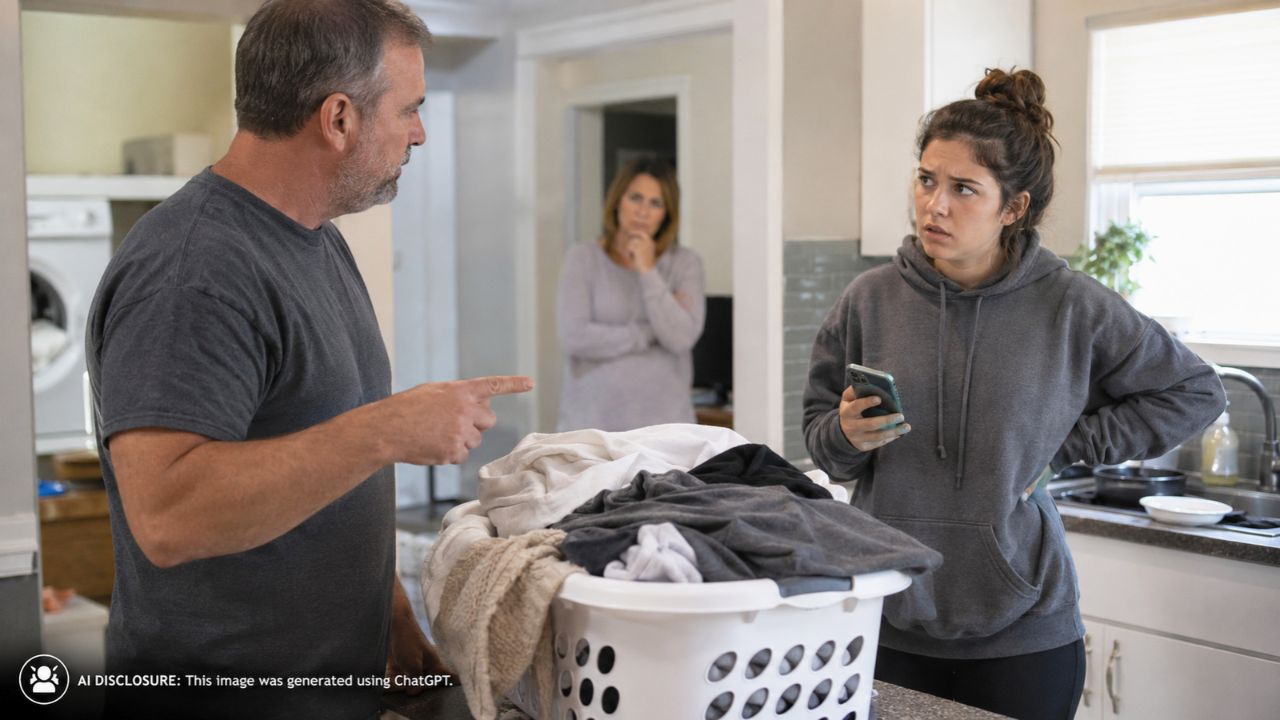
Photo credit: AI-generated image created using ChatGPT. Illustrative only.
It started like a normal family dinner: food on the table, everyone called in, a day finally winding down. But by the time the dishes became the next task, one blunt line from a stepfather turned the evening into a referendum on who’s pulling their weight—and who’s just taking up space.
In the original post, a stepfather described a home packed with moving parts: twin 21-year-old stepdaughters, a nearly 5-year-old child, and a 1-year-old who sleeps in the parents’ room. He says he cooks dinner every night while he and his wife both work full time, and the younger kids still need constant organizing. The problem, in his view, is that one of the twins has stopped participating in the basics of family life.
A crowded house, and one adult who never seems to leave
The stepfather framed the household as a place where everyone is stretched thin. Between full-time work, meals, and the daily management of two small kids, the adults are already juggling more than they can comfortably carry. He also painted a clear contrast between the twins.
He said one 21-year-old stepdaughter works full time, studies part time, and is “self sufficient in most cases.” The other, he wrote, has no job and relies on government benefits, only leaving the house to see friends. At home, he claims, she “barely does anything around the house” unless she’s asked first.
Over time, that imbalance didn’t just create annoyance—it became something he says he could feel every time he walked in the door. He wrote that he hates being home because she’s always there, a detail that makes the tension feel less like a single argument and more like months of resentment stacking up.
The dinner that exposed the fault line
The flashpoint was a routine night that turned sour. The stepfather said he cooked dinner, set the table, and called everyone to eat. Then one of the twins—he referred to her as “step daughter 1”—came home right as they finished dinner and sat down to eat anyway.
That detail mattered because it fed into the larger complaint: she benefits from the household without contributing much back. When it was time for cleanup, his wife asked the other twin—“number 2,” the one who works and studies—to do the dishes.
She refused. Her explanation wasn’t about being tired or busy. It was about fairness: she said her sister never does anything and the parents “never do them,” a line that suggests simmering frustration on her end too.
Instead of defusing it, the stepfather met the refusal head-on. He argued that everyone else works full time, he cooks every night, and there are younger kids to manage. Then he delivered the line that set off the bigger debate: if she didn’t like it, she could find somewhere else to live because “you need me more than I need you.”
“You need me more than I need you” isn’t just a comeback
In the moment, it functioned like a boundary and a threat at the same time. The stepfather portrayed it as simple truth: one adult child is living at home while not paying for food, electricity, water, gas, or internet. If she wants the privileges, she has to accept the expectations.
But the way he worded it also reframed the relationship. It wasn’t “we all need to contribute,” or “we have to set rules.” It was a power statement: you are dependent, and I can withdraw what you rely on.
His wife didn’t take it well. He said she got annoyed with him for saying it, even if he believes it’s accurate. That reaction hints at the deeper household problem: even if both adults are exhausted by the same behavior, they may not agree on how hard to push, or what kind of language crosses a line.
The stepfather made his position clearer afterward. He said he wouldn’t care as much if his unemployed stepdaughter was working, but she “just won’t look for work” and seems more focused on gaming and doing what she wants. In his mind, it’s not a temporary slump; it’s a choice that the whole home has to live around.
When chores become a proxy war for money, freedom, and respect
On paper, the argument was about dishes. In practice, it was about the entire structure of the home: who pays, who cleans, and who gets to act like they’re just passing through. With two small kids in the picture, every extra task becomes heavier, and every refusal can feel personal.
The stepfather also described a house where the working twin is reaching a breaking point. Her refusal wasn’t laziness—it was an objection to being assigned chores when she believes her sister is skating by. And because the parents asked the responsible twin to do the dishes anyway, it reinforced the idea that the reliable person gets punished with more responsibility.
That’s how a pattern gets locked in. The person who avoids chores learns they can wait it out. The person who helps learns they’ll be asked again. Then the only way to force change is confrontation, and confrontation inside a family rarely stays contained to the original issue.
Even the stepfather’s line about “all of us work full time” suggests another pressure point: in his frustration, he lumped people together while the household reality is uneven. One twin works and studies, one doesn’t. The small kids can’t contribute. The adults are trying to keep the machine running. When everyone hears the same “we all work” framing, it can make the people actually working feel unheard.
Readers mostly weighed the remark against the months leading up to it
The post itself was labeled “Not the A-hole,” and the stepfather seemed to lean into that judgment: he wrote that what he said was true, and he emphasized the financial cost of supporting an adult who isn’t paying toward utilities or food. The underlying message was that being direct is sometimes the only way to force reality into the room.
At the same time, the wife’s annoyance showed why people get uneasy about statements like “you need me more than I need you.” Even if the complaint is legitimate, that phrasing can land as humiliating and escalate the fight into something harder to repair. It also risks collateral damage: the working twin may hear it as a general threat, not just a warning aimed at her sister.
What stood out most in the details wasn’t a single messy kitchen moment, but the unresolved question of household rules. If one adult child can live at home without a job and without contributing to chores unless prompted, then the real issue is enforcement. Without a clear standard—who does what, and what happens when they don’t—every dinner becomes a new negotiation.
The hard part now is what happens after the line was crossed
The stepfather has already said out loud that he hates being home because of the constant presence of the unemployed stepdaughter. Once that’s in the air, it changes how everyone reads the next interaction, even the neutral ones. It’s no longer just about help around the house; it’s about whether she’s wanted there at all.
And if his wife doesn’t agree with the way he handled it, the argument can split into two battles at once: one over the stepdaughter’s lack of contribution, and another over how the adults should communicate and set boundaries. Meanwhile, the working twin is still stuck in the middle, watching the same pattern play out and wondering why she’s the one being asked to carry more.
For this family, the next step isn’t another fight over chores at the sink. It’s deciding, clearly, whether the unemployed 21-year-old is expected to work, pay something toward the household, or take on a defined share of responsibilities—and what the timeline is if she refuses. Because if nothing changes, the dishes won’t be the last thing that gets slammed down in that kitchen.
Check out more from Now Rundown:
- A Party of 12 Came Back a Month Later Demanding Their $80 Tip Refunded — My Restaurant Made Me Pay It
- Her Coworker Kept Filing the Same Complaint About Her After Being Warned — Then She Filed a Counter-Report With Every Email Documented
- Siblings Demanded Half of Their Sister’s $11 Million Inheritance — She Refused Because They Never Visited
- The Kid I Bullied in Middle School Just Interviewed for a Job on My Team — He Bombed It and I Didn’t Hire Him

Abbie Clark is the founder and editor of Now Rundown, covering the stories that hit households first—health, politics, insurance, home costs, scams, and the fine print people often learn too late.