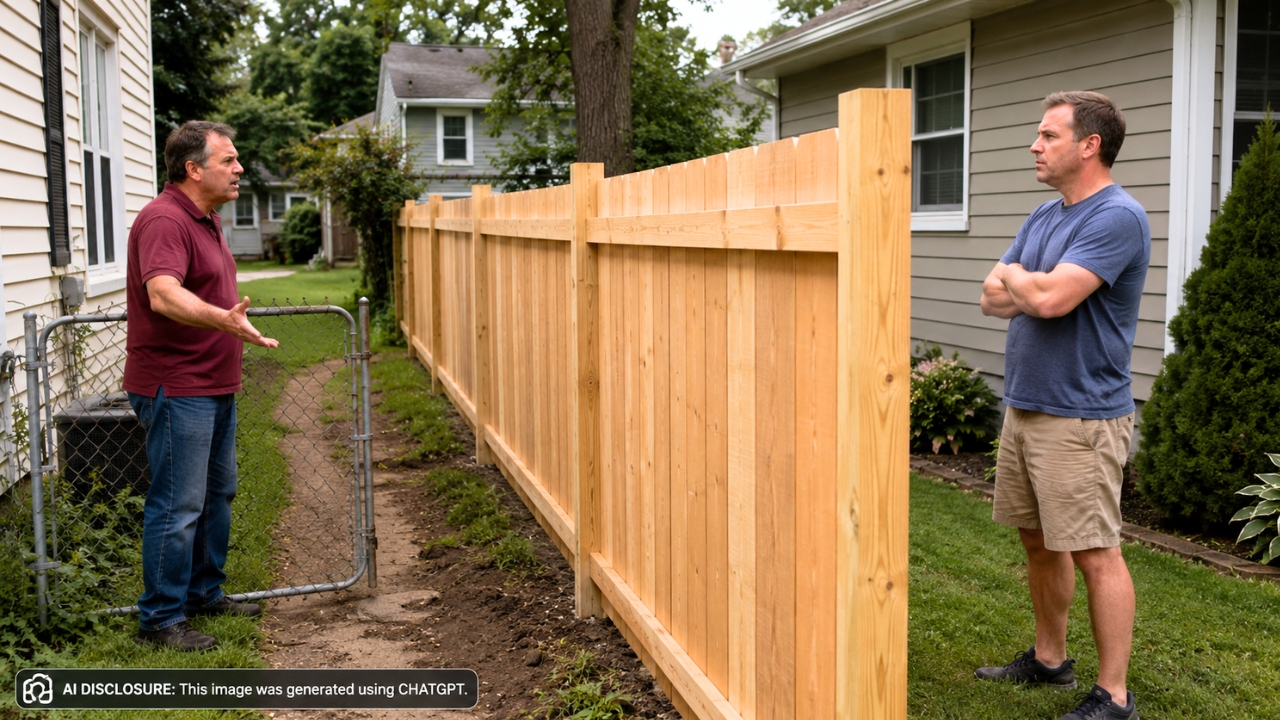
Homeowner Built a Fence Without Telling His Neighbor — It Cut Off the Path He’d Used for 10 Years
Photo credit: AI-generated image created using ChatGPT. Illustrative only.
A brand-new fence was supposed to be a simple upgrade: more privacy, a safe place for a dog, and a backyard that felt finished. Instead, the first day of installation turned into a doorstep confrontation that left one homeowner angry, his wife shaken, and a neighboring property line suddenly up for debate.
The homeowner, who’d lived in the subdivision for about a year, said he and his wife spent the money on a vinyl fence to enclose their backyard. They followed the usual steps—hiring a state-approved vendor to survey the lot and getting approval through the HOA—before scheduling the installers.
But once the posts started going in, one neighbor showed up furious. He believed the fence was stealing part of his yard and cutting off access he’d been using for years, even though the fence was being placed where the survey markers indicated the homeowner’s property actually extended.
A routine upgrade turned tense in the middle of a workday
The couple’s lot touches four other lots: two on the sides, one directly behind, and one that meets them at a back corner. Because the fence would sit near multiple neighbors, the homeowner admitted he wondered afterward whether he should have warned everyone ahead of time—even neighbors he barely knew.
He said the survey had been completed about a month earlier, and the boundary markers were visible in the yard. The results surprised them because the yard extended farther than they expected, but it matched their plot plan.
On installation day, the homeowner was at work. His wife was home and getting ready to leave when someone started knocking and ringing the doorbell repeatedly. She usually ignores the door when she’s alone, but the persistence forced the issue.
The neighbor at the back corner came in hot
At the door was the neighbor who lives at the back corner of their property, and he was already upset. According to the homeowner, the neighbor insisted the fence was encroaching “by at least 2 feet” onto his land.
The wife tried to explain that they’d had a survey done and the HOA had approved the plan. That didn’t calm him down. He dismissed the HOA entirely—using the line, “I don’t give a fuck about the HOA”—and continued pressing her about the fence placement.
The homeowner described it as harassment and said what bothered him most wasn’t just the accusation, but the way his wife was treated. The neighbor stayed at the door while she tried to find a solution, demanding action immediately as if she could stop the installation on her own.
With the neighbor standing there, she called her husband to get the project manager’s number. The interaction escalated into a speakerphone conversation, with the project manager repeating what she’d said: the fence was installed based on a professional survey, and the neighbor was welcome to order his own survey. If it turned out the fence was wrong, they would fix it.
Property lines, paperwork, and a yard that suddenly “belongs” to someone else
The homeowner said he was “about 99% sure” the survey was correct and that the fence sat squarely on their property. The neighbor, however, was focused on what he believed they were taking—two feet of land—and what the fence would change for him.
In many neighborhoods, a corner-lot boundary can become a kind of unofficial passageway. If someone has been cutting across a strip of grass for years, it can feel like an established right-of-way, even when it’s simply a neighbor’s property that no one bothered to mark clearly. The homeowner didn’t say the neighbor explicitly admitted to using that stretch as a path, but the anger was framed around the idea that the fence was taking something the neighbor had been able to use before.
The project manager’s offer was simple: get a competing survey if you believe the line is wrong. Still, the neighbor continued talking about what would happen once they had “ruined his yard,” suggesting he saw the installation itself as damage, not just a disagreement over a boundary.
For the homeowner, the immediate concern wasn’t only whether the neighbor might be correct—it was the possibility that this would become a long-term feud. Once you install a permanent structure near a property line, the next steps tend to involve receipts, permits, plats, and people digging in their heels.
The part that kept nagging at the homeowner: not telling anyone
Even while feeling justified, the homeowner said the day left him with “misgivings” about not giving neighbors a heads-up. He and his wife hadn’t built a relationship with the surrounding homes, and with one neighbor he said they’d never had more than a brief conversation. Another neighbor he didn’t even recognize.
He also pointed out he didn’t grow up in suburbia, so he wasn’t sure what the “unspoken or even spoken rules” were. In some communities, homeowners give a courtesy notice before something noisy or visually significant happens, even when they don’t need permission. In others, people treat property improvements as private business as long as rules are followed.
What complicated the courtesy question is how quickly the interaction became confrontational. There’s a big difference between a neighbor knocking to ask, “Hey, do you know where the line is?” and a neighbor showing up furious, ignoring explanations, and pressuring someone who’s home alone.
By the end of the exchange, the homeowner’s focus had shifted. He wasn’t brainstorming how to smooth things over with a friendly chat; he was angry, protective of his wife, and bracing for the next confrontation.
Readers zeroed in on surveys, boundaries, and keeping everything documented
In responses on the original post, the overall judgment was “Not the A-hole,” with commenters largely backing the homeowner’s decision to rely on a professional survey and HOA approval. The consistent message was that a neighbor’s assumptions don’t override paperwork—especially when the homeowner already paid for a plot survey.
People also emphasized a practical reality: if the neighbor truly believes the fence is over the line, the next move is verification, not intimidation. A second survey is the cleanest way to settle it, and it creates a record that matters if anyone tries to force changes later.
Commenters also tended to sympathize with the wife being put in the middle during a heated confrontation. When someone won’t back off at the door, the priority becomes de-escalation and safety, not neighborhood etiquette. Several responses implied that after an interaction like that, the homeowner would be wise to keep future communication in writing or through official channels, rather than informal doorstep arguments.
And while some saw value in giving neighbors a courtesy heads-up, the general view was that it’s not a requirement—especially when the couple had no real relationship with the surrounding homes and took the formal steps to confirm the boundary.
A fence can go up in a day, but the tension can linger
The biggest immediate consequence wasn’t a legal battle or a forced teardown—it was the change in tone between households that will keep sharing a property line. One side sees a paid-for improvement installed with approval and a survey. The other sees a fence where open space used to be, and a belief that something was taken without warning.
For the homeowner, the lingering question is less about whether he was allowed to build the fence and more about what kind of neighbor relationship comes after a first interaction like this. The fence may end up exactly where it belongs, but the next time someone knocks on the door, it won’t feel like small talk.

Abbie Clark is the founder and editor of Now Rundown, covering the stories that hit households first—health, politics, insurance, home costs, scams, and the fine print people often learn too late.