Employee Refused to Give a Micro-Influencer Free Coffee Upgrades Against Store Policy — Then Her Manager Reviewed the Footage and Backed Her Up
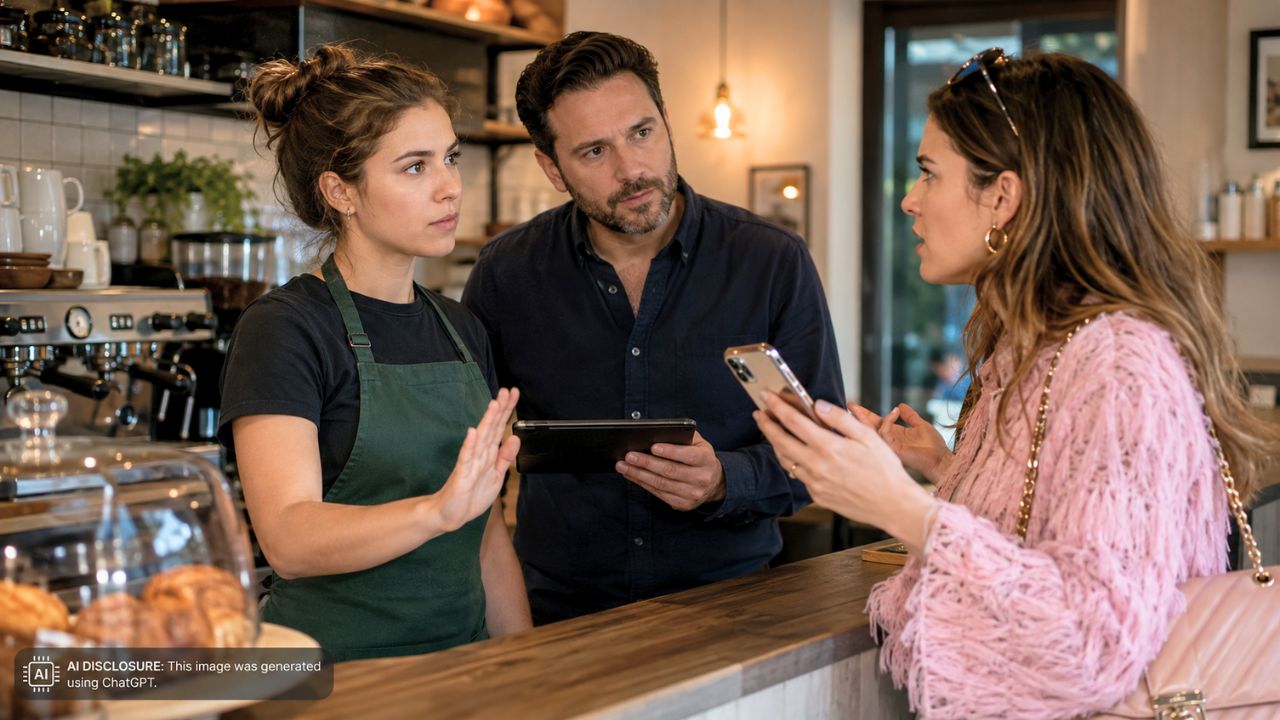
Photo credit: AI-generated image created using ChatGPT. Illustrative only.
It was the kind of shift that turns even simple orders into a stress test: line out the door, two coworkers out, and one barista trying to keep drinks moving fast enough to stop the lobby from boiling over. In the middle of it, a familiar face stepped up—one of those regulars who doesn’t just order coffee, but expects the rules to bend for her.
In the original post, a 22-year-old barista at a small local shop said she finally stopped comping add-ons for a “micro-influencer” customer who claimed she was promoting the business online. The customer didn’t just argue. She posted a callout naming the barista, and the fallout hit within hours—until the manager pulled the security footage and sided with the employee.
A daily routine built on unofficial freebies
According to the barista, the customer—identified only as Megan, late 20s—comes in almost every day and orders a “super complicated latte.” On top of that, she routinely asks for extra syrup, oat milk, and whipped cream at no charge, framing it as a fair trade because she shares the shop on her Instagram stories.
The key detail: there is no formal arrangement. The boss hasn’t made any kind of deal with her, which means giving away those upgrades is technically against store policy. The barista admitted she’d let it slide a few times, especially when the shop was slow and it felt easier to keep the peace than start an argument over a small upcharge.
But “letting it slide” had a shelf life. The barista said she’d already been warned about giving out freebies, making it less about a dollar here or there and more about whether she could get written up—or worse—for violating the rules.
The day the line was too long for special treatment
Last Saturday was different. The shop was slammed, the kind of rush where one delay ripples into ten more, and the barista was alone on bar. When Megan ordered, the barista rang it up normally at $6.75.
Then came the familiar request: add oat milk and vanilla “for free like usual.” This time, the barista said no. She told Megan she couldn’t comp the add-ons because her manager was watching the cameras, and she’d already been warned.
The refusal didn’t land quietly. Megan reportedly got “really snotty,” told the barista she’d take her business elsewhere, and then pulled out her phone. The barista said Megan took a photo of her mid-reach for a cup—an image that, stripped of context, could easily be turned into whatever story the poster wanted to tell.
A story post turned a $1.50 dispute into a pile-on
Before the barista could respond, Megan allegedly posted to her Instagram story: “[Shop Name] has the worst service, barista named [my name] was so rude for no reason. Don’t go here.” It wasn’t vague. It pointed directly at an employee by name and urged people to avoid the business.
The response was fast. Within a few hours, the barista said Megan’s followers left three one-star Yelp reviews specifically naming her. That kind of detail matters, because it’s not just criticism of a shop anymore—it’s an online paper trail tied to one worker’s identity.
And it didn’t stay online. The barista said two people came into the shop demanding discounts because, according to them, they “saw what I did.” In other words, an influencer-style complaint didn’t just bruise the shop’s rating. It changed how real customers behaved at the counter, turning a busy day into a confrontation cycle.
Then the manager checked the cameras
This is where the dynamic shifted. The barista’s boss reviewed the security footage, “laughed,” and told her she did nothing wrong. The cameras did what cameras do best: they turned a he-said-she-said into something concrete the manager could evaluate without guessing.
That review also backed up the barista’s explanation that she was enforcing policy, not picking a fight. It’s a small point that becomes huge in food service, where customers often assume whoever is behind the counter is freelancing the rules.
Still, the damage didn’t fully reverse. The barista said the shop lost a few regulars who saw Megan’s story. Even if management is on your side, losing customers is the kind of thing that can make staff feel like they’ll be blamed later, quietly, through fewer hours or colder treatment.
The pressure didn’t stop just because she was “right”
Even with the manager backing her up, the barista didn’t feel like the conflict was over. A couple of coworkers told her she should’ve just comped the $1.50 upgrade to avoid the drama and bad press. It’s a familiar workplace argument: do the “correct” thing, or do the thing that prevents escalation.
The owner, according to the barista, was “staying out of it.” That hands-off stance left the employee dealing with the ongoing aftermath, including Megan continuing to comment on the shop’s Instagram posts with “remember when your staff harassed me?”
That word—“harassed”—is where the stakes jump again. It reframes a policy dispute as misconduct, and it keeps the accusation alive long after the coffee is gone. For the worker being named, it’s not just annoying; it can feel like a public mark on their reputation that they can’t fully answer without breaking workplace rules or getting dragged into an online argument.
What people latched onto: policy, proof, and not rewarding the tactic
The barista’s question was simple: was she wrong for holding the line, knowing it might cost the shop business? But the details she shared make it clear why many people focus on documentation and boundaries in moments like this.
The biggest practical factor in her favor was the existence of security footage and a manager willing to review it. Without that, the story could’ve stayed stuck in the version broadcast online—where a single photo and a caption can outweigh what actually happened on a chaotic shift.
The other theme is how quickly “I post about you” turns into leverage. The barista described no official partnership, no discount code, no comp policy for promotions—just a regular customer insisting on special treatment and punishing the employee when she didn’t get it. For a lot of workers, giving in once doesn’t end the requests; it sets the expectation that the next employee should also bend.
And there’s a final, more grounded point: the barista wasn’t refusing service. She rang up the drink and offered to make it—just at the actual price. The blow-up came from the expectation that she should risk her job to protect someone else’s online brand and avoid a tantrum.
In the end, the manager’s camera review may have protected one employee from being scapegoated internally, but it didn’t erase the external mess: the one-star reviews, the in-store confrontations, and the lingering comments under the shop’s posts. The barista walked away “backed up,” but still stuck in the uncomfortable reality that doing the job by the book can cost you peace—especially when the person challenging you has an audience.
Check out more from Now Rundown:
- A Party of 12 Came Back a Month Later Demanding Their $80 Tip Refunded — My Restaurant Made Me Pay It
- Her Coworker Kept Filing the Same Complaint About Her After Being Warned — Then She Filed a Counter-Report With Every Email Documented
- Siblings Demanded Half of Their Sister’s $11 Million Inheritance — She Refused Because They Never Visited
- The Kid I Bullied in Middle School Just Interviewed for a Job on My Team — He Bombed It and I Didn’t Hire Him

Abbie Clark is the founder and editor of Now Rundown, covering the stories that hit households first—health, politics, insurance, home costs, scams, and the fine print people often learn too late.