My Husband Thinks I’m Overreacting About His Mom Trying On My $3,000 Wedding Dress Without Permission
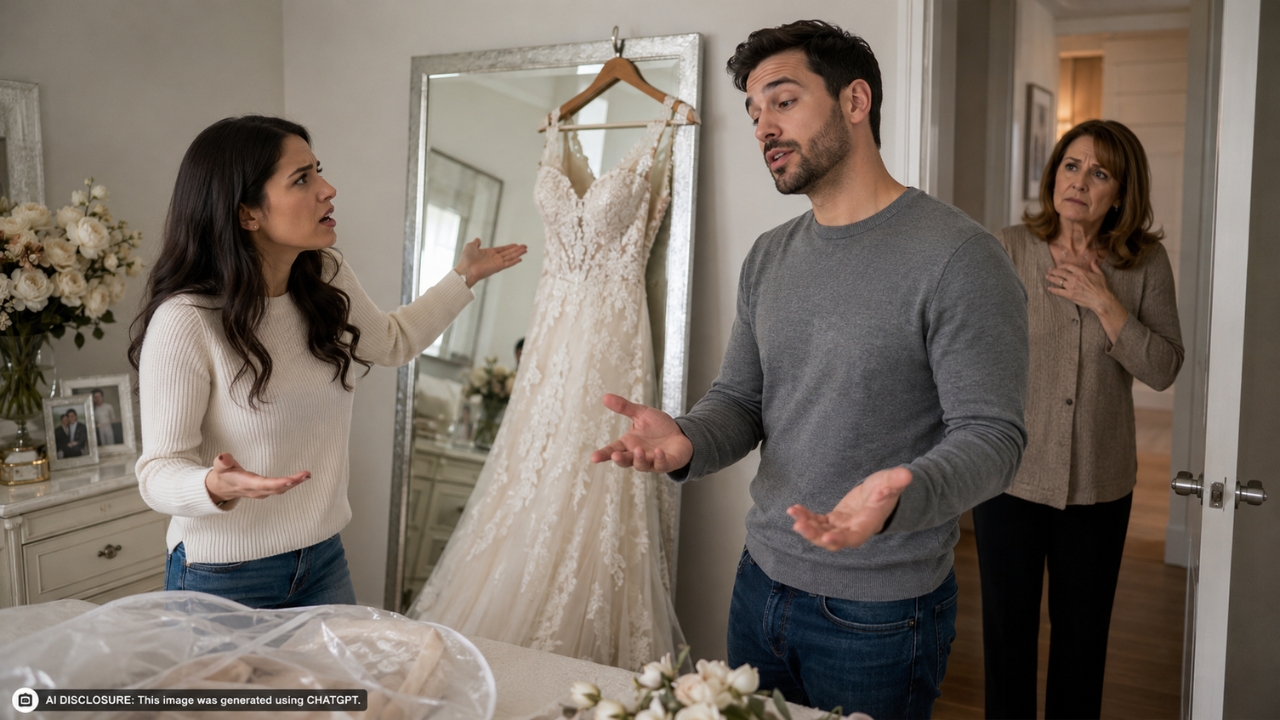
Photo credit: AI-generated image created using ChatGPT. Illustrative only.
She thought the only battle left before her wedding would be last-minute planning stress. Instead, she walked in early from work and found her future mother-in-law standing in her bedroom—wearing her wedding dress.
The bride-to-be said she’d spent $3,000 on the gown and had already made it clear it wasn’t up for debate: nobody else was trying it on. But in one surreal moment, she says her fiancé tried to block her from entering the room while frantically texting on his phone, only for her to push past him and see his mom in the dress anyway.
What happened next turned into a standoff over money, boundaries, and who gets protected when someone crosses a line.
The pressure to “just let her try it on” didn’t come out of nowhere
According to the bride, her fiancé’s mother had been asking for weeks to try on the dress. The requests weren’t subtle, and they didn’t stop after the bride said no. She described it as pestering—constant pushing that she kept shutting down.
At one point, the mother-in-law even offered her $100 for the chance to wear it, saying she loved wedding dresses and was “obsessed” with them. The bride refused again, saying she firmly believed the dress should only be worn by the bride.
That detail matters because it sets the expectation: this wasn’t a misunderstanding or a casual “Can I see it?” moment. She says she drew a hard line well before anyone ended up in her bedroom with the zipper up.
Coming home early turned into an ambush inside her own room
The bride said she came home from work early and immediately noticed something was off. Her fiancé was home and “freaked out” when he saw her, trying to stop her from going into her room while he texted someone.
She went in anyway. That’s when she says she found his mom standing there wearing the gown.
In the moment, she grabbed her phone and took a photo. From her perspective, it wasn’t just proof—she described feeling disgusted and said the dress was essentially ruined for her emotionally. She didn’t want to wear it anymore, even if there was no visible damage.
Her fiancé and his mother panicked, she said, as soon as they realized she had documented it.
The ultimatum: pay for a replacement, or the photo goes to the family
Shocked and angry, she told her future mother-in-law she had three days to pay for a new dress or she’d share the photo with the rest of the family. She felt it was fair: she had worked hard for the gown, spent thousands, and now couldn’t stand the sight of it.
The mother-in-law started crying and left, according to the bride. The fiancé didn’t focus on the boundary-crossing—he focused on the reaction. He allegedly told her she was overreacting because his mom “just wanted to try the dress on” and insisted “no harm done.”
The disagreement escalated into a full-blown fight. The bride said her fiancé accused her of treating his mother like an enemy and told her to “wake up” and stop. After failing to get her to back down, he left to stay with his mother.
Now the bride wasn’t only staring at a dress she no longer wanted—she was staring at the possibility that her fiancé would choose his mother’s comfort over her boundaries, even when the line was crossed in her own home.
When he offered to pay, it came with conditions about silence and control
Later, the fiancé called with what sounded, on the surface, like a compromise: he offered to pay for the new dress himself to “end the conflict.” But he attached conditions that went far beyond money.
He wanted her to hand him her phone so he could delete the photo himself. He also wanted her to swear she didn’t have copies she could “use” against his mom later. Then came two more demands: she should apologize to his mother, and she should quit the family group chat and log out of Facebook for at least a month.
She didn’t respond right away. And she made one point clear: she didn’t want him to cover the cost. She wanted the person who wore the dress without permission to pay for it, because to her that was the only real accountability.
The controls around the photo—and the request that she disappear from family communications—shifted the story from a dispute about a gown into something more unsettling: an attempt to manage what she’s allowed to say, who she’s allowed to talk to, and what evidence she’s allowed to keep.
People zeroed in on the betrayal, not the fabric
In the responses to the original post, many readers weren’t hung up on whether the dress was physically damaged. They focused on the consent issue and the fact that the fiancé appeared to have helped orchestrate the moment—trying to block the door, texting someone, and reacting with panic when she walked in.
Others emphasized documentation: if someone can get into your room and put on something that personal after being told no, the bigger question is what else they feel entitled to do. The photo, in that sense, wasn’t just leverage; it was a record of what happened in case the story got rewritten later.
Some also highlighted the financial reality. A $3,000 dress isn’t a small loss, and replacing it isn’t as simple as running to the mall. Wedding attire can involve tailoring, limited stock, and time-sensitive alterations. Even if the dress could technically still be worn, the bride’s point was that it no longer felt like hers.
And then there was the fiancé’s list of requirements—especially the demand that she log off social media and exit the family chat. To many, that read less like peacemaking and more like damage control.
What’s left is a wedding question, not just a dress question
The bride said some of her own family members think she’s escalating things and risking her relationship with both her future mother-in-law and her fiancé. But from her perspective, the relationship risk didn’t start with her ultimatum—it started when her boundaries were ignored and then minimized.
She’s now weighing two separate problems: the immediate cost of replacing a gown she no longer wants, and the longer-term cost of marrying into a dynamic where her “no” can be overridden in her own bedroom, then reframed as her being the problem.
The dress can be replaced with money, whether it comes from the mother-in-law, the fiancé, or some combination of both. The harder part is replacing trust—and deciding whether a wedding should move forward when the people closest to you are more concerned about deleting a photo than acknowledging what it took to create it.

Abbie Clark is the founder and editor of Now Rundown, covering the stories that hit households first—health, politics, insurance, home costs, scams, and the fine print people often learn too late.