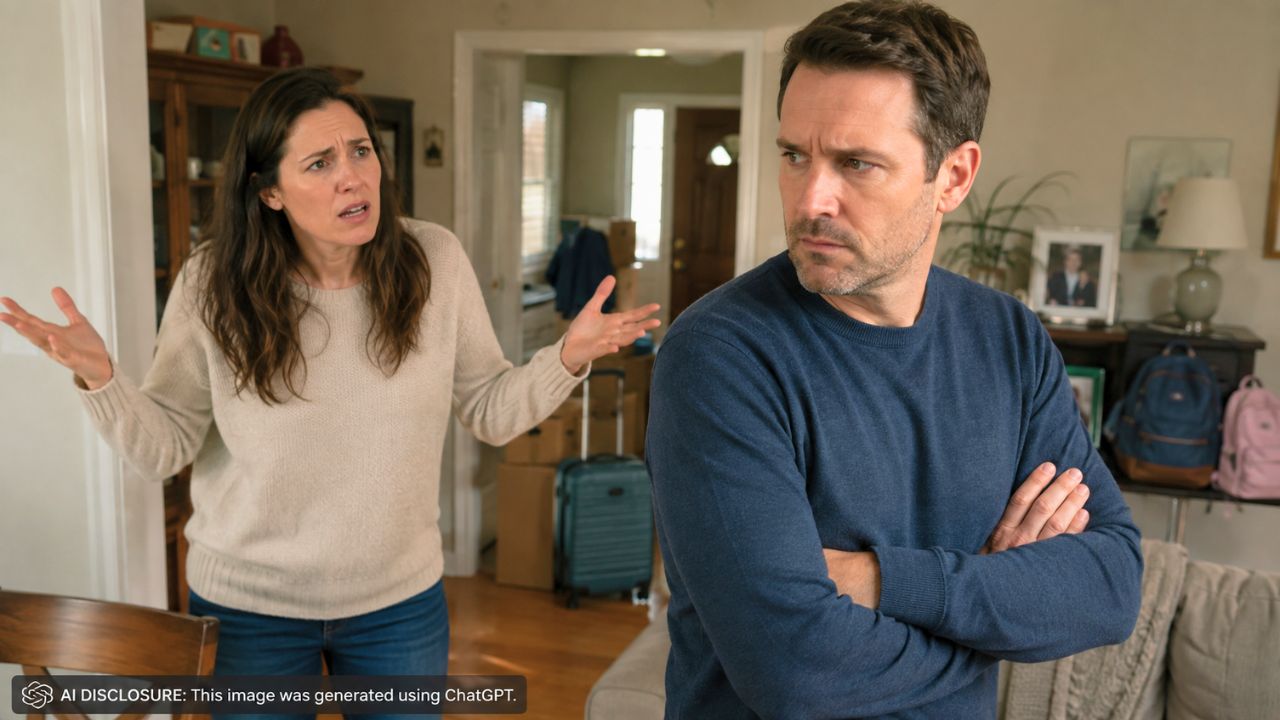
Man Said He Was Willing to End His Marriage Rather Than Uproot His Kids to Follow His Stepchildren, Who Were Moving Out of State
Photo credit: AI-generated image created using ChatGPT. Illustrative only.
Four years into a relationship and nearly two years into marriage, a father found himself staring down a choice he didn’t think a blended family would ever have to make: stay put for his children’s stability, or move out of state so his wife could be closer to hers. In the original post, he explained that he’s willing to let the marriage end rather than uproot his two kids for a move driven by his stepchildren’s relocation.
He and his wife both came into the marriage with children. He’s raising an 11-year-old daughter and a 9-year-old son after their mother died when they were younger. His wife shares two teenagers—15 and 16—with her ex, and for years they had a shared custody arrangement. Then everything shifted in a matter of months.
A custody change turned into a cross-state deadline
The man said his wife’s ex was granted permission to move to another state with their teens, largely because the kids wanted to go with their dad. That legal change didn’t just affect the ex’s household; it rewired the daily life of everyone in this marriage.
With her children now living out of state, the wife told her husband she planned to move too. She didn’t frame it as a casual idea. In his telling, it was a decision rooted in a fear of being away from her kids for long stretches, and a belief that being nearby is what a parent should do.
He said he understood that instinct and supported her desire to be close to her teens. But he also knew immediately that her plan came with a price he wasn’t willing to make his children pay.
He drew a line: his kids weren’t moving
The father’s reasoning was straightforward and painfully personal. His two kids have their lives where they are—family nearby, friends, routines, and a stability he describes as essential. Having already lost their mother, he wasn’t interested in putting them through a second major upheaval if he could help it.
His children also weren’t quietly flexible about the idea. He wrote that they overheard his wife mention moving weeks earlier, and they told him they didn’t want to leave. They’d miss everyone too much, and he took that seriously.
For him, the move wasn’t just about changing schools or finding a new neighborhood. It was about severing a support system his kids depend on, and forcing them into a new life because their stepsiblings—older teenagers—chose to relocate with their father.
The marriage hit a wall when “talk it out” didn’t change the math
When he told his wife he wouldn’t move the kids, he said she looked defeated. The conversation quickly stopped being hypothetical and turned into the practical question of whether a marriage can survive with one spouse in one state and the other somewhere else.
He told her he didn’t think it could. And instead of promising to try long distance, he told her he believed the best way forward would be divorce. That didn’t come out as a threat, in his version; it came out as an acknowledgment that they were both choosing their children and those choices didn’t align.
He described trying to comfort her through the fallout. She asked whether there was anything she could say or do to make him reconsider, and he gave her the same answer: he won’t move his kids, and he also wouldn’t ask her to be away from her teens for months at a time. In his mind, they were both acting in their children’s best interests, even if it meant sacrificing the relationship.
Plans started moving forward, and so did the resentment
The couple kept talking, but the practical steps kept happening too. While they discussed possibilities, he said she began making arrangements in the other state—looking for a place to live where her ex and kids now are, and lining up a new job.
To him, those moves signaled that she believed he might eventually give in, especially if she made the relocation feel inevitable. But the more she planned, the more he held firm. Instead of narrowing the gap between them, the conversations seemed to widen it.
Eventually, he said, her disappointment turned into anger. From her perspective, he was choosing to end the marriage rather than move so they could all stay together under one roof. From his perspective, moving would mean ignoring what his kids had already said they needed, and treating their stability as negotiable.
It’s the kind of standoff where both sides can claim they’re protecting their children, and neither can offer the other a compromise that doesn’t feel like a betrayal of that duty.
What people fixated on: whose “best interest” counts in a blended family
In the way he laid it out, the argument isn’t about whether his wife loves him or whether he cares about his stepchildren. It’s about whose lives get upended to solve a problem created by a custody change and a teenager-driven move.
The sharpest tension sits in the ages and circumstances. His kids are 9 and 11, rooted in school and community, and already carrying the grief of losing a parent. Her kids are 15 and 16, old enough to have a say in where they live and close enough to adulthood that their lives might change again soon anyway.
He also framed his position as refusing to put his children in a situation they don’t want simply to keep the adult relationship intact. At the same time, he acknowledged why his wife can’t imagine being a plane ride away from her own kids for months at a time.
People reading a story like this often zoom in on the practical implications beneath the emotions: if she relocates, what happens to the shared home, the finances, and the day-to-day parenting schedule? If they divorce, what does co-parenting even look like when the children aren’t shared? None of that was spelled out, but the direction of travel was clear—two households, two states, and no clean way to keep everyone happy.
A family can’t always be “kept together” without someone losing something major
What makes the dilemma feel so heavy is that neither option is a small adjustment. If he moved, his children would lose their familiar world and the family support system he believes is keeping them steady. If she stayed, she’d be living away from her teenagers during a time when they’re still minors and she wants to be present.
And if they split, the marriage ends not because of cheating, money, or day-to-day incompatibility, but because geography forced a decision no one could “work through” with better communication.
He seems to be bracing for the real-world mess that comes next—separate homes, hard conversations with kids, and the emotional whiplash of watching a blended family unravel even when both adults believe they’re doing the responsible thing. In the end, his stance boils down to one unmovable point: he can’t justify asking his children to leave the life where they’re thriving, even if it costs him his marriage.
Check out more from Now Rundown:
- A Party of 12 Came Back a Month Later Demanding Their $80 Tip Refunded — My Restaurant Made Me Pay It
- Her Coworker Kept Filing the Same Complaint About Her After Being Warned — Then She Filed a Counter-Report With Every Email Documented
- Siblings Demanded Half of Their Sister’s $11 Million Inheritance — She Refused Because They Never Visited
- The Kid I Bullied in Middle School Just Interviewed for a Job on My Team — He Bombed It and I Didn’t Hire Him

Abbie Clark is the founder and editor of Now Rundown, covering the stories that hit households first—health, politics, insurance, home costs, scams, and the fine print people often learn too late.