Homeowner Put Up a Privacy Fence and Neighbor Says She Destroyed the ‘Community Feel’ of the Entire Street
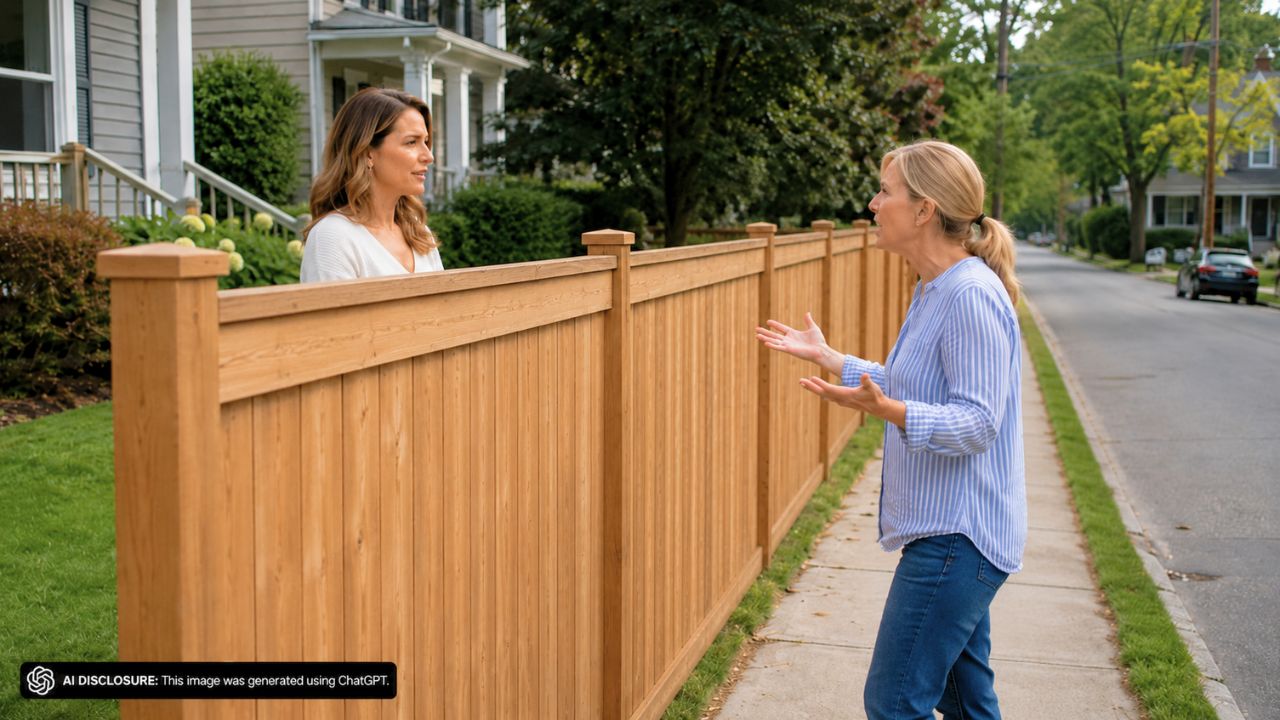
Photo credit: AI-generated image created using ChatGPT. Illustrative only.
When a 26-year-old woman moved into a semidetached house in the UK last December, she expected the usual new-home headaches: paint, repairs, and settling in with her two cats. What she didn’t expect was that a simple privacy fence—common on her street—would turn into a neighborhood standoff with the one neighbor who seemed most invested in keeping things open.
In the original post, the homeowner explains that most of the semis on her street have a fence running down the middle of the space between houses, separating driveways that are not shared. Her home and the neighbor’s next door are the exception: there’s no dividing fence between their driveways, leaving her property feeling exposed to the road and, in her view, too accessible to anyone walking through.
On this street, fences are normal—except between these two houses
The homeowner says each property has its own driveway, plus parking bays outside. Even so, the gap between houses is typically split by fencing, reinforcing what’s private and what isn’t. In her case, the lack of a fence and gate makes her home “extremely open to the road,” and she wants a clear boundary for privacy, safety, and keeping her cats secure.
Legally, she says she’s allowed to put a fence up. Still, she tried to handle it the neighborly way: she went over to let the woman next door know before any work started. That’s when the tone shifted.
The neighbor—described as a woman in her 40s—was initially friendly. But when the fence came up, she started groaning and sighing, saying she’d lived there for 20 years and liked not having one. The neighbor also said she’d hated a previous owner’s fence and had convinced the last owner to take it down.
A polite heads-up turned into an emotional dump
The homeowner says she explained her reasons: privacy, safety, and her cats. In response, the neighbor launched into personal details about her life—details the homeowner didn’t ask for and didn’t feel prepared to receive from someone she’d barely met.
According to the post, the neighbor said she was divorcing her husband because he was cruel toward her. She also said she lived alone with her 13-year-old son, who has additional needs and mimics his father’s behavior toward her. The neighbor added that she needs space to get her son in and out of the car.
The homeowner, who says she’s been through bad relationships herself, wrote that she felt “extremely uncomfortable” with how bluntly the neighbor shared all of this during what was supposed to be a basic conversation about a property boundary. She made an excuse and left.
Then came the driveway problem: boundaries that weren’t being respected
After that conversation, the homeowner says she began noticing a pattern: the neighbor was “nosy and overbearing,” especially whenever work was being done on the house. Workers painting or fixing a front door didn’t stop the neighbor from coming over and demanding to know what was happening.
One moment stuck out. When a friend parked in the homeowner’s driveway, the neighbor banged on the door and told her to move the car because she “couldn’t get into” her own driveway. The homeowner insists that wasn’t true; the neighbor simply wanted to park in a particular spot and avoid banging her car door into the friend’s vehicle.
The homeowner adds another detail that’s become part of the daily grind: the neighbor, along with her friends and family, routinely walks across the homeowner’s driveway, triggering the Ring camera “daily.” She admits she hasn’t confronted them about it, partly because she didn’t want any complaint to look like retaliation with the fence plan already in motion.
From her perspective, the neighbor’s behavior suggests she feels entitled to treat both driveways like shared space—something the homeowner says they are not.
The fence would help her feel safer—but it would also make parking tighter next door
This is where the homeowner starts questioning herself. Installing the fence would create the boundary she wants, but she acknowledges it would likely make things harder for the neighbor when getting in and out of her car.
The neighbor has already framed the issue around access and space, especially with her son. The homeowner’s parents also weighed in, telling her it wouldn’t be respectful to put up the fence given the neighbor’s family issues and the fact that her son “is a lot.” The homeowner notes that he sometimes stands on the driveway screaming at his mother, adding to the tension outside.
Still, she’s clear about her own motive: she wants physical distance. She’s tired of what she sees as constant monitoring, pushiness, and the steady stream of people cutting across her property. The fence isn’t just about looks—it’s about creating a line that can’t be argued with every time someone decides it’s convenient to step over it.
Reactions focused on rights, security, and documenting the pattern
While the post itself centers on whether she’d be wrong to build the fence, the practical themes are hard to miss: property lines, routine trespass, and the way a boundary dispute can spiral when one person treats access as a personal entitlement.
In discussions like this, people tend to focus on a few basics: if the homeowner is allowed to build on her property, then notifying the neighbor was already a courtesy. Others often point out that cameras like a Ring can help establish patterns—who’s crossing, how often, and whether it escalates after the fence goes up.
Another common thread in these disputes is avoiding personal entanglement. The neighbor’s personal circumstances may be real and painful, but the homeowner didn’t invite that level of intimacy, and it doesn’t automatically convert private property into shared space. In real life, that’s often where resentment grows fastest: one person feels they’ve provided a “reason,” and the other feels they’re being pressured into giving up control of their own home to manage someone else’s crisis.
A fence doesn’t solve the relationship—but it might stop the daily friction
No one in this story is arguing that neighbors shouldn’t be considerate. But the homeowner isn’t trying to fence someone out of a shared garden or block an essential access point. She’s looking at a street where fences between driveways are the norm, and asking to have the same basic separation everyone else already has.
At the same time, she’s also dealing with the human part: a neighbor who is lonely, stressed, and used to the old arrangement—and who now seems to be inserting herself into the homeowner’s comings and goings. The homeowner’s hesitation isn’t about whether she wants the fence. It’s about how much backlash she’ll face for installing it.
In the end, the fence is likely to go up because the homeowner wants her home to feel like her own. The bigger question is what happens after: whether the neighbor backs off once there’s a physical boundary, or whether the complaints simply shift from crossing the driveway to criticizing the barrier that stopped it.
Check out more from Now Rundown:
- A Party of 12 Came Back a Month Later Demanding Their $80 Tip Refunded — My Restaurant Made Me Pay It
- Her Coworker Kept Filing the Same Complaint About Her After Being Warned — Then She Filed a Counter-Report With Every Email Documented
- Siblings Demanded Half of Their Sister’s $11 Million Inheritance — She Refused Because They Never Visited
- The Kid I Bullied in Middle School Just Interviewed for a Job on My Team — He Bombed It and I Didn’t Hire Him

Abbie Clark is the founder and editor of Now Rundown, covering the stories that hit households first—health, politics, insurance, home costs, scams, and the fine print people often learn too late.