Woman Went No Contact With Her Violent, Narcissistic Father Decades After He Abused Her as a Child
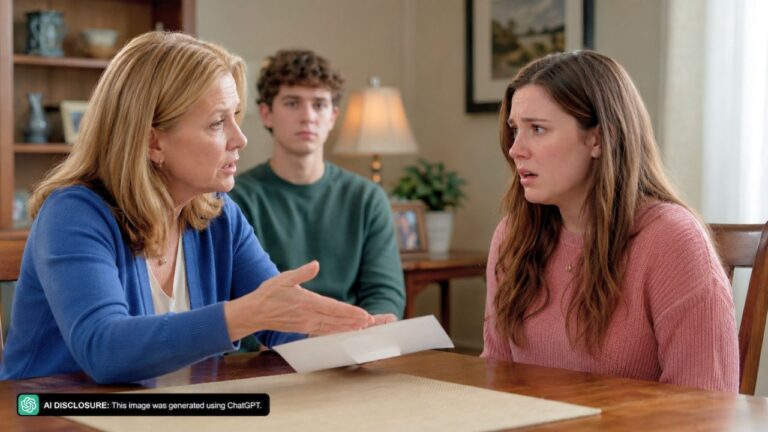
Photo credit: AI-generated image created using ChatGPT. Illustrative only.
For years, the arrangement was simple: she would help pay for her elderly father’s care, and in return he would leave her alone. It wasn’t forgiveness, and it wasn’t a reunion. It was distance, bought and maintained on purpose.
But a surprise visit—pushed by family pressure—collapsed that fragile truce in minutes. In the original post, the woman describes a childhood marked by violence and control, followed by a tense adulthood where money became the only tether still connecting her to the man who hurt her.
A childhood shaped by fear and a home ruled by control
She grew up in a family with nine children—seven girls and two boys—and says she’s the exact middle child. She also says she never had a good relationship with either parent, and that religion widened the gap. Her mother and sisters are described as devout Jehovah’s Witnesses, while she is an atheist, a difference that still fuels conflict.
The far darker part, she says, was her father. She describes him as violent and narcissistic, and recalls him framing cruelty as “kindness”—including making her choose which object she would be beaten with. Those are the memories sitting underneath every later interaction, even when the conversation is supposedly about logistics and elder care.
By the time her parents divorced, she had already learned the safest version of contact was limited contact. She avoided her mother because, she says, her mother routinely told her she “offend[s] God.” And with her father, she tried to make “no contact” not just an emotional boundary, but a financial contract.
The deal: she pays for a better facility, he doesn’t reach out
Her father is now in his mid-80s and, according to her, broke from years of “bad life choices.” She says he lives off state benefits and money the family provides. To keep him in a nicer elder care facility, she agreed to cover a little more than a third of the cost—on one condition: he would not try to contact her at all.
It was an uncomfortable compromise, but it worked on paper. She wasn’t pretending the past didn’t happen. She was paying to keep a vulnerable elderly person housed and fed while protecting herself from direct interaction.
That balance was already uneven inside the family. She later explained why she was paying so much in a nine-sibling household: seven of her sisters are “basically just JW full time,” she wrote, and only she and her brother have careers with money to spare. So the burden landed on the two siblings who could actually cover it.
A “mend fences” visit turned into threats and extortion talk
When she visited home recently, she says her father bullied her brother into pushing for an in-person meeting. The pitch was that he wanted to talk and “mend fences,” and she was asked to bring her wife. She agreed to go, despite the prior no-contact arrangement, and walked into what she describes as a familiar pattern.
She says her father immediately demanded more money. Not just a little more—he reportedly told her to take out a second mortgage on her home, insisting he knew how to make money off her money, and that she was too stupid to do it herself.
Then came the threat designed to reach beyond the family. She says her father told her he would personally call her boss and tell them how horrible she is if she didn’t give him what he wanted. To her, it wasn’t just manipulation; it was an attempt to endanger her livelihood.
She also describes him trying to physically intimidate her, standing too close and yelling. The size difference made it feel less like fear and more like a trigger—he’s 5’10” and 85, she wrote, while she’s 6’3” and 55—but the body language pulled her straight back into the dynamic she grew up under.
She snapped—and her wife saw a side of her she hadn’t before
She says she doesn’t remember every detail of what happened next, only that she was fighting the urge to choke him. According to her wife, she advanced on him so forcefully that she backed him into a wall.
In that moment, she says, she said the quiet part out loud: the only reason he has a home and food is because of her. She told him she pays most of his living expenses, and that she does it knowing she could stop at any time, which would leave him homeless and hungry. Then she walked out.
The ride home was icy. She says neither her brother nor her wife spoke to her the whole way. Later, her wife told her she’d never thought of her as violent—but she was scared, and truly thought she was going to hurt him.
That reaction mattered. It wasn’t just about whether her father “deserved” the confrontation. It was the realization that the past could still pull her into a place she didn’t want to be—especially with someone she loves watching it unfold.
The family backlash landed fast: apologize, pay more, and quote scripture
Afterward, she told her entire family she was going strictly incommunicado with both parents. If anything was needed, they could route it through her brother by email. She also considered blocking everyone except her brother.
Her relatives did not see it as self-protection. She says they accused her of “terrorizing an old man,” and urged her to follow the Bible’s instruction to “honor [her] mother and father.” Some pushed her to apologize and even give her father “at least a little more money” as a peace gesture.
To her, that framing felt upside down. The meeting began with demands, insults, workplace threats, and intimidation. The only part the family seemed to focus on was her reaction—especially because her father is elderly and she is physically bigger.
But the deeper conflict was old: a family system that asks the injured person to manage everyone else’s comfort, even when the price is their own stability.
Commenters zeroed in on safety, boundaries, and protecting her job
While she asked if she was overreacting, much of the practical attention went to what could happen next. A parent threatening to contact an employer isn’t a theoretical worry; it can become a real workplace problem quickly, especially if the person is persistent.
People also focused on the risk of future in-person meetings. When a dynamic has a history of violence and intimidation, the safest choice often isn’t winning the argument—it’s eliminating the opportunity for another confrontation. Several urged her to keep everything mediated and written, and to avoid being pulled into “one last talk” scenarios that tend to end the same way.
And then there was the financial leverage. If money is the only reason contact continues, it can become the weapon that keeps the cycle going—demands, threats, guilt, then pressure from other relatives to smooth it over.
He said he wanted her gone—so she cut the funding and blocked the calls
In a second update, she said her father emailed that he wanted her cut out of his life for being “violent.” She replied “fine,” cut off the auto-deposit, blocked his number and the facility’s number, and told everyone she was done.
Within an hour, she says she received 47 calls from various numbers. She put her phone in a drawer and described feeling dizzy and like she might vomit—an immediate physical crash after finally doing the thing she’d been trying to avoid for decades.
The practical fallout is clear even without the next chapter: when you remove money and access at the same time, the people who relied on your silence tend to get loud. For her, the line finally held—not because the family agreed, but because the mechanism that kept the relationship “manageable” snapped, and she chose not to rebuild it.
Check out more from Now Rundown:
- A Party of 12 Came Back a Month Later Demanding Their $80 Tip Refunded — My Restaurant Made Me Pay It
- Her Coworker Kept Filing the Same Complaint About Her After Being Warned — Then She Filed a Counter-Report With Every Email Documented
- Siblings Demanded Half of Their Sister’s $11 Million Inheritance — She Refused Because They Never Visited
- The Kid I Bullied in Middle School Just Interviewed for a Job on My Team — He Bombed It and I Didn’t Hire Him

Abbie Clark is the founder and editor of Now Rundown, covering the stories that hit households first—health, politics, insurance, home costs, scams, and the fine print people often learn too late.