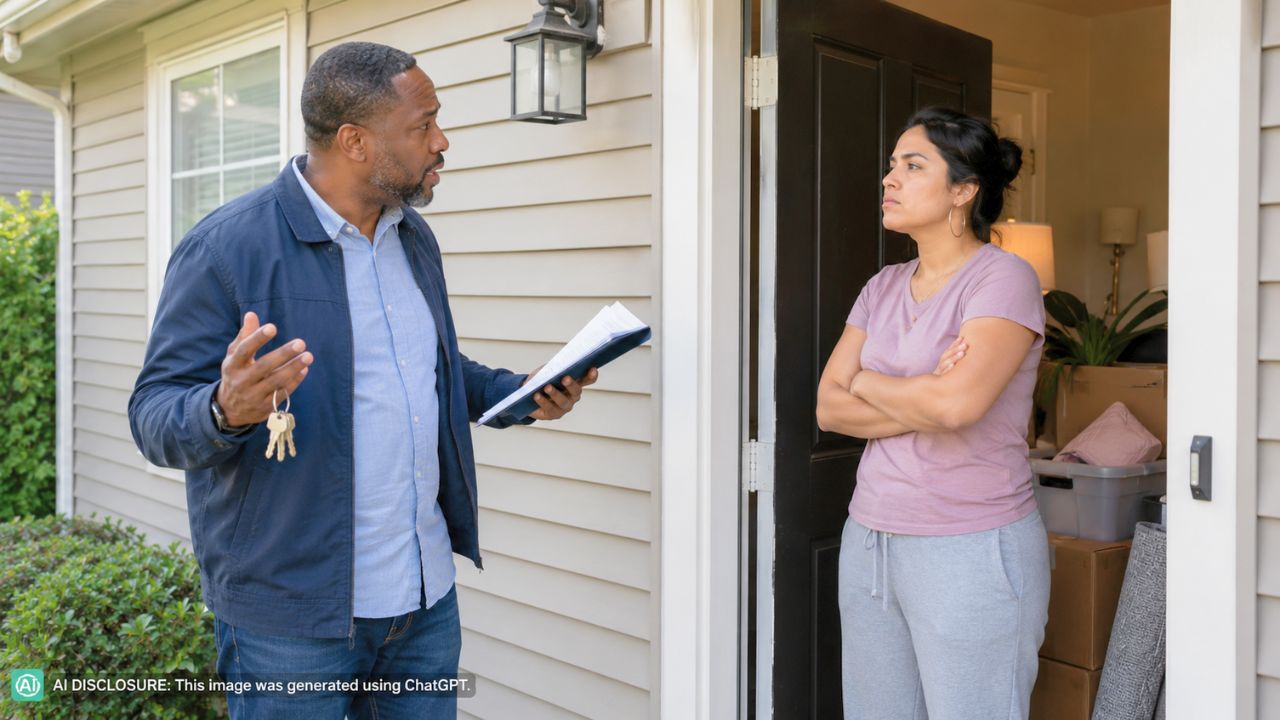
Woman Moved Into an Empty House Without Permission — Then Refused to Leave When the Real Owner Showed Up
Photo credit: AI-generated image created using ChatGPT. Illustrative only
It started as a rent dispute and ended with a tenant admitting she stayed put for months without paying—then questioning whether she went too far once the owner came looking for the missing money. In a post asking for judgment, the woman described what she saw as a justified move after accusing her landlord of taking cash through illegal “fees.”
In the original post, she said her state’s housing laws allowed her to withhold rent after those charges, treating the disputed amount as “prepaid rent.” So from June through August, she stayed in the house without paying. The real fight didn’t kick up until after she moved out—when the landlord confronted her, saying the lost income caused financial hardship.
The dispute began with “fees” she says weren’t legal
The tenant framed the entire decision around money she believed was taken from her unfairly. She said her landlord “took a bunch of money from me illegally via ‘fees,’” and that under her state’s rules she could stop paying rent after that happens.
Her logic was simple: if the landlord already had money they shouldn’t have, that money could count toward rent until the balance evened out. She described it as telling the landlord to “keep the stolen moneys as prepaid rent,” then remaining in the home without making rent payments for roughly three months.
It’s the kind of self-help remedy that can feel straightforward when you’re on the wrong end of a housing dispute. But it also sets up a predictable collision—because landlords typically don’t treat withheld rent as a bookkeeping disagreement. They treat it as missed rent.
She stayed in the home for months without paying
In her account, she “squatted the property from June–August without paying rent.” She didn’t describe changing locks, forcing entry, or taking over an abandoned building. She was already living there. The “squatting” label, as she used it, meant refusing to pay while continuing to occupy the space.
That detail matters because the stakes are different when someone moves into an empty house versus when a renter withholds payment in a dispute. Still, the effect on the owner’s side looks similar: someone is in the home, and the expected rent isn’t coming in.
She also noted the property was a four-bedroom house, and she was occupying just one bedroom. That becomes part of her defense later, because she believes the landlord had other ways to cover any income gap.
The confrontation came after she moved out
The sharpest twist in her story is timing. The landlord didn’t just argue while she was still living there, at least not in the details she shared. Instead, she said that “now that I’ve moved out,” the landlord is coming to her saying they “lost income and are struggling because of me.”
That post-move-out confrontation changed the tone. While she had felt firm about her decision while staying in the home, the landlord’s claim of hardship made her pause. She wrote that she didn’t feel bad at first because she believed the landlord had stolen from her—but the hardship claim left her wondering if she was in the wrong.
That’s also where the real-world pressure starts to creep in. A rent dispute can stay theoretical until someone demands money back, threatens collections, or moves toward an eviction filing. Even if those steps never happen, the threat of them is enough to make a former tenant second-guess what felt “legal” in the moment.
Her defense: wealthy owners and empty bedrooms
The woman didn’t just argue that her state’s laws allowed her to withhold rent. She argued that the landlord’s hardship claim didn’t add up. She said the landlords were “a family of plastic surgeons” with “three properties,” and that she found it difficult to believe they were truly struggling because of a few months of withheld rent.
She also pointed out that the house had multiple empty rooms. In her view, if income was tight, the owners could have rented out the other vacant bedrooms rather than relying on her payment alone. That detail reads like a practical rebuttal: the landlord had options, so the burden shouldn’t fall on her to fix their finances.
But it also reveals how differently landlords and tenants can view the same property. A renter might see unused bedrooms as easy income. An owner might see a lease as a contract for a specific amount—one that doesn’t come with a duty to find replacement roommates just because a tenant decides to stop paying.
Most reactions centered on process, not sympathy
The post itself included a clear judgment: “Not the A-hole.” Even without a full comment thread included, that verdict signals where the conversation leaned—toward the idea that a landlord who takes illegal fees shouldn’t expect smooth rent collection afterward.
Still, the details she shared point to the kinds of process-focused reactions these disputes usually trigger. When someone claims they’re “within my right” to stop paying, people tend to ask what steps were taken to document the fees, notify the owner in writing, or seek enforcement through official channels. A renter can feel morally certain and still end up exposed if they can’t prove the fees were illegal, or if the local rules require a specific notice procedure before withholding rent.
And when a landlord shows up later claiming hardship, that can be more than an emotional appeal. It can be the opening move in a demand letter, a small-claims filing, or a push to recover unpaid rent. Even if the tenant believes the money balances out, the paper trail—and who has it—often decides what happens next.
A messy ending: justified payback or a costly gamble?
The woman’s uncertainty at the end of her post is the part that makes the story feel unfinished. She believed she was responding to being overcharged. She also believed the owner had the financial cushion to absorb the hit. But once the landlord framed it as hardship, she started to wonder whether her method crossed a line.
In real life, these conflicts rarely stay contained to who’s “right.” They spill into reference checks, deposit disputes, and whether a former landlord decides to pursue money after the tenant is gone. For the tenant, the risk is that a stand that felt like payback becomes a long, draining argument about rent owed. For the landlord, the risk is that pushing questionable fees creates exactly the kind of blowback that turns a steady lease into a months-long loss.
By the time the owner confronted her, she was already out. The question she was left with wasn’t just whether she did something wrong—it was whether the choice she made in the moment was worth what might come next.
Check out more from Now Rundown:
- A Party of 12 Came Back a Month Later Demanding Their $80 Tip Refunded — My Restaurant Made Me Pay It
- Her Coworker Kept Filing the Same Complaint About Her After Being Warned — Then She Filed a Counter-Report With Every Email Documented
- Siblings Demanded Half of Their Sister’s $11 Million Inheritance — She Refused Because They Never Visited
- The Kid I Bullied in Middle School Just Interviewed for a Job on My Team — He Bombed It and I Didn’t Hire Him

Abbie Clark is the founder and editor of Now Rundown, covering the stories that hit households first—health, politics, insurance, home costs, scams, and the fine print people often learn too late.