Woman Called Out Her Mother-in-Law for Cutting the Food Line Ahead of the Kids at Thanksgiving — Then Refused to Let Her Take Home Leftovers
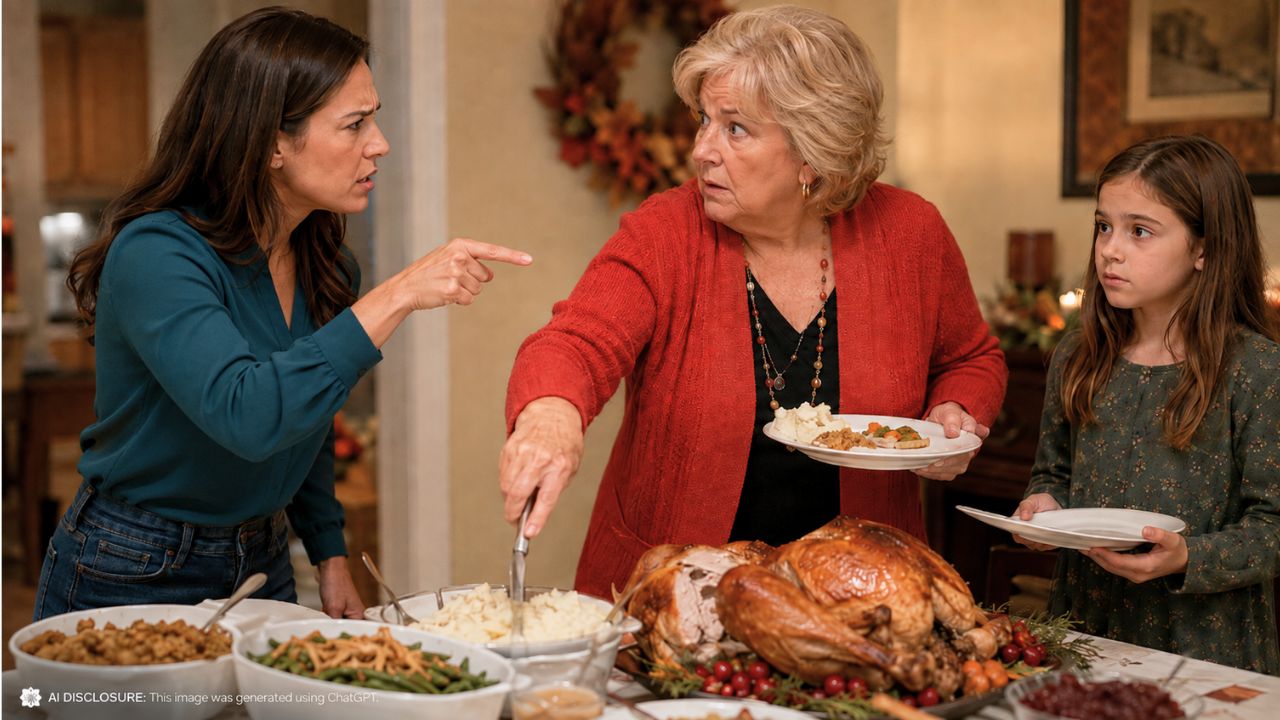
Photo credit: AI-generated image created using ChatGPT. Illustrative only.
Thanksgiving in this house has a rule: the kids eat first. But when an uninvited guest showed up anyway, that rule turned into an argument in front of a packed dining room—and spilled over into a standoff about leftovers afterward.
In the original post, a woman described hosting a large holiday meal for her family of six, plus extended relatives. She said the gathering was moved up a day to work around schedules, and she and her husband had already agreed not to invite his mother because of repeated food-related conflicts that have left others short on dinner.
A long-running food issue set the tone before anyone arrived
The host said her mother-in-law has “food insecurities and hoards food,” and that this has shown up at family meals in a specific way: taking food before everyone else, especially before the kids, and leaving with containers of leftovers without asking.
In her household, she explained, feeding order matters. With four kids, she serves them first, then her husband, then herself—meaning when someone cuts the line or packs up food early, she’s usually the one who ends up going without.
This year, she said, the stakes were higher. The family had spent about $1,000 on the holiday spread, and with a big crowd present, there wasn’t room for someone to treat the meal like a personal stockpile.
She wasn’t invited—then she showed up anyway
According to the account, the husband didn’t invite his mother, but she “caught wind” of the dinner and arrived regardless. Despite the history, neither the host nor her husband confronted her at the door.
The reason was simple: they didn’t want to “cause issue.” So they let her stay, even though the decision not to invite her was already a sign that the couple expected trouble if she came.
By the time dinner was ready, the home was full—roughly 12 adults and 10 kids, the host said. That meant any awkward moment would have an audience, and any breach of the house rules would happen in front of a lot of people.
The food line became the flashpoint in front of everyone
The host said she called the kids over first with a familiar announcement: “kids, food.” That was the cue for children to go ahead of the adults, the way the household normally does it.
But she wrote that her mother-in-law immediately jumped up from the couch and moved to the front of the line, trying to serve herself before the kids. That’s when the host drew a hard boundary out loud: “I’m sorry but are you a child? No? Go sit down and wait your turn.”
The response was instant. The mother-in-law’s face went “bright red,” she returned to the couch, crossed her arms, and muttered under her breath. Later, when the adults were called to eat, she stayed planted and made a comment in what the host described as a childish tone: “are you sure there’s even enough for me?”
The host said she chose not to react. But the mood had shifted. The message was clear: the mother-in-law felt singled out, and the host felt she had no choice but to enforce the rules publicly since a private, gentle approach had failed in the past.
The leftovers fight was the second round—and it got personal
After eating, the host said her mother-in-law moved quickly to the kitchen cupboards to get Tupperware—an action that, in this family, apparently has a history. The host confronted her and asked what she thought she was doing.
The mother-in-law answered that she was grabbing a plate for “Tom,” her boyfriend, someone the host emphasized that the family had never met. That’s where the host drew another line: she told her mother-in-law that feeding a boyfriend they don’t know “is not our problem,” and that she wasn’t taking their leftovers to feed him.
Then came a smaller compromise with a sharper edge. When the mother-in-law asked if she could take a plate for herself, the host agreed—but swapped out the oversized container her mother-in-law had grabbed for a normal-size one, estimating it would hold “roughly 2 cans of soup.” When the mother-in-law asked if she was serious, the host replied, “dead serious,” and walked away.
The host said the mother-in-law reacted by throwing the container into the sink and leaving without saying goodbye. No dramatic screaming match, no big exit speech—just a quiet storm-out after the leftovers were limited.
The phone call after dinner left the husband stuck in the middle
The blowback didn’t wait long. The mother-in-law called the host’s husband and “gave him an ear-full,” complaining she felt “unwelcome” during the holidays and accusing the host of acting “immature” and “high and mighty.” She also said she’d been embarrassed in front of everyone and demanded an apology.
The call was on speaker, and the host responded calmly but firmly. She said she wouldn’t apologize for enforcing the same rules everyone else follows, and suggested the real issue was entitlement around other people’s food. She also pointed to cost, saying they didn’t spend $1,000 for someone to take $200 worth home.
That ended the conversation. The mother-in-law hung up. But the bigger problem, the host wrote, was what happened next: her husband went “radio silent,” refused to talk about it, and started giving her the cold shoulder.
Where people tend to land: boundaries, backup plans, and who enforces the rules
Even without a full comment thread included in the account, the pressure points are obvious. A lot of people would likely focus on the same two questions the host was wrestling with in real time: how far you let a repeated pattern go before you stop it, and whether a boundary still works if only one spouse is willing to enforce it.
There’s also the practical side of hosting when food has already been a known trigger. The couple tried prevention—by not inviting the mother-in-law—but didn’t follow through when she appeared anyway. Once she was inside, the only tools left were public correction and physical limits on what could be taken home.
The result is a family dynamic that doesn’t just revolve around manners. It touches money, the logistics of feeding a big group, and the strain that hits a marriage when one person becomes the enforcer and the other opts out once the confrontation arrives.
By the end of the night, the host had succeeded at one thing: the kids ate first, and the leftovers stayed mostly in the house. But the cost showed up immediately—an angry mother-in-law, a demanded apology, and a husband who shut down instead of stepping in. For a family that tried to avoid drama by not sending an invite, it became a loud reminder that avoiding a problem and solving it are two different things.
Check out more from Now Rundown:
- A Party of 12 Came Back a Month Later Demanding Their $80 Tip Refunded — My Restaurant Made Me Pay It
- Her Coworker Kept Filing the Same Complaint About Her After Being Warned — Then She Filed a Counter-Report With Every Email Documented
- Siblings Demanded Half of Their Sister’s $11 Million Inheritance — She Refused Because They Never Visited
- The Kid I Bullied in Middle School Just Interviewed for a Job on My Team — He Bombed It and I Didn’t Hire Him

Abbie Clark is the founder and editor of Now Rundown, covering the stories that hit households first—health, politics, insurance, home costs, scams, and the fine print people often learn too late.