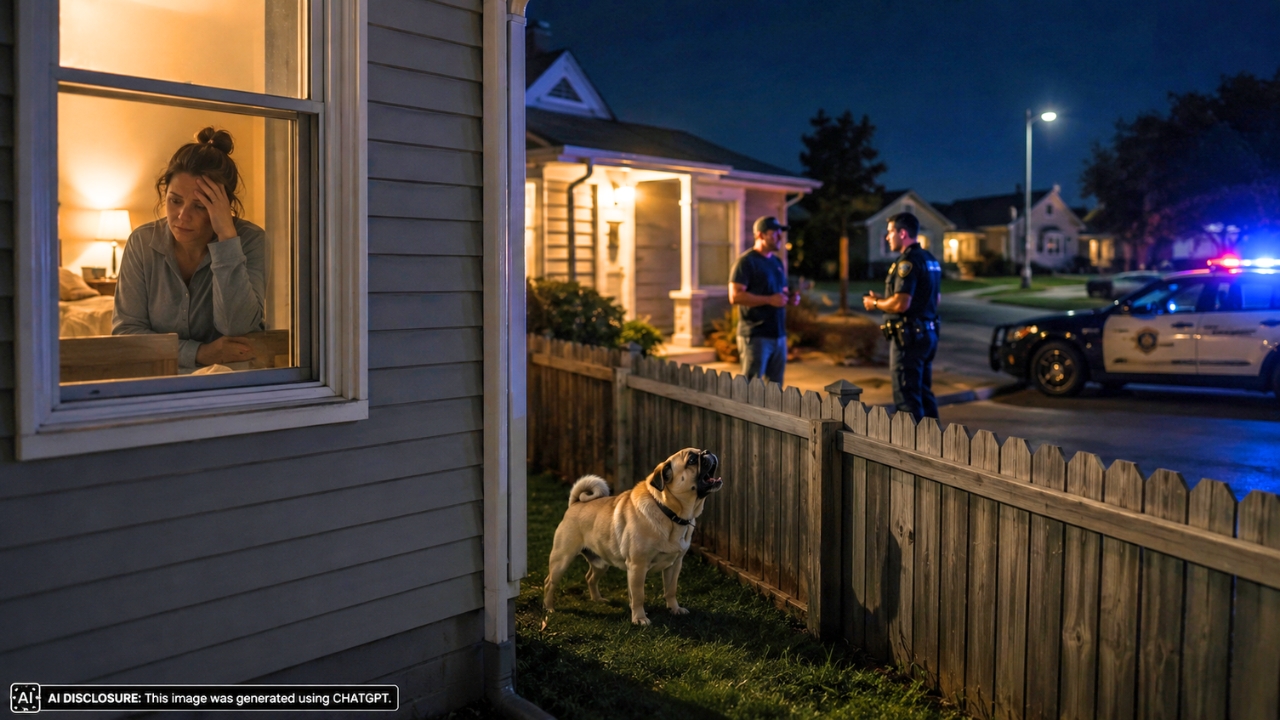
New Neighbor Called the Police Over a Barking Dog That Kept Her Up All Night Within a Week of Moving In
Photo credit: AI-generated image created using ChatGPT. Illustrative only
Moving into a new place comes with the usual little surprises: unfamiliar creaks, new routines, and neighbors you haven’t quite met yet. For one homeowner, the surprise was much louder—and it started almost immediately.
Within a week of settling in, the new resident says a neighbor’s pug was being left outside for long stretches, including overnight, and barking for hours right next to their bedroom. After one especially bad night with barely any sleep before work, they called the non-emergency police line to report the noise, a choice they later questioned in the original post.
The “cute pug” next door turned into an all-night problem
At first, the dog didn’t seem like a neighborhood issue at all. The new neighbor described the pug as “the cutest,” spotted napping in the sun and playing in the yard. There was also a second dog, but that one seemed to go outside briefly and then get brought back in.
The difference, they said, was that the pug appeared to be outside constantly—out all day, and then still out all night. And when night came, the barking didn’t sound like a quick burst that stopped on its own. It stretched on for hours.
The layout made it worse. The neighbor’s backyard was right up against the poster’s bedroom, meaning the barking wasn’t distant background noise—it was close enough to cut through walls and ruin sleep.
A breaking point arrived after an hour of sleep
The poster described one night as the moment everything tipped from frustration to desperation. They said they managed to sleep for about an hour before the barking woke them up again. With work in the morning, that wasn’t just irritating—it was the start of a full day running on fumes.
At that point, they decided they’d had enough and called the police through the non-emergency line to make a noise complaint. It wasn’t a 911 call, and it wasn’t framed as an emergency. It was a request for help getting the barking to stop so they could sleep.
In their telling, the response wasn’t immediate. Police arrived roughly two hours later, spoke to the neighbor, and the neighbor brought the dog inside.
Calling instead of knocking: the part they couldn’t stop replaying
After the dog was brought in, the poster’s attention shifted to the social fallout. They were the new person on the block, still in that fragile phase where no one knows you yet and every move can set the tone for years.
That’s what made them second-guess the call. They wondered if they were in the wrong for contacting police before trying to talk it out face-to-face, especially since they’d only lived there about a week. In many neighborhoods, the first complaint is expected to be a knock on the door, not an official report.
But the poster also painted a picture that made a direct conversation feel less simple. They said they’d heard the neighbors “yelling at the pug a lot,” and speculated that might be part of why the dog was kept outside. Whether that yelling was routine frustration, an attempt to quiet the barking, or something else entirely, it added a layer of unease to the idea of initiating a late-night confrontation.
What the quick fix did—and didn’t—solve
In the short term, the call worked: the dog went inside. That’s the cleanest outcome a sleep-deprived neighbor can hope for, and it suggests the noise complaint had enough weight to prompt immediate action once authorities showed up.
But it also leaves the bigger problem hanging in the air. If the pug is regularly left outside overnight, the barking likely isn’t a one-off. The poster had already noticed a pattern over several days, not a single bad night.
And when a problem is recurring, the first intervention can either reset expectations or harden resentment. A neighbor who gets a surprise visit from police may comply in the moment and then go right back to old habits later. Or they may decide the new person next door is “that neighbor,” and treat future interactions through that lens.
For the poster, the stakes weren’t theoretical. Lack of sleep can affect job performance, commuting safety, and health. When someone says they slept an hour and had to get up for work, it’s not hard to see why they chose the fastest option available.
Reactions centered on safety, documentation, and local rules
Even without seeing a long comment thread in the source material, the pressure points are familiar to anyone who’s lived through neighbor noise disputes. People tend to split into two practical camps: those who think the first step should be direct communication, and those who think it’s safer to avoid confrontation and keep everything official.
In this case, details like “new neighbor,” “all night,” “hours and hours,” and “yelling at the pug” would naturally steer many readers toward caution. If you don’t know the people next door, and you’re already hearing frequent shouting directed at an animal, a nighttime door knock can feel risky—and it can escalate fast if tempers are already high.
On the practical side, noise issues often come down to patterns and proof. People in similar situations commonly focus on logging dates and times, recording audio from inside their own home where it’s legal to do so, and checking local ordinances about quiet hours and animal noise. The goal isn’t to “build a case” for the sake of drama; it’s to have a clear record if the problem becomes chronic and a second call or formal complaint becomes necessary.
And because this is a dog being kept outside overnight, some readers would likely see it as more than just a noise problem. A pet left outside for long periods can raise welfare questions, depending on weather and conditions—though the poster didn’t describe the environment beyond the barking and the time outside.
Now the neighborhood has to live with the first move
The hardest part of a dispute like this is that it doesn’t end when the barking stops for one night. The poster still has to live next door, and the neighbor now knows someone complained.
Whether the next step is a polite daytime introduction, a written note, another non-emergency call if it happens again, or a mix of all three, the tone has already been set by that first choice. For the new resident, it was a choice made in exhaustion, with work looming and patience gone.
What’s left is the uneasy in-between: hoping the pug stays inside at night, hoping no retaliation follows, and realizing that sometimes the first week in a new home tells you more about the street than you wanted to know.

Abbie Clark is the founder and editor of Now Rundown, covering the stories that hit households first—health, politics, insurance, home costs, scams, and the fine print people often learn too late.