Neighbor Started Using Her Parking Spot and Left a Note Saying It Had Always Been Theirs
Photo credit: Nowrundown.com
It started with a small, irritating change in the evening routine. One Tuesday after work, Mara pulled into her apartment complex expecting to slide into the same spot she’d used for nearly two years—the one closest to the stairwell, the one she paid extra for when she signed her lease.
Except there was a silver SUV sitting in it, parked crooked like it had been rushed. At first Mara thought it was a visitor who didn’t understand the setup. Then she saw the little laminated tag hanging from the rearview mirror—the building’s resident tag.
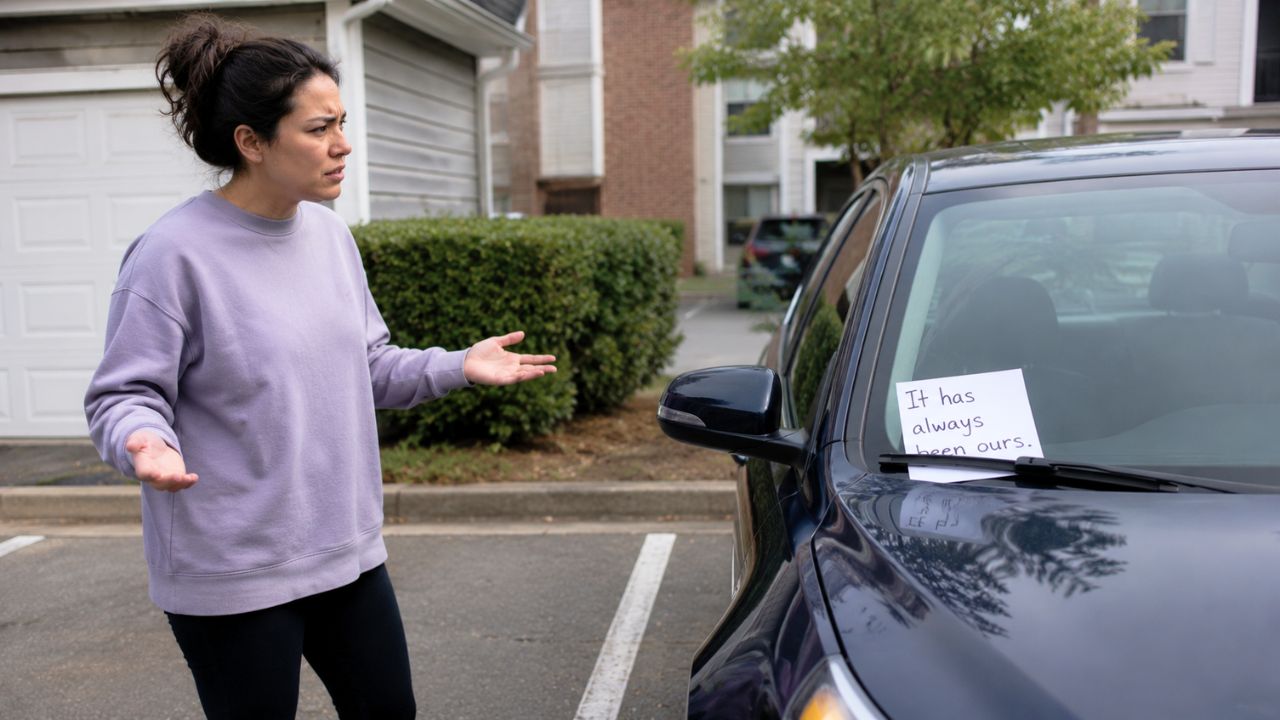
She circled once, found a spot far down by the dumpsters, and walked back fuming. Tucked under the SUV’s windshield wiper was a folded sticky note. It wasn’t an apology. It was a claim.
The problem started with a “temporary” move-in
Mara lived in a mid-size complex where parking was a mix of assigned spots and open spaces. Assigned spots had unit numbers painted on the curb, and management charged a monthly fee. Mara’s spot wasn’t glamorous, but it saved her from hauling groceries across the lot and kept her from feeling anxious during late returns from her nursing shifts.
A few weeks earlier, a new tenant had moved into the unit across the breezeway. The first interaction had been polite in that stiff, new-neighbor way—quick hello, a brief smile, then everyone goes back to their own lives.
Then Mara started noticing the SUV more and more. It was always close to her stairwell. It always felt like it was hovering around her spot, like the driver was testing the waters.
That Tuesday was the first time it flat-out took the space.
The note turned a parking issue into something personal
Mara expected a “sorry, I didn’t realize” kind of message. Instead, the sticky note read like a correction. It said the space had always belonged to the neighbor’s unit, and that Mara had likely been using it by mistake. It ended with a neat little sign-off and a suggestion that Mara “use the general parking like everyone else.”
Mara stood there reading it twice because it was so confidently wrong. The curb was painted with her unit number. Her lease addendum listed the spot number, the monthly charge, and the date she started paying for it.
But what bothered her most was the tone—like she was the one who’d been getting away with something.
She went upstairs, dug out the folder where she kept lease paperwork, and took a photo of the parking addendum. Then she took a photo of the curb marking, because suddenly it felt like she needed proof of her own reality.
When Mara tried to be civil, the neighbor doubled down
The next morning Mara caught the neighbor in the breezeway. The woman was unloading a tote bag and a set of brightly colored storage bins. Mara kept her voice calm and asked if there’d been a mix-up, explaining the spot was assigned to her unit and showing a picture of the curb number on her phone.
The neighbor barely looked at the screen. She said she’d lived “in this exact unit years ago” and that spot had always been hers. She insisted the complex had “messed up” and that Mara should talk to management if she had an issue.
Mara tried again, slower, like she was talking someone down from a ledge. She explained she wasn’t accusing her of anything; she just needed her paid spot back. The neighbor shrugged and said she’d park wherever she wanted until it was “officially settled.”
That was the moment Mara stopped treating it like a misunderstanding. It wasn’t confusion. It was a power move.
Management got involved, and the situation got messy fast
Mara emailed the leasing office with photos of the curb marking, her parking addendum, and a short description of what happened. Within a few hours, management responded with a simple confirmation: the spot belonged to Mara’s unit, and the neighbor had not paid for an assigned space.
It should have ended there. Instead, when Mara came home that evening, the SUV was back in her spot again.
This time, Mara didn’t circle the lot. She parked behind it in the driving lane just long enough to snap fresh photos showing the license plate and the curb number. Then she moved her car and called the after-hours security line posted near the mailboxes.
Security arrived, looked at the painted curb, and called the tow company the complex used. The SUV was gone within an hour, and the empty spot looked almost weirdly peaceful, like a chair returned to its place after someone tried to steal it.
Mara expected that to be the end. But around 9 p.m., there was loud knocking on her door.
The confrontation pulled other neighbors into it
Mara didn’t open the door at first. She checked through the peephole and saw the neighbor standing there with her phone out, recording. The neighbor’s face looked tight and angry, and she was talking loudly, like she wanted an audience.
Mara cracked the door with the chain still on and asked what she wanted. The neighbor demanded to know why her car had been towed, accused Mara of “targeting” her, and said she was going to report her for harassment.
That’s when two other residents stepped out into the breezeway. One was an older man who had lived there forever and had seen every version of parking drama imaginable. The other was a young woman from downstairs who’d recently had her own issues with someone blocking her space.
The older man pointed at the curb and told the neighbor, plainly, that the numbers didn’t lie. The downstairs neighbor asked why she didn’t just rent a spot like everyone else who needed one. The neighbor snapped that she shouldn’t have to pay for something she was “owed.”
It was bizarrely theatrical. Mara stood there in sweatpants after a long shift, listening to someone act like she’d stolen a family heirloom instead of protecting a parking space she was literally paying for.
Eventually the neighbor stomped away, still recording, still muttering about how she was going to “make this right.”
After the tow, the neighbor tried a different kind of pressure
The next day Mara found a typed letter slipped under her door. It listed a timeline of the neighbor’s “history” with the complex and claimed management had promised her the spot when she moved in. It also demanded reimbursement for the tow fee and suggested Mara should “be neighborly” and share the space since Mara “worked odd hours anyway.”
Mara didn’t respond. She forwarded it to the leasing office.
Management sent out a building-wide email reminding everyone that assigned spaces were tied to unit contracts and unauthorized parking could result in towing. They also offered to add the neighbor to a waitlist for available spots.
That’s when the social fallout began. The neighbor started giving Mara icy looks in the breezeway and loudly telling anyone within earshot that people in the building were “entitled” and “mean.” A couple residents rolled their eyes and avoided her. One resident, who was friendly with the neighbor, started parking half-in, half-out of a guest spot near Mara’s stairwell like a subtle protest.
But most people didn’t take the bait. They’d all dealt with the parking situation. They knew paying for an assigned space wasn’t optional if you wanted the convenience. And they also knew that once someone got away with taking one spot, they’d try for another.
Mara asked management if she could install a small collapsible parking post, the kind that locks upright. The complex approved it as long as it didn’t damage the pavement. The first night it went up, it felt a little dramatic. The second night, it felt necessary.
The neighbor didn’t stop being unpleasant, but she stopped taking the space. She started parking farther away, and every now and then Mara would see her standing behind the locked post like she was trying to will it to disappear.
In the end, nothing about Mara’s life changed except that she became the person who double-checks the curb paint and keeps her lease paperwork somewhere easy to reach. The spot was still hers, the same few feet of concrete she’d been using all along.
What changed was the feeling in the breezeway. It was a little less friendly, a little more watchful. Mara didn’t love that. But every time she pulled into her space after a late shift and didn’t have to walk the dark lot alone, she knew she’d made the right call anyway.
Check out more from Now Rundown:
- A Party of 12 Came Back a Month Later Demanding Their $80 Tip Refunded — My Restaurant Made Me Pay It
- Her Coworker Kept Filing the Same Complaint About Her After Being Warned — Then She Filed a Counter-Report With Every Email Documented
- Siblings Demanded Half of Their Sister’s $11 Million Inheritance — She Refused Because They Never Visited
- The Kid I Bullied in Middle School Just Interviewed for a Job on My Team — He Bombed It and I Didn’t Hire Him

Abbie Clark is the founder and editor of Now Rundown, covering the stories that hit households first—health, politics, insurance, home costs, scams, and the fine print people often learn too late.