Men Made Up Three Percent of the Servers and Bartenders Across Nineteen Restaurants — Regulators Sued Over the Hiring, and the Chain Paid $1,111,300
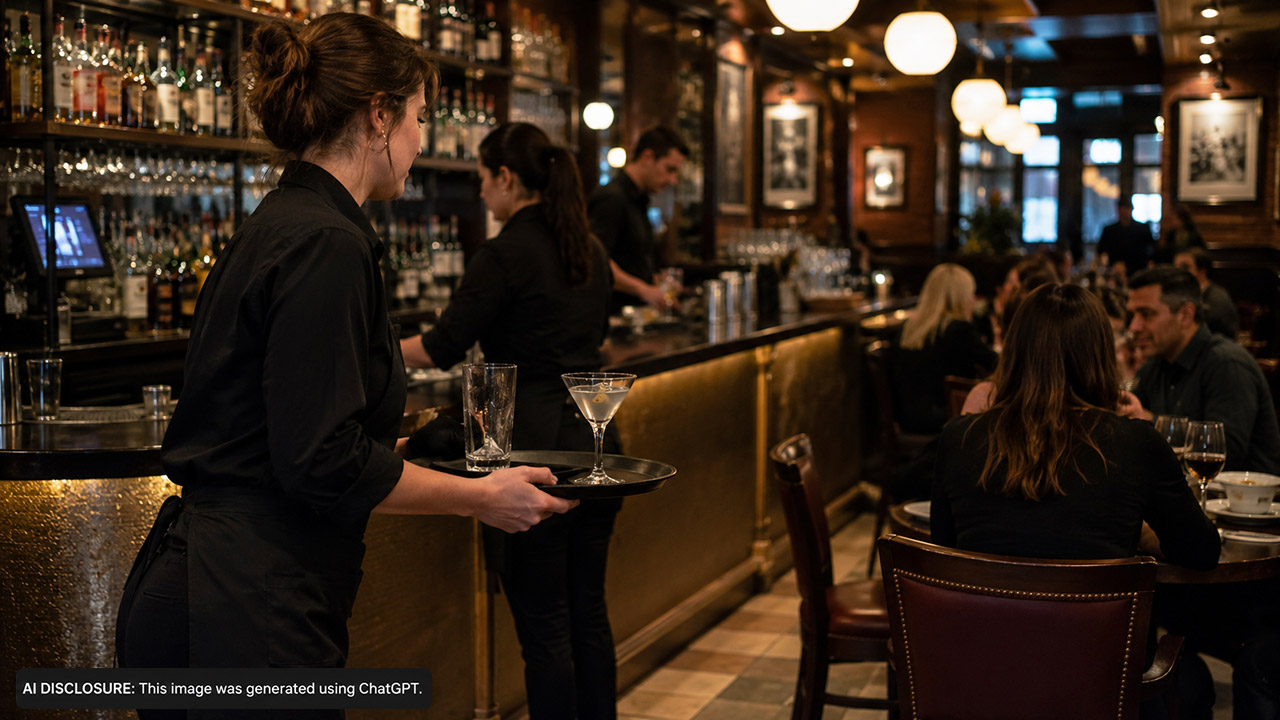
Photo credit: AI-generated image created using ChatGPT. Illustrative only
Walk into a sports-bar chain during a dinner rush and you can usually tell, at a glance, who’s running the floor: hosts at the stand, servers moving tables, bartenders juggling tickets. Federal regulators say that at Kickback Jack’s, a different pattern was hiding in plain sight—one where men almost never made it into those front-of-house roles.
The U.S. Equal Employment Opportunity Commission says the company behind the restaurants agreed to pay $1,111,300 to settle a lawsuit alleging sex-based hiring discrimination against male applicants, along with a long list of required changes. The details come from the EEOC’s announcement of the settlement, which describes what investigators and the agency’s lawyers say they found across 19 locations in three states.
The numbers that triggered a federal case
The EEOC sued Battleground Restaurants, Inc. and Battleground Restaurant Group, Inc., two North Carolina-based corporations operating as Kickback Jack’s. The agency’s claim wasn’t about one manager’s bad judgment on one hiring day—it described a systemwide pattern stretching across multiple stores.
According to the EEOC, Kickback Jack’s “systematically refused or failed to hire” men for non-managerial front-of-house jobs, including server, bartender, and host positions, going back to at least December 2019. Over a roughly 26-month window—from Dec. 1, 2019 to Feb. 18, 2022—the chain employed more than 2,100 people in those jobs at 19 locations in North Carolina, Virginia, and Tennessee.
Out of that group, the EEOC says only about 3% were male. Some restaurants allegedly had no male servers at all. If you’re a job applicant looking at a dining room where everyone in a certain role looks the same, it can feel like you already got your answer before you ever fill out the application.
From “preference” to Title VII allegations
The lawsuit was filed under Title VII of the Civil Rights Act of 1964, which bars employment discrimination based on sex. The EEOC’s allegations boil down to a common dynamic in service-industry hiring: the idea that certain front-of-house positions “fit” one gender better than another.
But Title VII doesn’t make room for that kind of sorting, even when an employer frames it as branding, customer preference, or “what works.” The EEOC said the companies had no legitimate business justification for excluding men from these jobs. The agency also alleged the employers failed to comply with Title VII recordkeeping regulations—an especially sharp point in hiring cases, where the paper trail often decides what can be proven.
EEOC Chair Andrea Lucas put it plainly in the announcement: “Hiring must be based on merit—not sex—as Title VII requires.” The agency emphasized that it views enforcement as “evenhanded,” regardless of whether the applicants shut out are women or men.
The case moved forward after talks didn’t settle it
Before filing suit, the EEOC attempted to resolve the matter through its voluntary conciliation process, which is basically the agency’s pre-lawsuit effort to negotiate a fix. That didn’t produce a deal, so the agency took it to court.
The case—Equal Employment Opportunity Commission v. Battleground Restaurants, Inc., and Battleground Restaurant Group, Inc. (Civil Action No. 1:24-cv-00792)—was filed in U.S. District Court for the Middle District of North Carolina, Greensboro Division.
That matters because the escalation to a federal lawsuit changes the stakes. It’s no longer an internal complaint or a back-and-forth with a local manager; it becomes a courtroom dispute where hiring data, application records, and testimony can be compelled and scrutinized.
The settlement: money for applicants, plus strict rules for the next three years
The payment—$1,111,300—goes to a class of male applicants, not to the federal government. But the money is only part of the settlement. The rest is a three-year consent decree that tells the company what it must do, and what it is prohibited from doing, moving forward.
Under that consent decree, Kickback Jack’s is barred from discriminating against qualified male applicants and from steering applicants into positions based on sex. It also can’t dispose of employment-application records, a key safeguard in a hiring case where missing paperwork can conveniently erase patterns.
The company must adopt policies prohibiting sex discrimination for employees and applicants, revise hiring procedures to keep sex out of decision-making, and offer interviews to any qualified applicant for an open position. It’s a direct hit at the informal gatekeeping that can happen when someone is screened out before ever getting face time.
There’s also a requirement aimed at optics and recruiting: the decree says Kickback Jack’s must include images of male servers in promotional materials that depict one or more front-of-house employees. In other words, the public-facing “this is who works here” messaging can’t quietly reinforce the same exclusion the EEOC says was happening behind the scenes.
Finally, the decree requires annual training on Title VII sex-discrimination rules for employees involved in hiring, plus periodic reporting to the EEOC about hiring practices. That reporting component is what turns a one-time settlement into ongoing oversight.
What people tend to focus on in hiring discrimination cases
The EEOC’s lead trial attorney, Joshua Kadel, highlighted the piece that frustrates applicants the most: hiring discrimination can be hard to spot in real time because “employee recruitment practices are often opaque,” and people may not realize they were rejected for an unlawful reason.
That’s typically where public reaction lands in cases like this—less on the courtroom filings and more on the practical question of how anyone proves it. The alleged recordkeeping problems matter because applications, interview notes, and hiring logs are often the only way to show a pattern across multiple locations.
The other thing people focus on is the “steering” issue. Even when someone does get hired, being pushed toward back-of-house work, or away from customer-facing roles, can create the same outcome as a flat rejection—just dressed up as a compromise.
And then there’s the number: 3% male across more than 2,100 front-of-house workers, with some stores allegedly having zero male servers. That kind of statistic is the sort of detail that makes people ask whether a company is truly running on neutral “best candidate” hiring, or whether the decision was effectively made before applications were even read.
Who may be eligible, and what happens next
The EEOC says male applicants who sought server, host, and/or bartender jobs at any of the defendants’ Kickback Jack’s restaurants in North Carolina, Tennessee, or Virginia—but weren’t hired, or were hired into a different position—may be claimants under the settlement. The agency encouraged potential claimants to contact the EEOC at 984-900-5910 or by email at KickbackJacks@eeoc.gov.
For the company, the next three years are about compliance: revised procedures, interviews for qualified applicants, training, records retention, and periodic reporting. For applicants, the settlement is both compensation and a promise—on paper, backed by a federal consent decree—that the next person who applies shouldn’t have to guess whether the job is actually open to them.
Check out more from Now Rundown:
- A Party of 12 Came Back a Month Later Demanding Their $80 Tip Refunded — My Restaurant Made Me Pay It
- Her Coworker Kept Filing the Same Complaint About Her After Being Warned — Then She Filed a Counter-Report With Every Email Documented
- Siblings Demanded Half of Their Sister’s $11 Million Inheritance — She Refused Because They Never Visited
- The Kid I Bullied in Middle School Just Interviewed for a Job on My Team — He Bombed It and I Didn’t Hire Him

Abbie Clark is the founder and editor of Now Rundown, covering the stories that hit households first—health, politics, insurance, home costs, scams, and the fine print people often learn too late.