Hospital Employee Asked for a Receptionist Job After Breaking Her Foot — the EEOC Says She Was Fired and Told Not to Reapply Until ‘Fully Recovered’
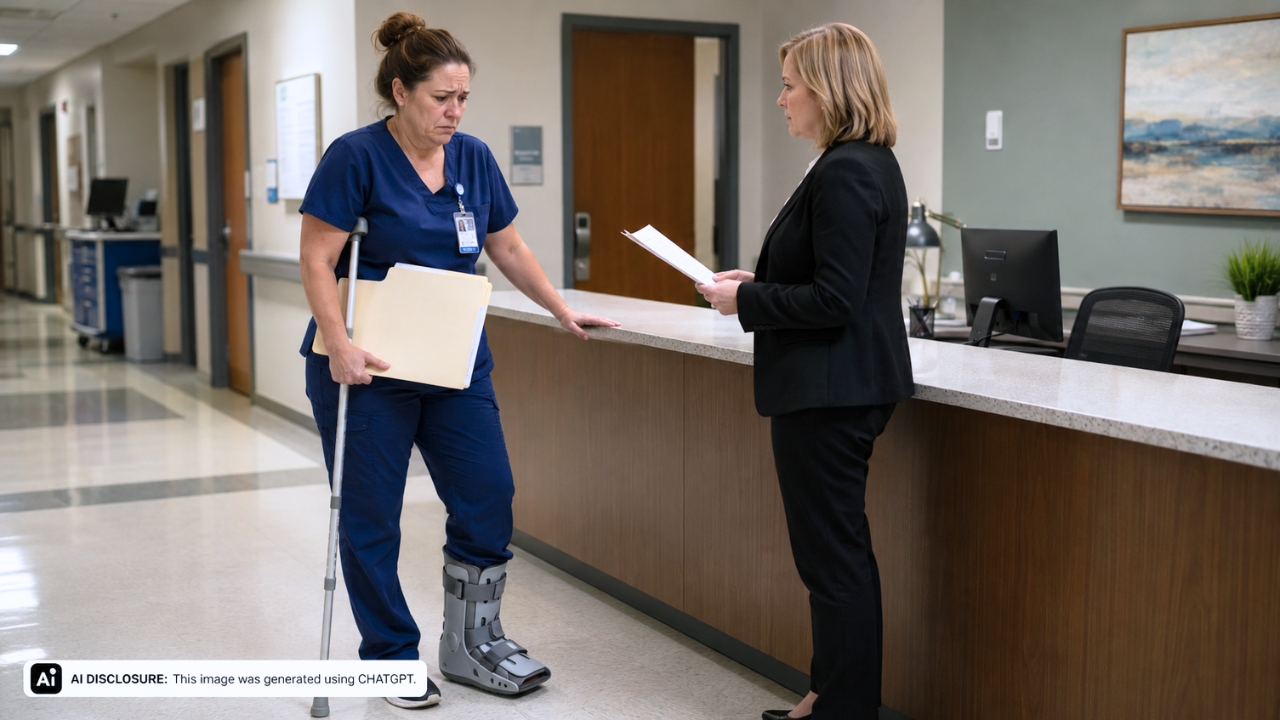
Photo credit: AI-generated image created using ChatGPT. Illustrative only.
A long-time hospital employee in Santa Fe says she did what workers are told to do when an injury changes what they can safely handle: she came back from leave, followed restrictions, and asked to be moved into a job she could do. The U.S. Equal Employment Opportunity Commission says that request didn’t lead to a new role — it led to a termination letter.
In a federal lawsuit announced by the EEOC’s press release, the agency alleges St. Vincent Hospital, which operates Christus St. Vincent Regional Medical Center (CSV), failed to accommodate the worker’s disability and fired her because of it, then told her she couldn’t be rehired until she was “fully recovered” or had “a release for full duty.”
She came back on light duty — then asked for a job that fit her limits
The EEOC’s complaint traces the dispute back to around 2021, when the employee fractured her foot and tore tendons in her ankle. She took medical leave, then returned to work under restrictions.
For months, the agency says, she worked light duty while still in a patient care position. That detail matters because patient care work can be physically demanding even when duties are “modified.” At some point, the worker requested something more lasting: reassignment to another job as a reasonable accommodation.
Instead of trying to squeeze her back into the same type of role, she asked to move into a different position that would match what her doctors allowed. It’s a common request in workplaces where injuries happen, and it typically comes down to one question: is there an open job the employee can do?
The receptionist opening was allegedly there — and she says she could do it
According to the EEOC, there was a vacant receptionist position available at the time — a job the employee could perform within her medical restrictions. Reassignment to a vacant position is one of the accommodations the Americans with Disabilities Act (ADA) contemplates when someone can’t do the essential duties of their current role.
The agency’s lawsuit alleges CSV did not reassign her to that receptionist opening. There’s no suggestion in the press release that the position wasn’t real, or that she was unqualified; the claim is that it existed and would have fit her limitations.
That’s where the story shifts from a frustrating workplace standoff to something with higher stakes. When an employer rejects an accommodation request, the next steps usually involve more paperwork, more conversations with HR, and sometimes a back-and-forth over medical documentation. The EEOC says CSV made a different move.
The firing letter is where the “fully recovered” language shows up
The EEOC alleges the hospital fired the employee rather than reassign her. The press release points to what CSV allegedly put in writing afterward: a termination letter stating she would not be eligible for rehire until she was “fully recovered” or had “a release for full duty.”
That kind of language is a flashing warning sign in disability cases because it treats “100% healed” as the price of admission. The EEOC’s regional attorney, Mary Jo O’Neill, said policies or practices requiring an employee with a disability to be fully recovered or to return at full duty levels violate the ADA.
The practical effect is easy to picture. If you’re injured and can still work — just not in the same physical capacity — being told “come back when you’re fully recovered” can function like an indefinite suspension. Income stops. Benefits may be jeopardized. And the employee is pushed out of the workplace at the exact moment she’s trying to stay attached to it.
Why the EEOC says the ADA required a different response
The ADA requires employers to provide reasonable accommodations to qualified employees with disabilities, absent undue hardship. The EEOC says reassignment to an open position is one of those accommodations, especially when an employee can no longer perform the essential duties of the job they already have.
In the press release, EEOC Phoenix District Director Melinda Caraballo framed it in plain terms: when an employee can’t do the essential duties of her current job due to a disability, reassignment to a vacant position should be considered as an accommodation under the ADA.
This case is also a reminder that “light duty” isn’t always a solution, even when it’s offered in good faith. Temporary modifications can keep someone working for a while, but if an injury becomes longer-term, a worker may need a permanent change — and that’s when reassignment requests tend to land on a manager’s desk with real urgency.
The EEOC says it attempted to resolve the matter before filing suit, going through its administrative conciliation process first. When that didn’t produce a settlement, it filed the case in U.S. District Court for the District of New Mexico: EEOC v. St. Vincent Hospital d/b/a Christus St. Vincent Regional Medical Center, Case No. 1:26-cv-00968.
What people tend to zero in on in cases like this
The press release doesn’t include public comments, but disputes like this typically turn on a few very grounded, document-heavy questions — the kind employees and managers argue about in real time while someone is trying to keep paying their bills.
First: whether the “vacant” position was truly available, and what the employer did (or didn’t do) to consider the employee for it. Second: what restrictions were on file and whether the employee could perform the receptionist job’s essential functions with those restrictions. And third: the paper trail — the termination letter language and any internal communications about “full duty” requirements.
The reason those details draw so much attention is simple: they can show whether this was a legitimate breakdown in process or a hard line that shut the door on disabled workers. A single phrase like “release for full duty” can become central because it implies the employer won’t even consider accommodations unless the worker returns to the same physical baseline as before.
The case now puts the hospital’s handling of the request under a microscope
For the employee at the center of the lawsuit, the alleged sequence is brutally direct: a serious foot and ankle injury, a return to work under restrictions, a request to move into an open receptionist role, and then termination paired with a warning not to come back until fully healed.
For the hospital, the lawsuit means its decision-making — and its “full duty” language — will be tested in federal court. The EEOC is seeking to prove that CSV’s response wasn’t just unhelpful, but illegal under the ADA.
And for other workers watching from the sidelines, it’s the kind of case that lands close to home: injuries happen, restrictions last longer than anyone wants, and the difference between a reassignment and a termination can decide whether someone stays in the workforce or gets forced out until their body meets a standard the law doesn’t require.

Abbie Clark is the founder and editor of Now Rundown, covering the stories that hit households first—health, politics, insurance, home costs, scams, and the fine print people often learn too late.