
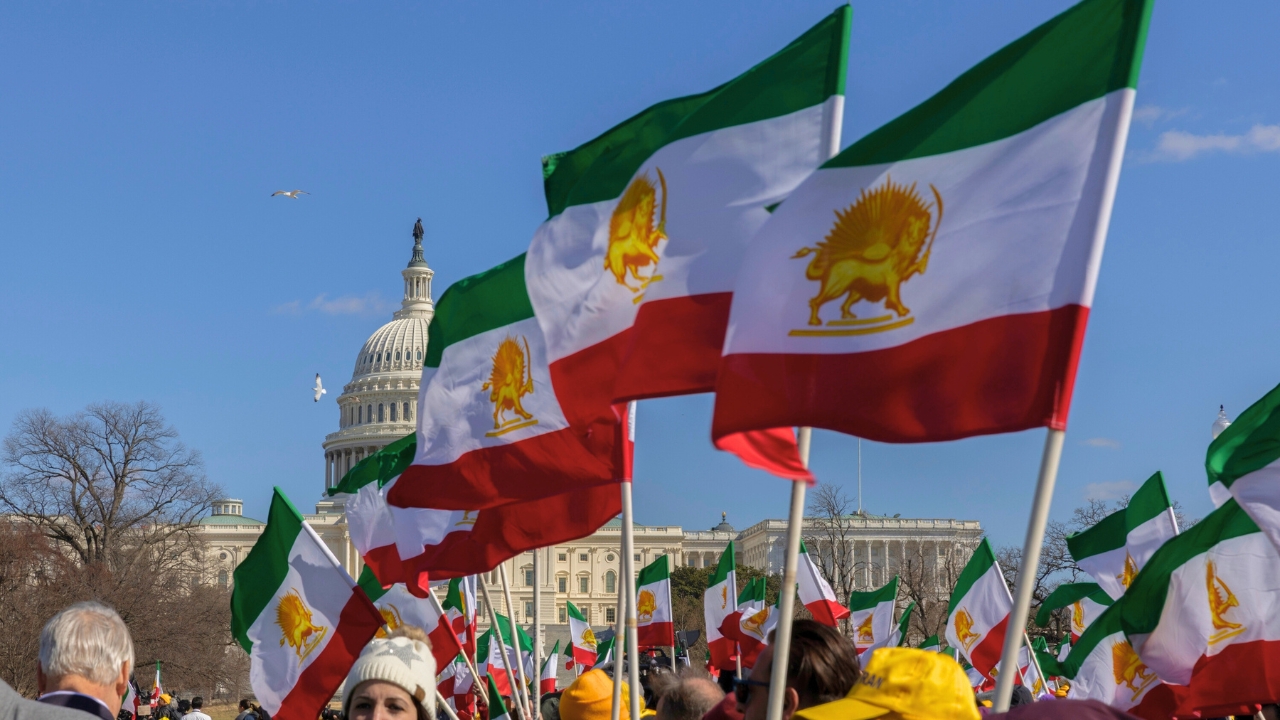
“Do Leftists literally stand for EVERY COUNTRY but America?????” critics ask as Iran flags appear at U.S. protests
A viral post asking, “Do Leftists literally stand for EVERY COUNTRY but America?????” ripped across X on Friday as protests over the U.S.-Israel strikes on Iran produced familiar images that critics say keep repeating: antiwar crowds, anti-U.S. foreign policy chants — and foreign flags in the frame.
The post, shared alongside protest video, listed a rolling timeline of recent flashpoints — Ukraine, Gaza, immigration, Venezuela and now Iran — and argued the same political coalition keeps showing up for overseas causes while looking uninterested in American interests. The claim is broad, political and not something that can be “proven” as a single fact. But the optics it points to are real — and they’re one reason these demonstrations routinely trigger backlash.
Hundreds gathered outside the White House on Saturday to protest the strikes and call for an end to escalation, according to The Washington Post. The paper reported organizers and participating groups included Code Pink D.C., 50501 D.C. and the Palestinian Youth Movement, and it noted demonstrators included people with Iranian roots worried about family in Iran.
What’s happening at these protests
Antiwar protests are often a coalition of groups that already exist for other fights — anti-intervention activists, immigration groups, progressive organizations, and diaspora communities. When the U.S. bombs or supports bombing overseas, those networks can mobilize quickly, and cameras immediately find the most visually striking symbols: flags, large signs, and anything that can be clipped into a 10-second video.
That’s why a foreign flag can become the entire narrative. For supporters of the rally, it can mean solidarity with civilians or simply cultural identity. For critics, it looks like public sympathy for whoever America is fighting — even if the protest’s stated message is “don’t start another war.”
Why it seems like left-wing activists back “every country but America”
There are a few reasons this perception keeps sticking — and why it keeps showing up across different issues:
The modern left has a strong anti-intervention reflex.
A major part of today’s activist left is built around opposing U.S. military action abroad. When the U.S. uses force, their default response is to protest Washington’s role first. To many voters, that reads less like “anti-war” and more like “anti-America,” because the loudest message in the clip is often opposition to U.S. action, not criticism of the foreign regime involved.
Coalition politics blends symbols across causes.
Activist groups often frame issues as connected — immigration enforcement, Gaza, U.S. foreign policy, sanctions, policing — and symbols travel with the coalition. This is why you sometimes see Palestinian flags at rallies that aren’t “about” Gaza. A 2025 report on Palestinian symbols showing up at anti-ICE protests described organizers and participants explicitly using “intersectionality” language to link the causes.
Diaspora participation makes foreign flags unavoidable.
In protests about Iran, Iranian Americans show up — and their identity is visible. The Washington Post’s reporting on the White House-area protest specifically mentioned an organizer with Iranian roots and concerns for family in Iran. That context rarely travels as far as the flag does.
Flags are a protest accelerant — and everyone knows it.
This isn’t unique to Iran. AP photo coverage of immigration protests has documented how Mexican flags became a national argument: conservatives called it anti-American, while others said it was pride in heritage and part of the American story. The same dynamic repeats every time a foreign flag becomes the most shareable image.
Why the backlash hits so hard
Because in U.S. politics, optics often beat nuance. A foreign flag at a protest about U.S. military action is easily packaged into one accusation: they’re rooting against us. And since many Americans already distrust activist politics, the clip doesn’t need to be “fair” to go viral — it only needs to confirm what a viewer already suspects.
The more complicated truth is that these crowds are mixed, motivations vary, and symbols mean different things to different people. But the viral post isn’t really arguing nuance — it’s arguing that the movement keeps choosing imagery that looks like America is the last priority.


