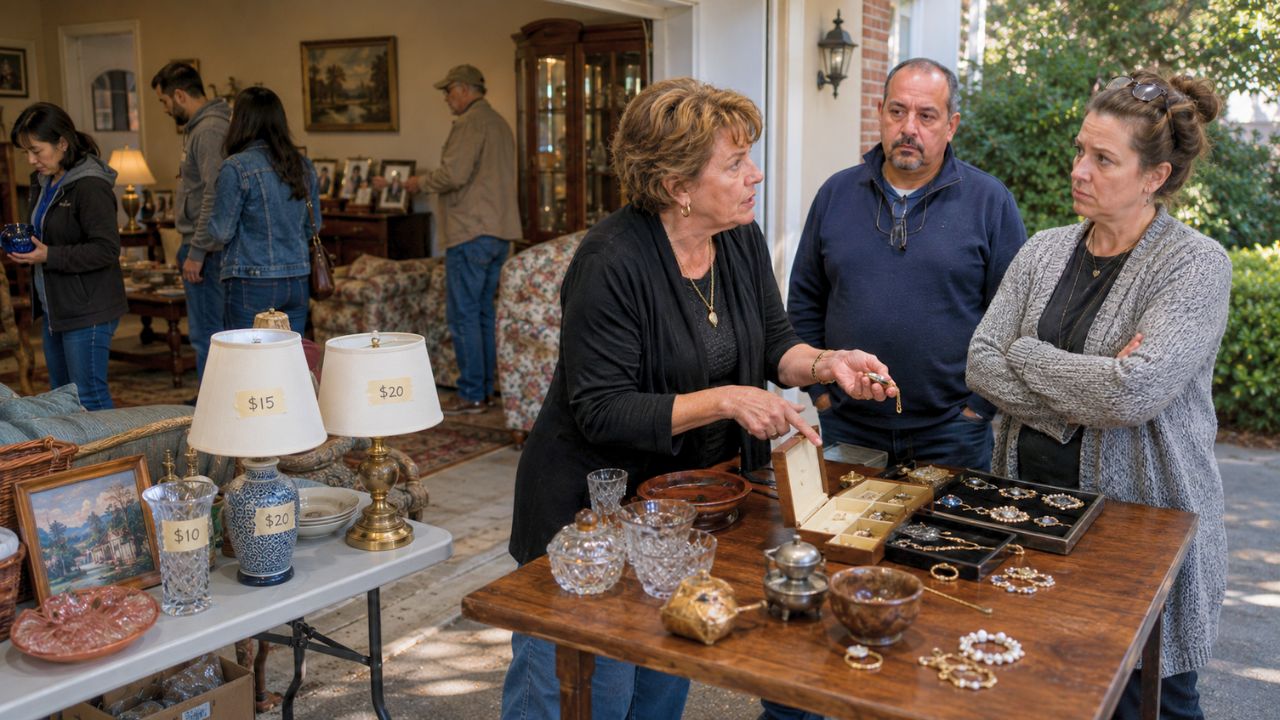
Aunt Brought a Witness to the Estate Sale to Claim the Family Jewelry
Photo credit: Rundown.com
The estate sale was supposed to be the clean, practical part of grief. A folding table in the driveway, masking tape labels on lamps, strangers filing through the living room trying not to look at the family photos still on the walls. I thought if we kept it simple—sell what we could, donate the rest, split the money three ways—my sister and I could finally breathe.
Then my aunt arrived with a man none of us recognized, and she walked in like she had an appointment.
The problem started before the first price tag went on
My grandmother had been the quiet center of our family. Not perfect, but steady. When she passed, the will was straightforward: her two daughters and my dad, her son, would divide what was left after the bills. Dad had died a few years earlier, so my sister and I stepped into his share, which my grandmother had updated correctly.
That update is what my aunt never forgave.
She’d spent months hinting that we “didn’t need” anything from Grandma because we were young and “had time.” She wanted the house to be kept “in the family,” meaning her family, meaning her. When the paperwork didn’t go her way, she pivoted hard into sentimental claims, especially anything small and valuable.
The jewelry became her favorite topic. A few pieces were genuinely meaningful: a slim wedding band, a locket with a tiny photo inside, a bracelet my grandmother wore so often it had polished itself against her skin. But there were also pieces that were just… jewelry. A pearl strand, some mid-century gold earrings, a ring with a stone that looked expensive if you didn’t know better.
My mom suggested we set anything personal aside before the sale. My sister and I agreed, and my other aunt did too. We put the most sentimental items in a small safe box and made a short list of what we’d chosen, mostly so no one would later swear something had “disappeared.”
It wasn’t meant to be a legal document. It was meant to keep the peace.
The estate sale was supposed to be simple
We held it at my grandmother’s house because it was easier than hauling everything away. The first morning, we had early shoppers lined up, the kind of people who bring tape measures and flashlights and ask how old the water heater is. My sister ran the cash box at the kitchen counter. I floated between rooms answering questions and trying not to cry when someone picked up Grandma’s teacups like they were nothing.
We’d decided the jewelry wouldn’t be out until later. Not because we were hiding it, but because we wanted to talk as a family one last time before anything changed hands. The pieces that might be sold were in a small zip pouch inside a drawer in the master bedroom, with my mom and sister aware of where it was.
We were doing everything the “responsible adult” way, which is exactly why it felt so jarring when my aunt showed up like she was storming a courthouse.
She came late morning, sunglasses still on, and she didn’t greet anyone. She walked straight through the front door, past the people browsing, and said she needed to “check on a few things.” Behind her was a man in a collared shirt holding a folder.
He didn’t look like a shopper. He looked like he’d rather be anywhere else.
She didn’t come alone, and it changed the whole mood
At first, I assumed he was a friend. Maybe she needed help lifting furniture. But he stayed close to her shoulder and kept glancing around like he was taking mental notes. When my sister asked who he was, my aunt said he was there to “witness” the division of property.
That word—witness—landed like a threat.
My other aunt stepped in and asked what my aunt meant. My aunt said she had concerns that “items were being withheld” and that she wanted someone impartial present to verify what was in the house. She said it in that careful, formal tone people use when they want to sound reasonable while they accuse you of something ugly.
Meanwhile, strangers were still standing in the hallway holding a set of candlesticks, watching a family argument unfold in real time.
My mom tried to guide everyone into the kitchen, away from customers. My aunt refused. She asked, loudly, where the jewelry was. Then she said she knew my grandmother had a “family set” and that it was supposed to go to her oldest daughter.
The problem was, that wasn’t true. There was no family set written into anything, and my grandmother had told us more than once she wanted my sister and me to have a few pieces because my dad wouldn’t be around to give us anything from her later. It was one of the rare times Grandma had been blunt.
My aunt didn’t want blunt. She wanted leverage.
The moment she tried to claim it, people stopped shopping
My sister kept her voice calm and said we weren’t discussing the jewelry in front of customers. She offered to talk after the sale hours or schedule a time when it was just family. My aunt waved that off and marched toward the bedroom like she owned the place.
I moved in front of the hallway and told her she couldn’t go back there. I didn’t touch her, but I blocked the path.
That’s when the “witness” finally spoke. He said he was there because my aunt had asked him to observe and document, and that he would “note any refusal” to allow access. He didn’t introduce himself properly, didn’t show anything official. He just held the folder like it made him important.
My mom asked if he was an attorney. He said he wasn’t. He said he worked in “legal services.” Which could mean anything and also nothing.
My aunt took that opening and announced to the room—customers included—that we were hiding jewelry and that she was making sure it was handled fairly. A woman holding a vintage handbag put it down and left. Another man looked at the front door like he suddenly remembered an appointment.
It wasn’t just embarrassing. It was disruptive, and it felt calculated. Like if she couldn’t get the jewelry, she’d at least ruin the day.
My other aunt, the one who’d actually been helping with the estate, told her to stop. My aunt accused her of being “bought off.” Then she demanded we open the drawer and show what was inside.
My sister finally snapped—not screaming, but firm. She said the jewelry had already been inventoried and would be distributed as outlined, and if my aunt had a problem she could put it in writing through the executor. No one was doing a jewelry parade in front of strangers.
My aunt responded by pulling out her phone and filming.
Family friends had plenty to say afterward
The rest of the sale ran, but the energy never recovered. People still bought items, but the easy friendliness was gone. A neighbor who’d known my grandmother for decades came over with a box for donations and gave me a look like she wanted to ask questions but didn’t want to make it worse.
Later, when the driveway finally cleared, my mom’s friend—someone who’d helped cook after the funeral—said quietly that bringing a “witness” felt like a stunt. Another family friend pointed out something that made my stomach drop: if my aunt was filming, she wasn’t there to resolve anything. She was there to build a story.
My sister was furious in a way I’d never seen. Not because of the jewelry itself, but because my aunt had turned a sad day into a spectacle. My other aunt looked exhausted, the kind of tired that comes from defending reality against someone committed to rewriting it.
Even the “witness” seemed uncomfortable by the end. He hovered near the door, no longer taking notes, like he’d realized he’d been brought into a family mess and didn’t know how to get out cleanly.
The fallout didn’t end when the sale did
That night, my aunt texted a long message saying she would be “pursuing her rightful inheritance” and that we’d “regret” being secretive. She also sent a blurry screenshot from her video and claimed it proved we were hiding things, even though it was just a clip of me standing in a hallway.
The executor—who was not my sister, not me, but a neutral third party my grandmother had chosen—was looped in the next morning. He told us not to engage directly and to keep everything documented. He also made it clear that a random “witness” at an estate sale didn’t override anything in the will or inventory process.
In the end, the jewelry that had been set aside stayed set aside. The sentimental pieces were distributed the way my grandmother had intended. A few items were appraised and sold properly later, not out of a zip pouch at a kitchen counter.
My aunt didn’t get what she came for, but she did accomplish something else: she cracked the family into sides that are still uncomfortable around each other. Holidays became careful. Group chats went quiet. My other aunt stopped answering calls unless she had to.
And my sister and I learned a lesson we never wanted: sometimes people don’t bring a witness because they’re right. They bring one because they want you to look wrong, no matter what you do.
The house is empty now. The tables are gone. The strangers have moved on to other sales. But that moment—her marching in, folder-man at her shoulder, demanding proof that we weren’t thieves—still hangs over everything like dust you can’t quite wipe away.
Check out more from Now Rundown:
- A Party of 12 Came Back a Month Later Demanding Their $80 Tip Refunded — My Restaurant Made Me Pay It
- Her Coworker Kept Filing the Same Complaint About Her After Being Warned — Then She Filed a Counter-Report With Every Email Documented
- Siblings Demanded Half of Their Sister’s $11 Million Inheritance — She Refused Because They Never Visited
- The Kid I Bullied in Middle School Just Interviewed for a Job on My Team — He Bombed It and I Didn’t Hire Him

Abbie Clark is the founder and editor of Now Rundown, covering the stories that hit households first—health, politics, insurance, home costs, scams, and the fine print people often learn too late.