Amber Rose fiercely defends Charlie Kirk’s widow from vicious online attacks
Photo credit: Saku_rata160520/Shutterstock.com
Amber Rose has stepped into one of the most emotionally charged corners of American political culture, publicly backing Erika Kirk as the widow of conservative activist Charlie Kirk faces a wave of online hostility. Her intervention links celebrity culture, partisan warfare and the raw grief of a young family still living with the fallout of an assassination that shocked the right.
By calling out what she describes as a punitive “woke” culture and insisting that grieving spouses should not be targets, Rose has turned her defense of Erika into a broader argument about empathy across ideological lines. The clash unfolding around the Kirks now doubles as a test of whether social media outrage will dictate how public figures are allowed to mourn, forgive and move forward.
Amber Rose steps into a political firestorm
Amber Rose’s decision to defend Erika Kirk did not emerge in a vacuum, it came after months in which the widow of Charles James Kirk had been dissected, mocked and second guessed across platforms. In a recent interview, Rose argued that “Unfortunately, the ‘woke’ left cancels people for having a different ideology,” framing the pile-on against Erika as part of a broader pattern in which political disagreement becomes a license for personal cruelty. She contrasted that with her own posture, saying that “Fortunately for” her, she does not care about being canceled and instead sees value in “open conversations,” a stance that casts her as a rare celebrity willing to risk backlash to defend a conservative figure’s spouse, as reflected in the detailed comments linked through Entertainment.
Her remarks landed squarely in a conservative media ecosystem that has already elevated the story of Charlie Kirk’s killing into a symbol of political violence and cultural division. Coverage that highlighted how Amber Rose had broken with much of Hollywood by defending a conservative widow quickly circulated on right leaning feeds. In that context, her comments were embraced not only as a gesture of personal solidarity but also as a cultural data point, suggesting that the instinct to shield a grieving spouse from harassment can, at least occasionally, override partisan reflexes.
Who Erika Kirk is beyond the backlash
To understand why Amber Rose’s defense resonated, it helps to look at who Erika Kirk is apart from the storm around her. Before her husband’s death, Erika had already built a profile as an entrepreneur and faith based content creator, serving as the CEO of Proclaim Streetwear and leading a ministry project called BIBLEin365, while also working in real estate and media. According to biographical details compiled on Erika Kirk, she also became closely associated with Turning Point USA, the youth focused conservative organization her husband helped turn into a powerhouse.
After the assassination, Erika’s role expanded from partner and collaborator to institutional leader and public face of a movement in mourning. Reporting on her trajectory notes that she stepped into a top leadership position at Turning Point USA, with one profile describing how she became the new CEO of the group and moved with their two young children to continue the work Charles James Kirk had championed. That transition, detailed in coverage of Why she took over the organization, underscores how her personal grief is inseparable from the institutional responsibilities she now carries.
The assassination that reshaped the right
The killing of Charlie Kirk is the dark backdrop to every argument now unfolding about his widow. Charles James Kirk, widely known as Charlie, was born October 14, 1993 and rose to prominence as a conservative activist, founding Turning Point USA and hosting The Charlie Kirk Show, before he was shot and killed at a university event in Utah. Biographical entries on Charles James Kirk and contemporaneous news reports describe how his death on September 10, 2025, instantly turned him into a martyr figure for many on the right.
Initial coverage of the shooting at Utah Valley University described how the conservative activist was gunned down during an event, with early “persons of interest” later released and supporters gathering to mourn. One account of the incident, which noted that a “Conservative” crowd chanted messages of love for him, captured the shock among attendees who had come to hear Charlie speak and instead watched him die. That moment, documented in reports on the Conservative activist’s death, set off a cascade of political commentary, security debates and conspiracy theories that still shape how Erika is perceived.
Inside the legal maze after the shooting
The criminal case that followed has been as tangled as the political reaction, adding another layer of strain for Erika Kirk and her family. Prosecutors have charged a young man named Robinson, identified as 22 years old, with capital murder, and he faces a possible death sentence if convicted of assassinating Kirk on Sept. 10. Court filings described in coverage of the prosecution note that the state has even debated whether to show graphic video of the shooting at upcoming hearings, with one report explaining that they would not play the footage if the defense agreed to stipulate to certain facts, a detail laid out in summaries of the case against Robinson.
At the same time, the defense has pushed back aggressively, with Left side courtroom photos showing Tyler Robinson seated next to his attorney Kathryn Nester as they argued that the prosecution team should be disqualified. In filings described in national coverage, they claimed conflicts of interest and potential misconduct, turning the case into a broader test of how the justice system handles a high profile political assassination. Those tensions are captured in reporting on Tyler Robinson, and they help explain why Erika’s every public move is scrutinized through both legal and political lenses.
False confessions and the hunt for Kirk’s killer
The investigation into Charlie Kirk’s assassination has been further complicated by a bizarre episode involving a false confession, which fueled confusion and online speculation. In the chaotic minutes after the shooting at Utah Valley University, a man stepped forward and claimed he had fired the fatal shots, only for investigators to later determine that he had lied. Court records show that this individual ultimately faced a charge of obstruction of justice, with one detailed account noting that he was prosecuted for the disruption he caused “In the” immediate aftermath of the attack, as described in coverage of the man who falsely claimed he shot Charlie Kirk.
Another man, George Zinn, 71, later admitted to falsely presenting himself as the conservative political activist’s killer and also acknowledged possessing child sexual abuse material, according to a separate set of court documents. He pleaded no contest to allegations that included the false confession and now faces a potential sentence of up to 15 years, a development that has only deepened public anger over those who sought attention off the back of Kirk’s death. Reporting on the case against George Zinn and the involvement of Ramon Antonio underscores how the legal process around Kirk’s killing has been marred by bad faith actors, further inflaming the online environment in which Erika is now trying to live her life.
Erika’s public grief and the criticism it sparked
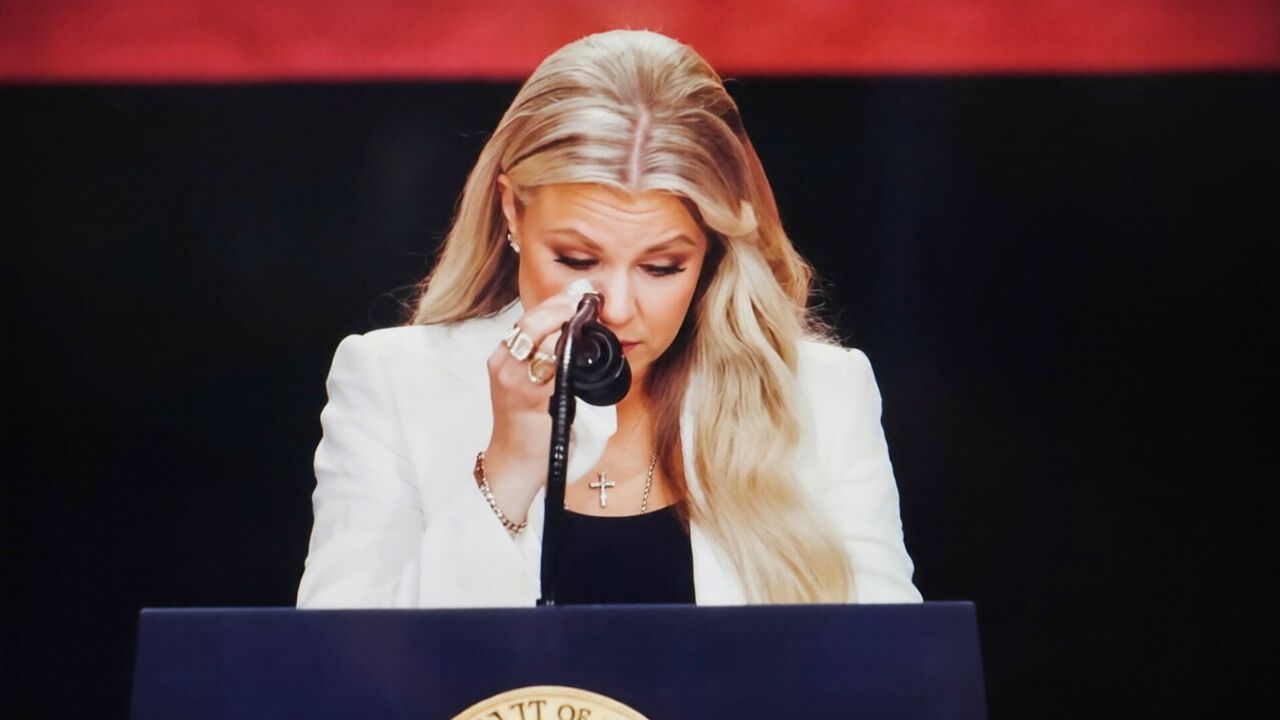
From the moment she stepped back into public view, Erika Kirk’s way of grieving has been treated as a political Rorschach test. In a widely shared memorial service, she stood before mourners and said through tears, “I forgive him,” referring to the man accused of killing her husband, adding that she did so because it was what Christ did and what Charlie would have done. That act of radical forgiveness, captured in coverage of her remarks about Christ and Charlie, drew admiration from some Christians and conservatives who saw it as a powerful expression of faith, but it also triggered skepticism and derision from critics who questioned her sincerity.
As weeks passed, Erika began posting more frequently about her life, her children and her work, only to find that every photo and caption became fodder for attack. In one video, Erica Kirk, as she was referred to in the clip’s description, directly addressed those who told her how a widow should behave, responding to a commenter with the blunt phrase “baby just stop” and insisting that no one outside her family could dictate her mourning process. That pushback, preserved in a recording of Erica Kirk speaking about the criticism, illustrates the emotional toll of living inside a feedback loop where strangers feel entitled to grade a widow’s grief in real time.
The Candace Owens rift and the right’s internal drama
Complicating Erika’s situation further is the fact that some of the harshest scrutiny has come not from the left but from within the conservative movement itself. Inside Candace Owens’ long running friendship with Charlie Kirk, which once saw them appear as best friends and frequent collaborators, tensions have reportedly flared since his death, with disputes over an audio recording linked to Erika and questions about how Turning Point USA is being run in his absence. A detailed account of this evolution, framed around the phrase “Inside Candace Owens,” traces how personal and professional disagreements spilled into public view, as described in reporting by Sehjal Gupta for Inside Candace Owens.
That same reporting, credited to Sehjal Gupta of TIMESOFINDIA and COM and timestamped in Jan at 04:30 IST, details how an “audio recording linked to Erika” became a flashpoint, feeding speculation and fueling factions inside the movement Charlie helped build. A follow up version of the story, which again cites Sehjal Gupta and the TIMESOFINDIA.COM byline, underscores how the controversy has given Erika’s detractors on the right new ammunition. For Amber Rose, stepping into this environment meant not only confronting ideological opponents but also implicitly challenging the appetite for internal drama that now surrounds Erika’s every move.
Turning Point USA, martyrdom and the culture war
Charlie Kirk’s assassination did more than devastate a family, it also jolted a sprawling conservative youth organization that had become a fixture on campuses and in right wing media. Analyses of the killing and its aftermath describe how Turning Point USA, headquartered in Phoenix, scrambled to preserve its influence and narrative after losing its most recognizable face, with one long form piece examining the “Charlie Kirk murder” and the group’s future in the city where it had grown into a major player. That reflection on the organization’s trajectory, linked through a discussion of the Turning Point USA murder in Phoenix, highlights how Erika’s leadership is now inseparable from debates about whether the group should double down on combative tactics or pivot toward a softer image.
At the same time, more formal accounts of the assassination, such as those compiled in reference style entries on the assassination of Charlie Kirk, emphasize the political symbolism that has attached to his death. For supporters, he is now a martyr whose killing proves that conservative speech is under violent threat, a framing that places enormous pressure on Erika to embody resilience and ideological purity. For critics, the same event is folded into broader arguments about polarization and radicalization, which in turn feed the online campaigns that Amber Rose is now publicly condemning.
What Amber Rose’s stand reveals about online outrage
Amber Rose’s intervention is striking because it cuts against the usual script in which celebrities either stay silent on polarizing political figures or join the chorus of condemnation. By explicitly tying the attacks on Erika to what she called a “woke” culture of cancellation, she framed the harassment as a symptom of a deeper intolerance for ideological diversity, even in moments of personal tragedy. Her comments, which appeared in an interview highlighted in Jan coverage of Charlie Kirk related entertainment news, suggest that she sees a distinction between criticizing ideas and targeting grieving families.

Abbie Clark is the founder and editor of Now Rundown, covering the stories that hit households first—health, politics, insurance, home costs, scams, and the fine print people often learn too late.