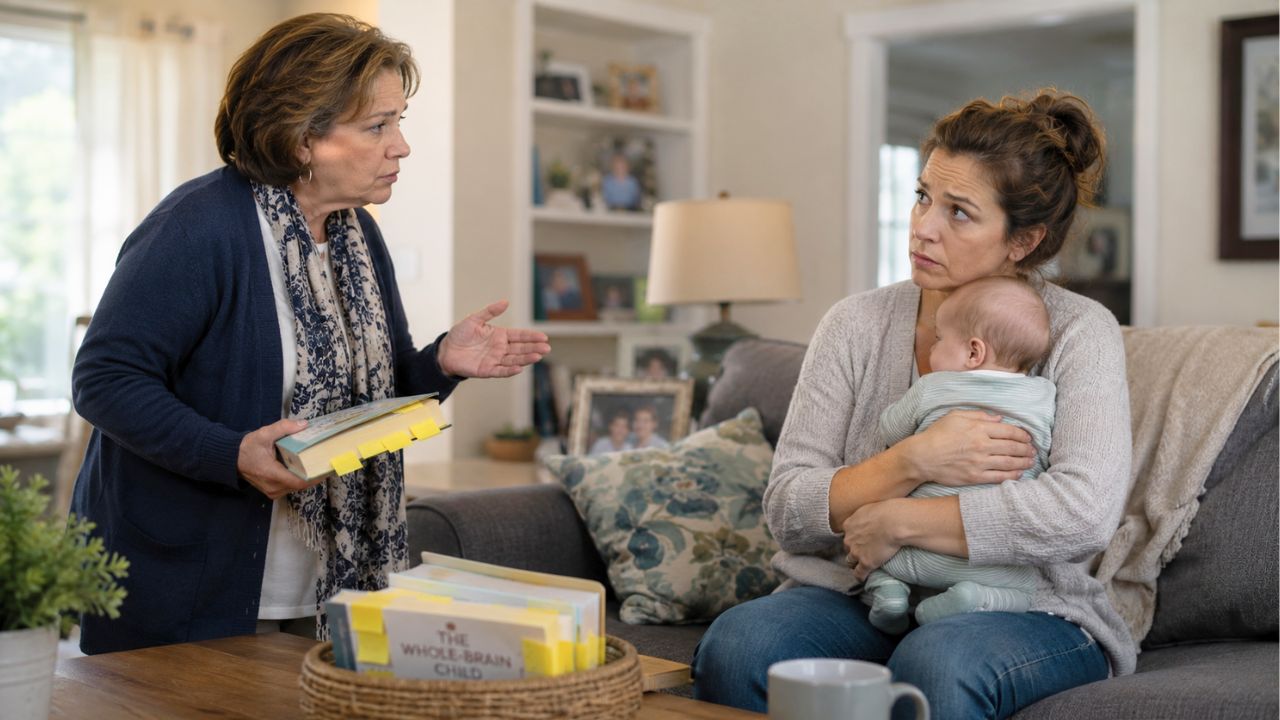
MIL Kept Leaving Parenting Books With Passages Highlighted and Sticky Notes Attached
Photo credit: Nowrundown.com
It started with a book on the nursery rocker like someone had been there when she wasn’t looking. The cover was bright and cheery, the kind meant to calm nervous new parents. But the pages were dog-eared, neon-highlighted, and studded with sticky notes that weren’t subtle at all.
Her mother-in-law didn’t say much at first. She didn’t have to. The notes said it for her, like little paper whispers left behind in a house that wasn’t hers.
The first highlighted page felt like a test
After their daughter was born, the couple tried to keep things simple: a short list of visitors, no pop-ins, and a routine they could actually survive on two hours of sleep. Her husband’s mom offered to “help,” which mostly meant hovering and narrating everything they did.
Then the books began appearing. A sleep-training guide left on the kitchen counter with a sticky note pointing at a passage about “letting babies self-soothe.” Another one on feeding, open to a section about “scheduled meals” with three sentences highlighted like evidence in a trial.
At first, the new mom tried to laugh it off. Maybe it was her mother-in-law’s clumsy way of feeling involved. But the notes weren’t warm. They weren’t suggestions. They read like instructions with a smiley face taped on top.
Her husband noticed, too, but he kept defaulting to the same line: she means well, she’s excited, let’s not make it a thing. The problem was, it was already a thing. It was in their living room, on their coffee table, in the baby’s room like a quiet critique.
The drop-offs got bolder as the baby got older
By four months, it wasn’t just one book. It was a rotating stack, each with new highlights, each with a note that somehow managed to sound polite and pointed at the same time. She started recognizing the pattern: the passages always “corrected” whatever choice they’d made that week.
If the baby went through a clingy phase, a book about “over-responding” showed up. If they mentioned starting solids later than she wanted, she “found” a guide about early feeding and left it by the high chair, open like a stage prop.
The mother-in-law never directly asked if they were reading them. She just waited for someone to mention it so she could swoop in with, “I left you something that might help.” And when they didn’t bite, she’d sigh and say, “It’s so hard to watch new parents struggle when there are so many resources.”
The new mom started feeling like she was being graded. She’d come downstairs in the morning and scan the counters, not for bottles, but for paperback criticism.
The confrontation didn’t happen at the baby shower—until it did
The breaking point came during a small family get-together hosted at their place. Her husband’s aunt had brought cupcakes, someone had balloons, and for once it felt like a normal afternoon. Then she walked into the hallway and saw it: another parenting book propped on the entry table like it was part of the decor.
This one wasn’t subtle. A sticky note was slapped on the front that said something like, “This is the one you need.” The highlighted section inside was about “discipline beginning in infancy,” and the note in the margin pointed out that “babies can manipulate if you let them.”
She felt her face go hot. Not because of the book, exactly. Because her mother-in-law had chosen a party with witnesses to make her point. It was a performance, and she was the target.
Instead of confronting her in the kitchen like she normally would have, she carried the book into the living room and placed it down in front of her mother-in-law. Calm voice, steady hands, not trying to create a scene—just refusing to be quietly shamed in her own house.
She told her they appreciated concern, but the book drops needed to stop. No more leaving things open to specific pages. No more notes. If she had a question, she could ask like an adult.
Her mother-in-law didn’t explode. She looked hurt in the way people do when they’ve been caught doing something unkind but want the spotlight on their feelings instead. She said she was only trying to help, that she was worried, and that the new mom was being “defensive.”
Then she turned to her son and asked if he agreed with his wife “talking to her like that.”
His reaction changed the whole power dynamic
For months, he’d been trying to keep everyone happy, which mostly meant letting his mom keep pushing until his wife swallowed it. But with the book sitting there and family members looking between them, he couldn’t pretend it was harmless anymore.
He said the book notes made them feel judged. He said he didn’t like finding “assignments” around the house. He didn’t raise his voice, but he didn’t soften it either.
His mom went quiet, then started listing everything she’d done for them: meals she’d dropped off, diapers she’d bought, the afternoon she watched the baby so they could nap. It was the classic move—turning a gift into a receipt and a boundary into ingratitude.
The aunt tried to smooth it over with a joke about parenting books being overwhelming. Someone else said all grandmas worry. But the new mom could feel the divide forming. Not everyone heard the same thing. Some heard a daughter-in-law being “too sensitive.” Others heard a mother-in-law refusing to respect the fact that the baby already had parents.
When the gathering ended, her mother-in-law left without taking the book with her. It stayed on the table like a dare.
She didn’t stop—she just got sneakier
For a couple of weeks, nothing happened. Then the new mom opened the mailbox and found a padded envelope addressed to them. Inside was yet another book, this time with passages tabbed and a note that implied it was a “peace offering.”
She found one in a grocery bag left by the back door after the mother-in-law had dropped off “a few things.” She found another on the passenger seat of her car after a family outing where her mother-in-law insisted on carrying the diaper bag.
That’s when it stopped feeling like overbearing advice and started feeling like a game. The new mom wasn’t imagining it anymore. This wasn’t about helping; it was about staying in charge without being told no.
So she changed the rules. Any book that showed up—left, mailed, hidden—went straight into a box in the hall closet. No discussion, no argument, no reading it just to prove she wasn’t stubborn. Her husband texted his mom that they weren’t accepting parenting material anymore and asked her to stop bringing it into their home.
His mom responded by calling his sister, who called him, who called them both “ungrateful.” Then an older cousin reached out to the new mom privately and admitted the mother-in-law had always done this, just with different topics. Diet plans. Marriage devotionals. Organizing systems. It was her way of controlling without saying the quiet part out loud.
People around them picked sides fast
Once the family heard about it, the story got simplified in the way family stories always do. Some relatives repeated it like the new mom had banned books. Others framed it like the mother-in-law was only trying to share her wisdom.
But the people who spent real time with them saw the pattern: it wasn’t one book. It wasn’t one note. It was the steady message underneath all of it—your instincts aren’t good enough, but mine are.
Even friends who didn’t love confrontation understood why it landed so badly. Parenting choices are personal, and postpartum already makes you feel like the whole world is watching. Having someone leave “corrective” literature around your home is like being scolded with stationery.
The mother-in-law tried one last angle: she offered to pay for a parenting course, saying it would be “fun for them to learn together.” Her son said no. After that, she went chilly, reduced her visits, and started asking for the baby to come to her house instead.
The couple said visits could happen, but not unsupervised, and not if she was going to keep taking little digs. She didn’t like that answer, so she called it “punishment.” They called it the natural result of ignoring a simple request.
Now the box of books is still in the closet, not thrown away, just contained. The new mom says it feels symbolic: she can’t control what her mother-in-law thinks, but she can control what gets planted in her home. Family gatherings are more careful. Conversations are more scripted. And her husband, finally, isn’t stuck in the middle—he’s standing where he should’ve been all along.
Check out more from Now Rundown:
- A Party of 12 Came Back a Month Later Demanding Their $80 Tip Refunded — My Restaurant Made Me Pay It
- Her Coworker Kept Filing the Same Complaint About Her After Being Warned — Then She Filed a Counter-Report With Every Email Documented
- Siblings Demanded Half of Their Sister’s $11 Million Inheritance — She Refused Because They Never Visited
- The Kid I Bullied in Middle School Just Interviewed for a Job on My Team — He Bombed It and I Didn’t Hire Him

Abbie Clark is the founder and editor of Now Rundown, covering the stories that hit households first—health, politics, insurance, home costs, scams, and the fine print people often learn too late.