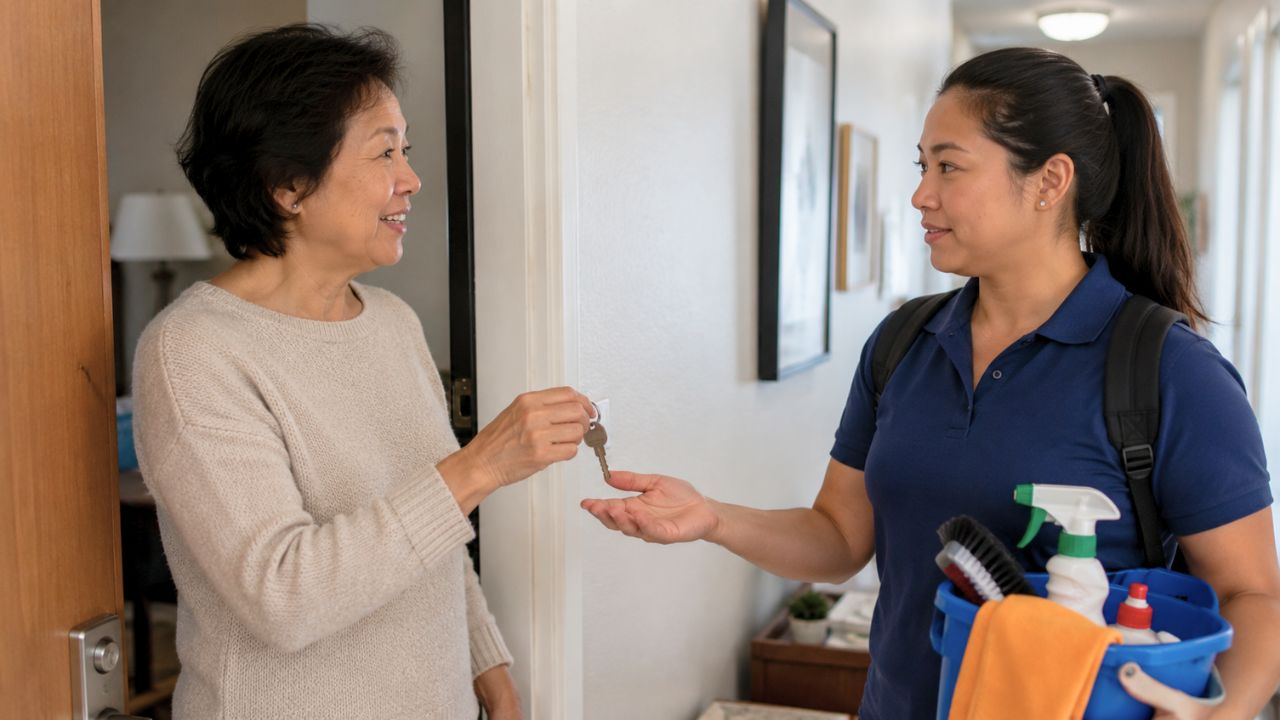
MIL Hired a Cleaning Service and Gave Them a Key to the Apartment
Photo credit: Nowrundown.com
Jules realized something was off the second she stepped into the apartment and caught a sharp, citrusy cleaner smell that didn’t match anything under her sink. The place looked too perfect, too staged—throw pillows squared, the bathmat hanging like it had been measured, even the dish towel folded into a little rectangle. Her stomach dropped before she could talk herself out of it.
Then she noticed it: the spare key hook by the entry was empty.
When her husband, Ben, came out of the bedroom holding a sock like he’d just been interrupted mid-routine, she asked the simplest question possible—did you have someone in here?
Ben’s face did that slow shift from confusion to dread. He didn’t answer right away, which told her everything.
The problem started before the big blowup
Jules and Ben had moved into the apartment six months earlier, a fresh start after a messy year of job changes and family stress. It was small but cozy, and Jules loved that it finally felt like theirs. No childhood furniture. No hand-me-downs that came with strings. Just the two of them and their routines.
Ben’s mom, Marianne, did not love that. She’d always been the kind of parent who treated “helping” like a form of access. She brought bags of groceries they didn’t ask for. She rearranged cabinets when she visited. She made comments about dust on baseboards like she was conducting an inspection.
Jules tried to keep things polite because Ben was close to his mom, and he kept saying she meant well. But “meaning well” had started to look a lot like Marianne deciding she knew best, even in a home that wasn’t hers.
The key issue had already been a sore spot. Early on, Marianne pushed for a spare “in case of emergencies,” and Ben—trying to keep the peace—had given her one. Jules had found out afterward, not because Ben wanted to hide it, but because he genuinely didn’t think it was a big deal. They’d argued for two days, then reached a compromise: Marianne could keep it, but she wasn’t allowed to use it without asking first.
Apparently, Marianne heard, “Keep it and do whatever you want.”
The day the apartment stopped feeling like theirs
Ben finally told her what happened, and it came out in chunks, like he was hoping he could soften it with enough pauses. Marianne had texted him that morning saying she wanted to do something nice for them. She’d “found a deal” on a cleaning service and thought it would be a treat since Jules had been working longer hours.
Ben had replied with something noncommittal, the kind of message that’s supposed to be polite but isn’t actually an agreement. He figured she’d drop it or at least ask again. Instead, she booked it.
And because the service needed access while both Jules and Ben were at work, Marianne gave them the spare key.
Not only that—she also told the cleaners to “take care of everything,” including their bedroom and the small office Jules used for remote days. Jules stood in the hallway, looking at the too-perfect couch cushions, and felt her cheeks get hot. This wasn’t someone tidying up a shared family home. This was strangers touching their laundry hamper, opening drawers, moving personal things around.
She walked straight into the bedroom and opened the nightstand. The drawer was slightly crooked, like it had been taken out and shoved back in. It wasn’t even about what was inside. It was the fact that it had been opened at all.
Ben kept saying, quietly, that he didn’t know it would go that far. Jules didn’t yell. She didn’t have the energy for yelling. She just asked him why his mother still had a key if she couldn’t be trusted to treat their space like it was private.
Ben didn’t have a good answer.
When Jules confronted Marianne, it got worse fast
Jules called Marianne that evening. She tried to start calmly, even though her hands were shaking. She said she understood the intention but that it was not okay to send anyone into their home without permission, especially with a key.
Marianne didn’t apologize. She acted offended, like Jules had accused her of something cruel instead of pointing out a basic violation. She insisted she was “just helping,” and then pivoted into a lecture about how adults these days were too sensitive and didn’t know how to accept generosity.
Then she said the thing that flipped Jules from upset to stunned: she’d stopped by during the cleaning, too. Not inside for long, just to “check on things.” As if that made it better.
Jules asked whether Marianne had told the cleaners she was the homeowner. Marianne brushed it off and said it didn’t matter because she had the key. That line landed like a slap.
Ben finally stepped in, taking the phone and telling his mom she couldn’t do that again. He asked for the key back. Marianne refused, saying it was for emergencies and she wasn’t giving it up because Jules was “making a big deal over a clean bathroom.”
It turned into a circular argument: Marianne insisting she was the victim, Ben trying to be firm without sounding “disrespectful,” and Jules sitting on the edge of the couch feeling like a guest in her own place.
After the call ended, Jules said the one thing she’d been thinking since she smelled the cleaner: they needed to change the locks.
The fallout hit Ben right in the middle
Ben hesitated, not because he didn’t agree, but because he knew what it would trigger. Changing the locks would be a statement Marianne couldn’t ignore. It would make the problem real. It would also guarantee a blowup.
Jules didn’t give him an ultimatum. She just told him she couldn’t relax knowing someone else could let themselves in whenever they felt like it. She couldn’t sleep with that little click in her brain saying, What if she comes in again? What if she lets someone else in again?
So the next morning, Ben called their landlord and arranged for a lock change. He paid the fee and didn’t tell his mom first. Jules watched him do it and felt a mix of relief and sadness. Relief because finally, their home would be their home. Sadness because it shouldn’t have taken strangers vacuuming their bedroom to get there.
When Marianne found out, she did exactly what Ben feared. She didn’t call him. She called his sister. Then his aunt. Then she started sending a stream of messages about how she was being shut out, how she was “treated like a criminal,” how Jules was controlling him.
Ben’s sister texted him asking why he was “letting things go this far” and reminding him that their mom was lonely. Jules stared at that message for a long time. Lonely didn’t equal entitled. Lonely didn’t equal keys and access and decisions.
Ben tried to respond gently, but he didn’t back down. He said it wasn’t about love; it was about permission.
Friends and family picked sides in a way Jules didn’t expect
What surprised Jules wasn’t that Marianne complained—it was how quickly other people echoed her. One cousin messaged Ben about “honoring your mother.” A family friend suggested Jules should be grateful because cleaning services were expensive and “not everyone gets that kind of help.”
But outside Ben’s family bubble, the reaction was immediate and blunt. Jules’ best friend asked whether the cleaners could have copied the key. A coworker told her she’d be changing the locks and adding a camera the same day. Even their downstairs neighbor, when Jules mentioned a lock change in the hallway, gave her a look and said, carefully, that letting strangers in through a spare key was “a lot.”
That’s what made Jules feel less crazy. Not because she needed everyone to agree with her, but because the situation had been framed like she was ungrateful and dramatic. Hearing people call it what it was—intrusive, unsafe, disrespectful—snapped her back into reality.
Marianne, meanwhile, didn’t seem capable of seeing it from any angle except her own. She sent Ben a long message listing everything she’d ever done for him and ending with a note that she would be “waiting for an apology.”
Jules didn’t respond at all. She’d learned that every reply became more fuel.
The apartment was clean, but nothing else was
For a few days after the lock change, Jules kept noticing little things that made her chest tighten: a chair pulled out slightly, a cupboard door that didn’t close smoothly, the faint smell of the cleaner trapped in fabric. She rewiped countertops that were already spotless, not because they needed it, but because she needed to feel like she was reclaiming her space.
Ben was quieter than usual. He didn’t defend his mom, but he also looked like someone grieving the version of his family he wished he had. One night, he admitted he’d spent years smoothing things over and calling it love. He said he didn’t realize how much he’d normalized until Jules moved in and started asking questions he’d never asked himself.
Marianne didn’t stop. She tried to drop off food and demanded to be let in “to talk like adults.” When Ben met her outside instead, she cried in the parking lot loud enough for other tenants to glance out their windows. She told him she felt unsafe not having a key. Ben said, evenly, that they were the ones who had felt unsafe.
They’re not fully no-contact, but they’re not pretending, either. Marianne gets invited over when both Jules and Ben agree, and she doesn’t come in when they’re not home. The spare key is gone. The cleaning service never came back, and Jules can’t decide if she hates that citrus smell because it reminds her of intrusion, or because it reminds her of how quickly “help” can turn into control.
What lingers isn’t the mess the cleaners erased. It’s the fact that Marianne didn’t just cross a line—she acted like the line never existed. And now that Jules and Ben have drawn it in permanent ink, the family is learning they actually mean it.
Check out more from Now Rundown:
- A Party of 12 Came Back a Month Later Demanding Their $80 Tip Refunded — My Restaurant Made Me Pay It
- Her Coworker Kept Filing the Same Complaint About Her After Being Warned — Then She Filed a Counter-Report With Every Email Documented
- Siblings Demanded Half of Their Sister’s $11 Million Inheritance — She Refused Because They Never Visited
- The Kid I Bullied in Middle School Just Interviewed for a Job on My Team — He Bombed It and I Didn’t Hire Him

Abbie Clark is the founder and editor of Now Rundown, covering the stories that hit households first—health, politics, insurance, home costs, scams, and the fine print people often learn too late.