Divorced Father Was Held in Contempt and Cut to Three Supervised Hours a Week With His Children — an Appeals Court Undid the Custody Change
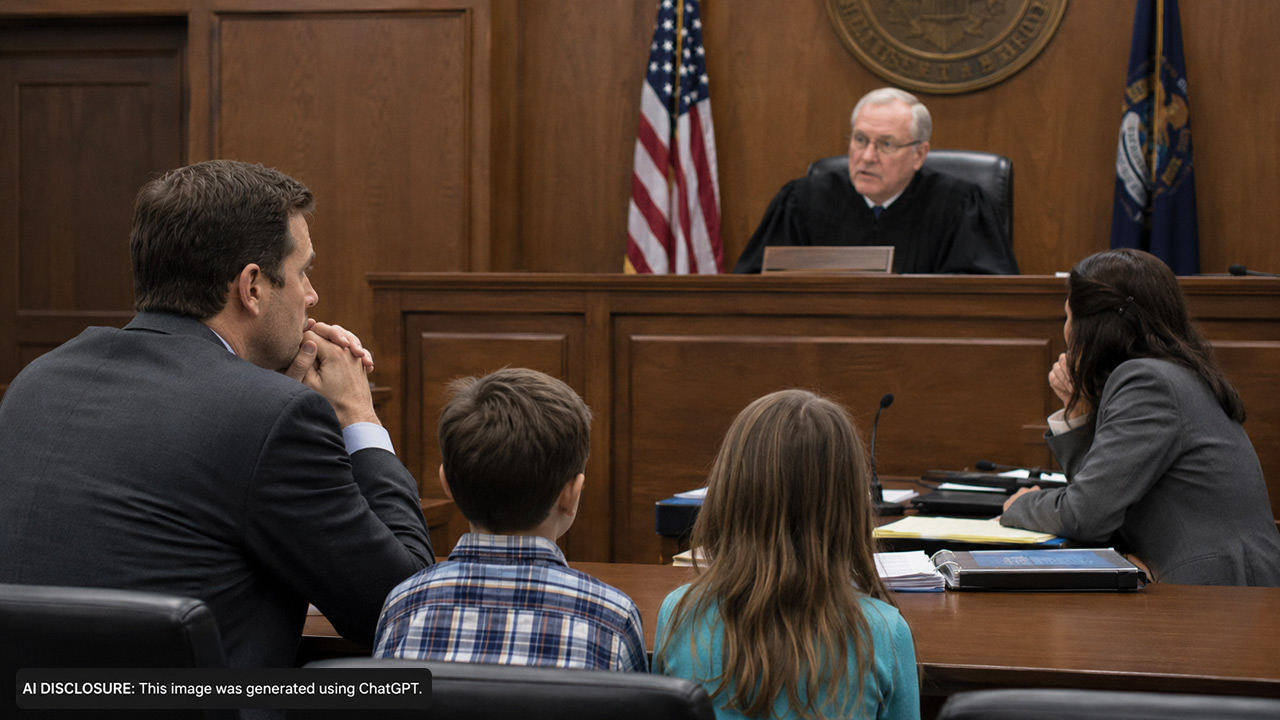
Photo credit: AI-generated image created using ChatGPT. Illustrative only
A bitter co-parenting breakdown in Arizona ended with a trial judge sharply cutting a father’s time with his kids and handing mom full control over major decisions. But the state appeals court stepped in and said the punishment went too far, even while agreeing the father had crossed lines set out in the parties’ court-approved parenting plan.
In an August 2026 decision, the Arizona Court of Appeals reviewed the case of Jeffrey and Betty Boettcher, a divorced couple with three minor children, in the court’s opinion. The panel upheld a contempt finding against the father for violating specific conduct rules in the parenting plan—but threw out the parts of the order that changed legal decision-making and slashed his parenting time to three supervised hours a week.
A parenting plan that was supposed to keep the peace
The couple’s divorce was finalized in late 2022 through a consent decree. The decree provided for joint legal decision-making and roughly equal parenting time, pointing to a joint parenting plan “attached hereto and incorporated herein as Exhibit A.”
That plan wasn’t just a schedule. It included basic behavioral ground rules aimed at keeping the children out of adult conflict: no interrogating the kids, no arguing in front of them, no disparaging the other parent, and no interference with the other parent’s relationship with the children.
Even on paper, the court later described the co-parenting relationship as contentious, attributing much of it to the father’s “temper, unreasonableness, and inability to let any slight, perceived or real, go.” Whatever the intentions in 2022, the family was heading toward repeat courtroom visits.
Escalation: modification fights, a protection order, and a recorded call
By March 2024, the mother asked the court to modify the parenting plan, alleging repeated violations. One allegation mentioned in the appellate opinion was that the father verbally abused the oldest child at a sports practice.
An evidentiary hearing followed in September 2025. The court kept joint legal decision-making in place, but added a significant power shift: if the parents couldn’t reach agreement in good faith, the mother would have final say. Around that time, the mother also obtained a no-contact order of protection against the father.
Then came the enforcement push. In November 2025, the mother petitioned to enforce the parenting plan and hold the father in contempt after a phone call with their oldest daughter. According to the court, the father “aggressively disparaged” the mother during the call, and the daughter cried. The mother provided a recording to the court and asked for serious remedies, including a behavioral health evaluation, supervised parenting time, and parental education classes.
The contempt ruling came with life-changing consequences
After another evidentiary hearing in March 2026, the superior court found the father in contempt. The judge concluded he knowingly and willfully violated specific restrictions in the consent decree and parenting plan.
The sanctions were heavy. The court awarded the mother sole legal decision-making authority and reduced the father’s parenting time to three supervised hours per week. The court also ordered him to undergo a forensic psychological evaluation and complete a parenting class, saying the evidence raised questions about his mental health.
The father tried to undo the contempt finding, arguing there wasn’t a valid court order to support it. His position was that the parenting plan wasn’t enforceable through contempt because it wasn’t properly ordered by the court.
The superior court rejected that argument, and the dispute moved up to the Court of Appeals through a “special action” procedure—used because contempt findings and resulting civil sanctions generally aren’t directly appealable in Arizona.
The appeals court drew a hard line: enforceable plan, but no backdoor custody changes
The appeals court split the difference. First, it agreed the father could be held in contempt based on the parenting plan because it had been incorporated by reference into the court-signed consent decree.
The opinion pointed to Arizona law stating that terms “set forth or incorporated by reference in the decree are enforceable by all remedies available for enforcement of a judgment, including contempt.” In other words, even if an agreement retains contractual status when incorporated by reference, the court can still enforce it through contempt.
The panel also took the unusual step of striking an apparently false quotation the father included in filings—language suggesting contempt is “legally impossible” without a valid order—because the cited cases didn’t contain it and the court couldn’t find the quote in Arizona case law. The court declined to impose sanctions over it, but the warning was clear: hallucinated or fabricated quotations are a serious problem.
But when it came to the punishment, the appeals court said the superior court abused its discretion by using contempt sanctions to effectively rewrite custody and parenting time without following the statutory requirements for doing that.
The key issue was procedure and safeguards. Arizona law requires specific steps before legal decision-making can be modified, including a modification petition and a modification hearing. And when parenting time or decision-making is changed, the court must consider and make findings on the best-interests factors listed in Section 25-403(A).
Here, the appeals court said there was no pending modification petition and the enforcement/contempt hearing was not a modification hearing. That meant the superior court didn’t take testimony geared toward best interests and didn’t make the required best-interests findings.
There was another major problem: contempt sanctions must include a “purge” condition—something the person can do to come back into compliance and avoid the sanction. The court found the father had no way to prevent the parenting-time cut and decision-making change from taking effect. That, the panel said, doesn’t fit how civil contempt is supposed to work.
The result: the contempt finding stayed, but the custody and parenting-time modifications were vacated. The appeals court left the psychological evaluation and parenting class in place, noting the father had consented to them and therefore waived challenges to those parts of the order.
The practical lesson people latched onto: courts can punish, but not by using kids as leverage
Even without a comments section in the court record, the opinion reads like a response to a familiar public reaction: if a parent is behaving badly, why shouldn’t a judge immediately cut them off?
The appeals court’s answer was that custody isn’t supposed to function as a punishment tool. The opinion cited a longstanding principle that punishment “is not to be visited on the children” and that custody “is not to be used as a reward or punishment of parental conduct.” If parenting time has to be restricted for safety, the court can do that—but it must do it through the legal framework designed to protect children’s best interests, with evidence and required findings.
At the same time, the decision underscores that “general terms of conduct” in a parenting plan are not just polite suggestions. If they’re incorporated into a decree, they can be enforced with contempt, especially when the alleged violations are documented—like the recorded call described in this case.
The Boettcher case now sits in a tense middle ground: the father remains in contempt, but the most extreme custody changes the trial judge imposed through that contempt order can’t stand. The message from the appeals court is narrow but forceful—enforcement is real, and so are the procedural limits when children’s time and decision-making are on the line.
Check out more from Now Rundown:
- A Party of 12 Came Back a Month Later Demanding Their $80 Tip Refunded — My Restaurant Made Me Pay It
- Her Coworker Kept Filing the Same Complaint About Her After Being Warned — Then She Filed a Counter-Report With Every Email Documented
- Siblings Demanded Half of Their Sister’s $11 Million Inheritance — She Refused Because They Never Visited
- The Kid I Bullied in Middle School Just Interviewed for a Job on My Team — He Bombed It and I Didn’t Hire Him

Abbie Clark is the founder and editor of Now Rundown, covering the stories that hit households first—health, politics, insurance, home costs, scams, and the fine print people often learn too late.