Longtime Female Van Driver Was Suspended and Fired Over a Van Lift Incident — a Male Driver’s Nearly Identical Incident Months Earlier Drew No Discipline
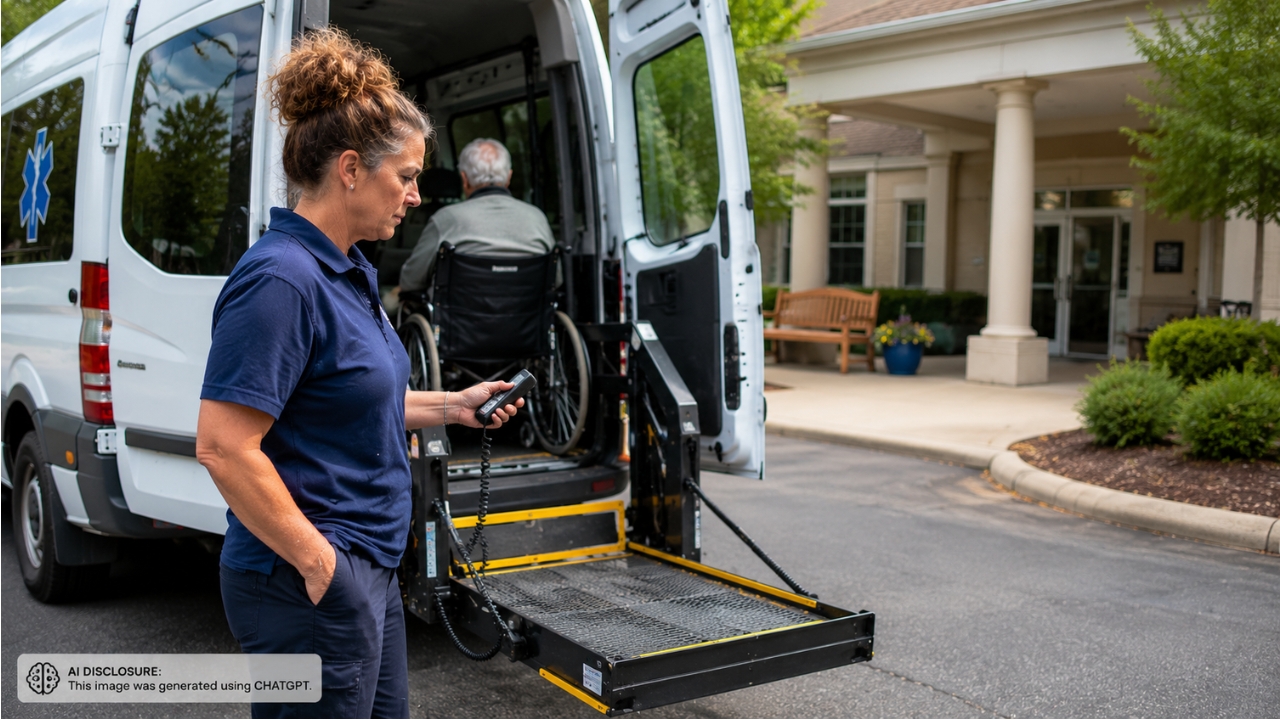
Photo credit: AI-generated image created using ChatGPT. Illustrative only.
A longtime van driver at a Maryland healthcare facility allegedly watched her job unravel over a lift problem that wasn’t treated the same way when it happened to a man. The U.S. Equal Employment Opportunity Commission says the woman was suspended and then fired after a van lift mishap—only months after a male driver had a nearly identical lift problem and kept working without discipline.
The EEOC laid out the allegation in the original post announcing a federal lawsuit against TidalHealth, the operator of TidalHealth McCready Pavilion in Crisfield on Maryland’s Eastern Shore. The agency says the split response wasn’t a one-off judgment call, but sex discrimination.
A routine job with real safety stakes
On paper, being a facility van driver can sound straightforward: pick people up, drop them off, keep a schedule. In reality, it’s a job built around mobility equipment, careful timing, and safety checks that have to be right every time—especially when a vehicle lift is involved.
The EEOC’s lawsuit focuses on one of those moments: a lift-related problem. The agency doesn’t describe the lift malfunction in detail, but it frames the issue as conduct serious enough that TidalHealth used it as a basis to suspend and terminate a veteran female employee who drove the van.
That’s what makes the comparison central to the case. The EEOC says another driver—male, also a van driver—had a nearly identical lift problem just months earlier. His employment status didn’t change. No suspension. No termination. Nothing, according to the agency.
Two similar lift problems, two very different outcomes
The timeline described by the EEOC is blunt: a male driver has a van lift problem and receives no discipline. A few months later, a female driver has a similar lift problem and is first suspended, then fired.
The heart of the allegation isn’t that employers can’t discipline mistakes. It’s that the standard has to be applied evenly. The EEOC is essentially saying TidalHealth treated the two drivers as if they were operating under different rulebooks.
In the agency’s view, that difference wasn’t based on seniority, job duties, or some clearly spelled-out policy change. It was based on sex. That’s why the suit is being brought under Title VII of the Civil Rights Act of 1964, the federal law that prohibits sex discrimination in employment.
How the EEOC says the decision crossed the line
The EEOC’s announcement includes a direct warning to employers about discipline that looks consistent on paper but plays out differently in practice. “While employers are free to maintain performance and disciplinary standards, applying them in a sex-discriminatory manner violates federal law,” said Debra Lawrence, regional attorney for the EEOC’s Philadelphia District.
She added that firing a woman for conduct that didn’t even draw discipline for a similarly situated man is unequal treatment—and unlawful. That “similarly situated” phrasing matters, because it gets to the usual workplace defense: that two people weren’t really comparable even if their job titles matched.
The EEOC is taking the position that the two drivers were comparable enough that the gulf in punishment is what stands out. And because the woman’s punishment escalated from suspension to termination, the stakes weren’t just a write-up or a bad week. The allegation is that she lost her job over something a man didn’t even get reprimanded for.
The fight moved from the workplace to federal court
The lawsuit is filed as EEOC v. TidalHealth Peninsula Regional, Inc., and TidalHealth, Inc., Case No. 1:26-cv-02201-ABA, in U.S. District Court for the District of Maryland Northern Division. The EEOC says it first attempted to resolve the matter through its administrative process, including conciliation—a pre-lawsuit effort to settle.
When that didn’t produce an agreement, the case shifted into litigation. That move tends to harden the dispute: the employer has to respond in court, and the agency has to prove that what it’s alleging isn’t just unfair management, but unlawful discrimination.
The press release doesn’t spell out what remedies the EEOC is seeking, but these cases commonly involve back pay, potential reinstatement or front pay, and policy changes—especially where the dispute centers on inconsistent discipline. At minimum, the lawsuit puts the facility’s disciplinary practices under a microscope.
What people usually focus on in cases like this
Even without a public comment thread attached to the EEOC’s announcement, the pressure points are familiar to anyone who has watched workplace discipline disputes play out. The first question is almost always documentation: who wrote what down, when, and whether the “nearly identical” events really line up once schedules, reports, and witness statements are compared.
In a job involving lifts and transporting residents or patients, that paper trail can be extensive—vehicle checks, safety procedures, incident reports, supervisor notes, and training records. Those details are often where these cases are won or lost, because a company may argue the two events weren’t alike in some meaningful way.
The second thing people zero in on is consistency. If a workplace has a progressive discipline policy—verbal warning, written warning, suspension, termination—then skipping steps for one person but not another can become a central fact pattern. The EEOC is plainly arguing that the female driver got the “strict” version of the policy, while the male driver got the forgiving one.
And the third is timing. The EEOC says the events were only months apart, which makes it harder to argue that standards changed over time or that leadership turned over. When two similar workplace events happen close together, the contrast becomes harder to explain away as “different eras.”
A healthcare operator now has to answer for its standards
TidalHealth McCready Pavilion is described by the EEOC as a medical services and assisted living facility in Crisfield, and TidalHealth is its operator. That setting matters because transportation isn’t a side task—it’s part of how people access care and services, and it often involves vulnerable passengers.
The EEOC’s suit doesn’t accuse the facility of ignoring safety. It accuses it of enforcing safety-related discipline unevenly depending on whether the driver was a man or a woman. If the agency proves that claim, the case becomes less about a single lift problem and more about whether the workplace’s discipline system was applied through a gendered lens.
For the driver who was fired, the stakes are immediate: loss of income, loss of a long-held position, and the challenge of finding the next job with a termination on record. For the employer, the stakes are also real: legal exposure, a forced deep dive into how discipline decisions are made, and the possibility that other employees will reexamine their own write-ups and suspensions through the same comparison.
The case is now in federal court, where the question won’t be whether a lift error can be serious—it can. The question will be whether the response was truly about the lift, or about who was behind the wheel.
Check out more from Now Rundown:
- A Party of 12 Came Back a Month Later Demanding Their $80 Tip Refunded — My Restaurant Made Me Pay It
- Her Coworker Kept Filing the Same Complaint About Her After Being Warned — Then She Filed a Counter-Report With Every Email Documented
- Siblings Demanded Half of Their Sister’s $11 Million Inheritance — She Refused Because They Never Visited
- The Kid I Bullied in Middle School Just Interviewed for a Job on My Team — He Bombed It and I Didn’t Hire Him

Abbie Clark is the founder and editor of Now Rundown, covering the stories that hit households first—health, politics, insurance, home costs, scams, and the fine print people often learn too late.