Homeowner Called the Police on a Car That Kept Illegally Parking in Front of Their House on Garbage Day — After Months of Letting It Slide
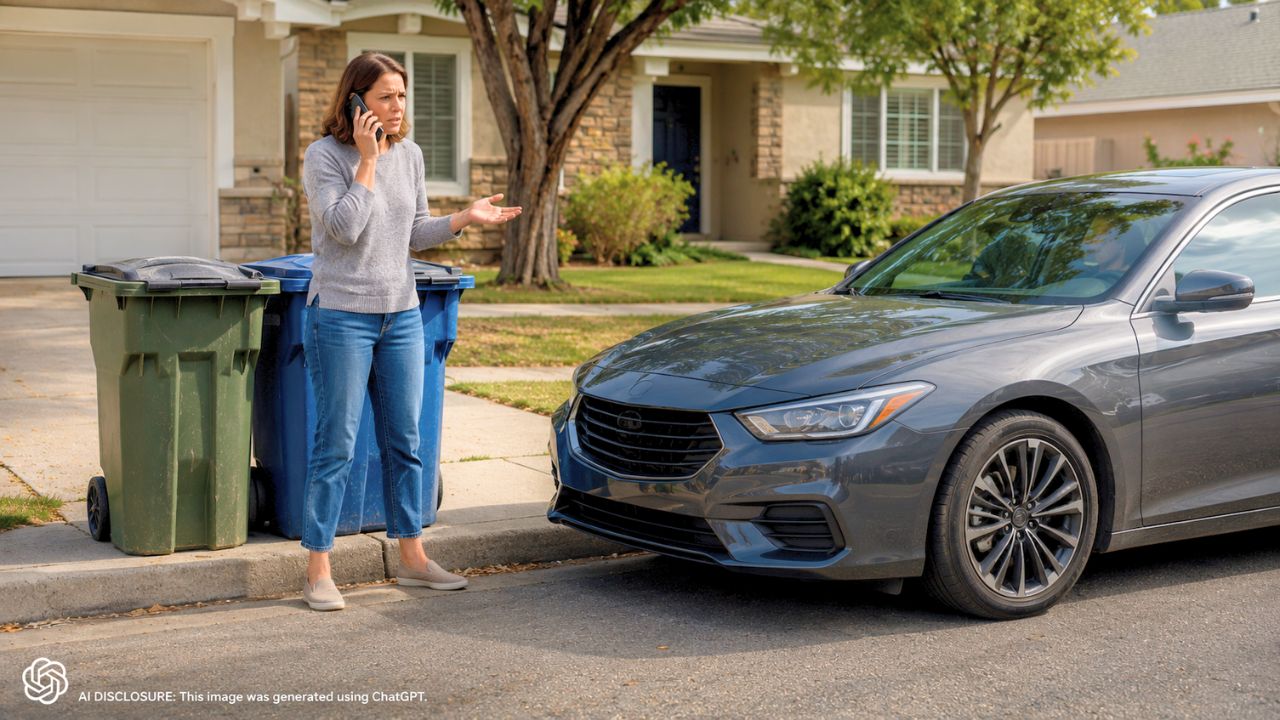
Photo credit: AI-generated image created using ChatGPT. Illustrative only
On a street lined with apartment buildings, one standalone house has a small but important buffer zone out front: two posted “No Parking” signs marking off a stretch of curb. The homeowner says they usually let minor overhangs slide, until one repeat offender parked fully inside the restricted area and tight against the edge of the driveway—on the one day that curb space mattered most.
In the original post, the homeowner explains that the car’s placement on garbage day kept them from getting trash cans to the curb. With two jobs and a narrow window to handle basic chores, they made a call to the local non-emergency line. They expected a ticket or warning. What happened next escalated fast.
A neighborhood where the rules are posted, and usually ignored
The homeowner describes living in an unusual pocket of the block: their house is the only standalone home, surrounded by apartments. In front of their property, signage clearly marks a no-parking zone between two points. It’s not ambiguous, and it’s not new.
Even so, the homeowner says they’ve tried to be flexible. If a car is “slightly over the line,” they don’t make a big deal out of it. In dense neighborhoods, curb space is always tight, and most people don’t want to start fights over a few feet of pavement.
This time didn’t look like a simple misjudgment. The car was reportedly parked completely between both “No Parking” signs, not partially. And it wasn’t just in the zone—it was right up against the edge of the driveway, shrinking the usable space where the homeowner needed to work.
Garbage day turned a nuisance into a real problem
The breaking point wasn’t aesthetics or principle. It was logistics. The homeowner says the illegally parked vehicle blocked the area where they needed to place trash cans for pickup.
They acknowledged there was a workaround: they “could have technically dragged them behind the vehicle.” But to them, that’s the issue—having to haul cans around someone else’s car because that person chose to park where signs explicitly say not to.
Timing made it worse. The homeowner says they work two jobs, leaving at 5:15 a.m. for the first and not returning until 5:30 p.m., then heading to the second job from 6:00 p.m. to 10:00 p.m. With that schedule, a blocked curb isn’t a minor inconvenience. It’s the difference between getting trash collected and missing pickup entirely.
The call they made—and the response they didn’t expect
Rather than confronting a neighbor directly, the homeowner called the local non-emergency line to report the vehicle. They describe it as a practical decision: limited time, repeated parking behavior from the same car, and clear signage backing them up.
They also say they didn’t anticipate how quickly enforcement would move. In their mind, the likely outcome was a ticket or a warning—something that might discourage the driver from doing it again without creating a bigger scene.
Instead, the response was immediate towing. That’s the moment the story shifts from an everyday parking annoyance into something with real cost and consequences for the person who left the car there.
A knock at the door and a new kind of stress
Later that day, the car’s owner came to the homeowner’s door looking for the vehicle. The homeowner says they could hear the person mention having a Ring doorbell, adding a layer of discomfort—like this wasn’t just a complaint, but something that could become personal.
Rather than answer, the homeowner and their wife stayed inside. They weren’t interested in a doorstep argument, and they didn’t want the situation to escalate face-to-face. If the towing already felt like a big step, direct confrontation felt like another.
But not answering didn’t make the tension disappear. The homeowner’s wife worried that because theirs is the only house on the street, they could be easily identified and “singled out” if the car owner stays angry. In a neighborhood where most residents are in apartments, one house can feel exposed.
The backlash wasn’t from the street—it was at home
The homeowner posted the question because the biggest immediate fallout wasn’t public. It was marital. In an update, they say their wife is upset and feels embarrassed about the tow, and she’s worried about future confrontations.
That embarrassment seems tied to visibility and safety. If someone believes the homeowner is responsible for the tow, it’s not hard to imagine lingering resentment, especially when the house is easy to pick out.
The homeowner says they tried to calm her nerves and explained their viewpoint. They also note that she had complained about the parking issue in the past, too. Still, she remained “very mad/upset” that they called it in—suggesting that even when two people agree a behavior is wrong, they may disagree on how much enforcement is worth the risk.
What people fixated on: the signs, the pattern, and avoiding a face-to-face blowup
The post itself was labeled “Not the A-hole,” reflecting the basic argument that the driver chose to park in a clearly marked no-parking zone and paid the predictable price. The homeowner didn’t describe calling 911 or exaggerating the problem; they used the non-emergency line and expected a smaller response.
There’s also the pattern factor. This wasn’t described as a one-time mistake by a lost visitor. The homeowner says it wasn’t the first time this specific car had parked there, which reframes the tow as a response to repeat behavior rather than a one-off bad break.
And even though the car owner showed up at the door, the homeowner’s choice to avoid a confrontation lines up with a common instinct in neighborhood disputes: keep it procedural. When someone is angry enough to knock and demand answers, a porch conversation can go sideways quickly, especially when cameras are involved.
In the end, the homeowner is left balancing two realities: a posted no-parking zone only works if it’s enforced, but enforcement can create the kind of personal friction that’s hard to shake when you live on the same block.
The curb is clear now, but the uneasy part is what comes next. The homeowner solved the immediate garbage-day problem with one phone call. Whether that call creates longer-term neighbor tension—especially for a family that feels like the most visible target on the street—is the part they can’t tow away.
Check out more from Now Rundown:
- A Party of 12 Came Back a Month Later Demanding Their $80 Tip Refunded — My Restaurant Made Me Pay It
- Her Coworker Kept Filing the Same Complaint About Her After Being Warned — Then She Filed a Counter-Report With Every Email Documented
- Siblings Demanded Half of Their Sister’s $11 Million Inheritance — She Refused Because They Never Visited
- The Kid I Bullied in Middle School Just Interviewed for a Job on My Team — He Bombed It and I Didn’t Hire Him

Abbie Clark is the founder and editor of Now Rundown, covering the stories that hit households first—health, politics, insurance, home costs, scams, and the fine print people often learn too late.