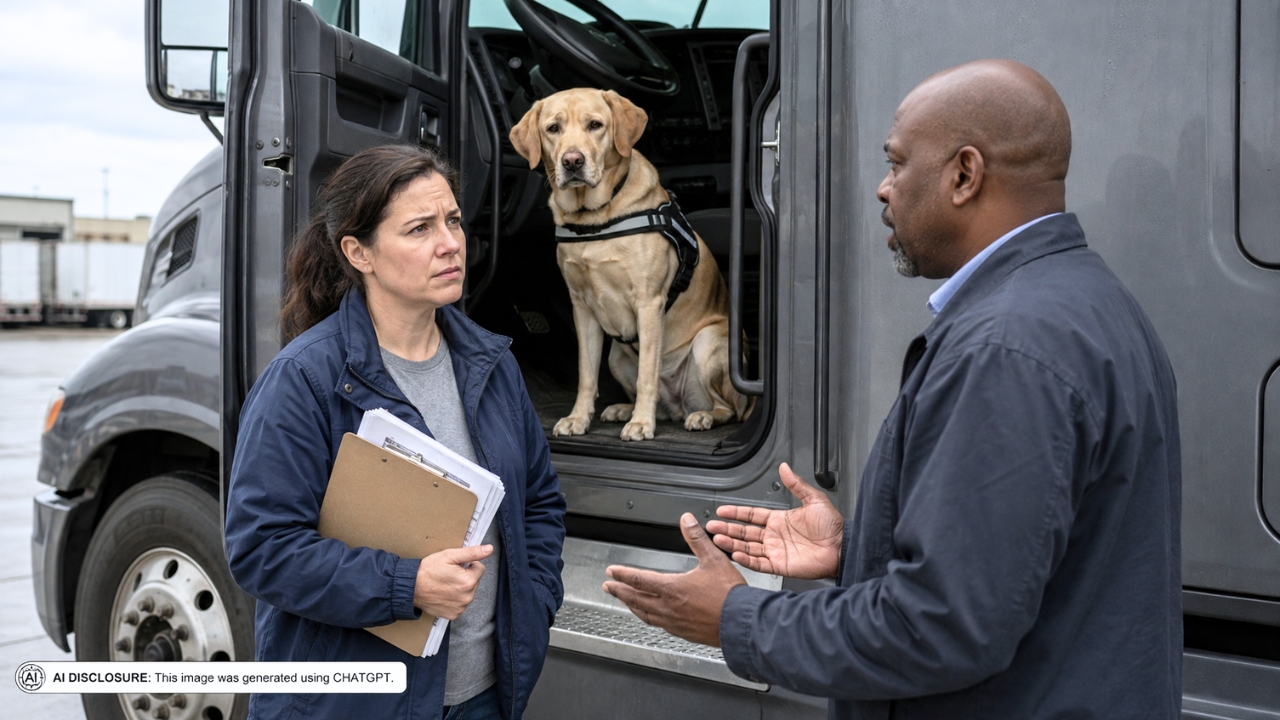
Truck Driver Earned Her Commercial License With Her Service Dog in the Cab — the EEOC Says the Carrier Pulled Her Job Offer Over Her PTSD
Photo credit: AI-generated image created using ChatGPT. Illustrative only.
A trucking job offer can feel like the finish line after weeks of training, tests, and paperwork. For one driver candidate in the Baltimore region, it turned into a next-day reversal after she disclosed she has PTSD and relies on a service dog to manage symptoms.
The U.S. Equal Employment Opportunity Commission says Schneider National crossed a legal line when it refused to let her bring the dog into the cab and then pulled the offer because of her disability. The details are laid out in the agency’s announcement of the lawsuit, filed in federal court in Maryland.
A conditional offer, then a sudden pause
According to the EEOC’s lawsuit, Schneider National, a nationwide transportation and logistics company headquartered in Green Bay, Wisconsin, extended a conditional offer of employment to the applicant in September 2023.
The timing matters. The EEOC says the very next day—after the company learned she had post-traumatic stress disorder and needed her service dog—Schneider withdrew the job offer “pending further review.”
In hiring, “pending further review” can sound like a routine step. But the EEOC’s framing is that the review was triggered by her disability and the accommodation she requested, not by her driving qualifications.
She said the dog wasn’t optional—this was the accommodation
When Schneider asked for more information, the applicant provided it, the EEOC says. She told the company her dog was certified as a service animal and trained to alleviate and prevent symptoms of PTSD.
She also pointed to something unusually concrete in the accommodation discussion: the dog had already been in the truck with her during training, and she successfully earned her Class A commercial driver’s license with the dog accompanying her in the cab.
That detail cuts through a lot of the usual abstract back-and-forth. From her perspective, the dog wasn’t a new request or a preference—it was part of how she safely functioned behind the wheel, and she had a track record of doing the job’s core task while using that support.
The EEOC says the carrier flatly refused
The EEOC alleges Schneider ultimately refused to allow her to drive with the service dog as a reasonable accommodation. In the same sequence of events, the company withdrew the job offer.
The agency’s lawsuit says that combination—denying the accommodation and pulling the offer—violated the Americans with Disabilities Act. Under the ADA, employers can’t deny employment to qualified individuals because of disability or because they need reasonable accommodations.
What the EEOC is putting front and center is the idea that the applicant was “qualified” and had already shown she could operate in the role with her service animal. The dispute, as presented by the agency, wasn’t about whether she could drive—it was about whether the company would accept her accommodation.
How the legal fight got to federal court
The EEOC says it filed the case—EEOC v. Schneider National, Inc., Case No. 1:26-cv-00905-JMC—in the U.S. District Court for the District of Maryland after trying to resolve the matter first through the agency’s administrative conciliation process.
That step is significant in the real world because it’s the part where an employer can sometimes settle, change policies, or agree to relief without full-blown litigation. The EEOC’s announcement makes clear those efforts didn’t get the dispute over the finish line.
Debra Lawrence, regional attorney for the EEOC’s Philadelphia District Office, emphasized the basic rule the agency says was ignored: “Under federal disability law, employers are required to reasonably accommodate workers with disabilities, absent an undue hardship. An employer cannot sidestep these obligations by refusing to employ a qualified individual because they need reasonable accommodations.”
Why a service dog in a truck cab becomes a flashpoint
Even without getting into arguments not described in the EEOC’s release, it’s easy to see why this kind of request can become a pressure point in trucking. The cab is both a workplace and a confined living space for long stretches, and employers often have strict rules meant to standardize safety and equipment.
But the EEOC’s case description narrows the question to a simpler one: was the applicant entitled to a reasonable accommodation, and did the company illegally treat the need for that accommodation as a dealbreaker?
The agency’s version of events also highlights that this wasn’t an untested idea. The applicant says she had already done the training and licensing process with the dog present—suggesting the accommodation had been used in the same physical environment and task demands the job would require.
For workers watching from the sidelines, that’s often the practical dividing line: a request that’s theoretical versus a setup that has already functioned in the field.
What people tend to latch onto in cases like this
When a dispute centers on accommodations, outside observers usually focus less on the label—“service dog,” “emotional support,” “pet”—and more on documentation and consistency. The EEOC says the applicant told the company the dog was a certified service animal and trained for PTSD-related symptoms, and that she had already driven with the dog during the process of obtaining her CDL.
Another thing people fixate on is the employer’s timing. A job offer that changes immediately after a disability disclosure reads, to many, like the moment the hiring process stops being about qualifications and starts being about risk management—fairly or not.
And in workplaces where “no animals” policies are common, the ADA question becomes: did the employer actually explore an accommodation process, or did it treat the policy as automatically overriding the request? The EEOC’s allegation here is that Schneider refused the accommodation and withdrew the offer because of the disability.
Now it’s headed to court, where the fight will be about what happened inside that “further review,” what the company considered, and whether allowing the service dog would have been reasonable or an undue hardship under the ADA. In the meantime, the applicant is left without the job she thought she’d secured—despite having already proven, at least in training, that she could do the work with her service dog by her side.
Check out more from Now Rundown:
- A Party of 12 Came Back a Month Later Demanding Their $80 Tip Refunded — My Restaurant Made Me Pay It
- Her Coworker Kept Filing the Same Complaint About Her After Being Warned — Then She Filed a Counter-Report With Every Email Documented
- Siblings Demanded Half of Their Sister’s $11 Million Inheritance — She Refused Because They Never Visited
- The Kid I Bullied in Middle School Just Interviewed for a Job on My Team — He Bombed It and I Didn’t Hire Him

Abbie Clark is the founder and editor of Now Rundown, covering the stories that hit households first—health, politics, insurance, home costs, scams, and the fine print people often learn too late.