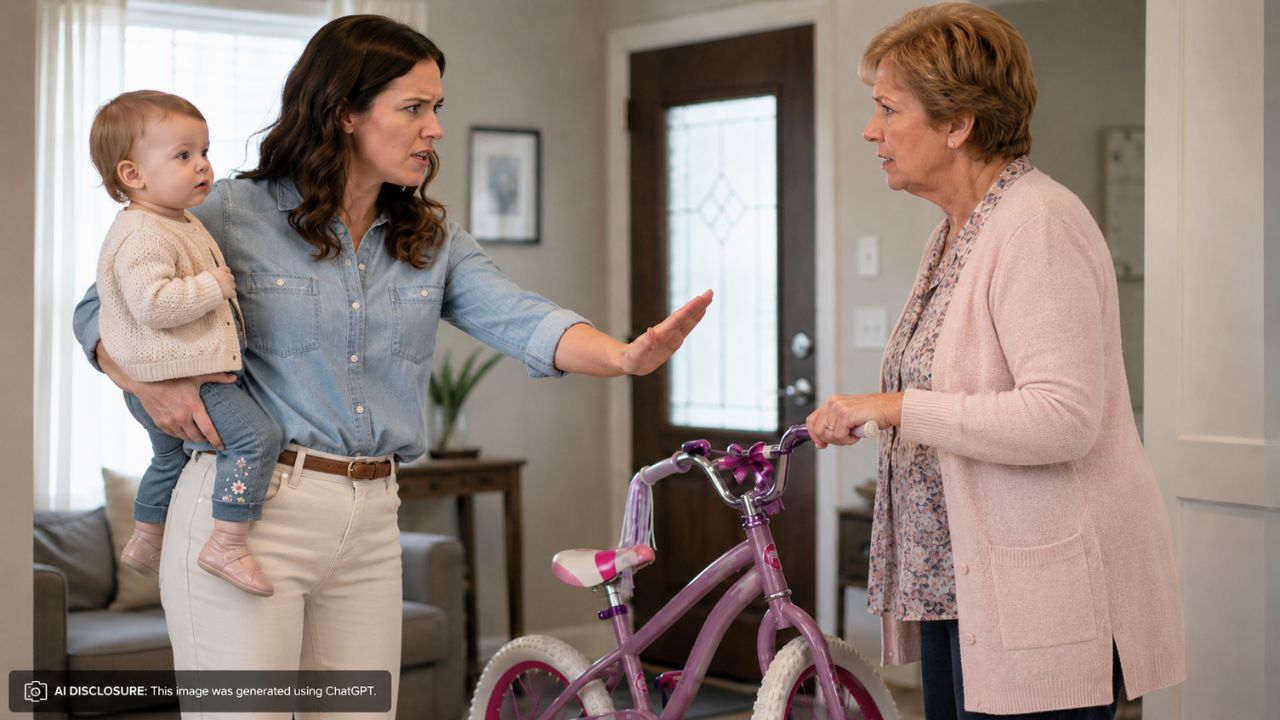
Mother Told Her Mother-in-Law to Return the Bicycle She Bought Their Daughter for Her First Birthday — the Parents Had Already Decided to Wait
Photo credit: AI-generated image created using ChatGPT. Illustrative only
A first birthday is supposed to be simple: cake, photos, a few gifts, and a toddler who has no idea what day it is. But for one couple, the week leading up to their daughter’s big day turned into a tense standoff over a small, inexpensive present—because it landed on the one tradition the parents had already claimed for themselves.
In the original post, the child’s mother explains that her husband is deeply into cycling. He worked at a bike shop through college, keeps the hobby going in his 30s, and has been excited to share it with their daughter since before she was born. The issue wasn’t just “a toy bike.” It was the first bike—something he’d been planning and researching for months.
For this dad, the “first bike” wasn’t just another gift
The husband wasn’t casually browsing. The mother says he’d been researching kids’ bikes since she was pregnant, comparing styles for different ages and development stages, and picturing the moment he’d pick the right one for their daughter.
But the parents also weren’t rushing it. Their daughter was about to turn one, and they’d decided to wait a few months until she was developmentally ready for a balance bike. So even though the bike moment mattered to them, their plan was to hold off—not make it a first-birthday centerpiece.
That plan would’ve been easy to follow if the extended family had been looped in. Instead, the first real friction came from a familiar modern family problem: busy schedules, missed texts, and a gift ordered before anyone had a chance to respond.
The warning signs were there in the texts
Weeks before the birthday, the mother-in-law—visiting from out of state—texted the couple a couple of gift ideas. The mother admits she and her husband were too busy to look at the links right away and didn’t respond for a couple days.
Then came a message that a gift was already being delivered. The mother went back and checked the links and saw two options: a balance bike and a Little Tikes push/ride car, both listed around $30–$40 on Amazon.
She says she was hoping the delivery wasn’t the bike. When the first package arrived, it turned out to be a completely different gift. For a moment, it looked like the potential clash had been avoided.
Then a second package showed up.
The second delivery turned a parenting choice into a power struggle
The mother-in-law had sent the bike after all. The mother texted her to say they thought the Little Tikes toy would be better for their daughter’s current stage and that they’d decided to wait on a bike for a few months.
Instead of just refusing, the parents tried to offer an easy fix. The mother suggested returning the bike—simple since it was purchased through Amazon—and buying the other toy at a nearby Target. The mother-in-law agreed to that plan at the time.
But once she arrived in town, with the birthday just days away, the agreement started to slide. The husband asked whether she was going to return the bike and swap it for the other gift. That’s when she became resistant.
She insisted she wanted to give the bike anyway, saying “it has good ratings and she’ll like it.” The husband tried to explain why this particular gift mattered to him: he’d been looking forward to picking out his daughter’s first bike himself, and he’d done a lot of research.
The mother-in-law still wouldn’t budge.
“Fine, I just won’t get her anything then!”
What stung wasn’t just the gift, but the escalation. According to the mother, her mother-in-law got upset and responded, “fine, I just won’t get her anything then!”
That reaction left the couple feeling like the conversation had stopped being about what their daughter needed and turned into a standoff about who gets to decide. The mother notes that her mother-in-law isn’t even a cyclist and that the bike is “just a $40 Amazon toy,” which made the refusal to switch gifts feel even more confusing.
From the parents’ point of view, the fix was straightforward: return the bike, buy the other present the mother-in-law herself had already considered, and let the dad choose the bike later when the child is ready. The mother-in-law’s pushback, especially after initially agreeing, is what made the moment feel loaded.
And because the mother-in-law is visiting from out of state, the disagreement isn’t happening over the phone. It’s unfolding in the same house, in the days right before a milestone birthday, with the pressure of a celebration closing in.
The stakes weren’t the money—it was the “first”
On paper, this is a small-dollar dispute. But the parents aren’t arguing about a price tag. They’re arguing about timing, safety/development, and the emotional weight of a first experience.
The mother makes clear the dad’s attachment isn’t to a random gift, but to the act of choosing it: he wanted to pick the right bike at the right stage, not have the moment forced early by someone else’s purchase and a delivery notification.
There’s also the practical side the parents keep coming back to. They’d decided to wait until their daughter was ready for a balance bike. Even if the gift is well-reviewed, “good ratings” doesn’t change a child’s coordination or size, and a bike that isn’t developmentally appropriate can quickly become clutter—another large item taking up space while everyone waits for the child to grow into it.
That reality is part of why the parents proposed the swap. A push/ride toy fits now, and a carefully chosen balance bike can be a planned later moment—still exciting, still meaningful, and more likely to be used immediately.
What people tended to focus on: boundaries, not the bicycle
Although the post itself centers on the mother’s question—whether she was wrong to ask her mother-in-law to return the bike—the details naturally steer attention toward a common family boundary problem: when a grandparent’s gift starts to override a parent’s decision.
The parents weren’t demanding the mother-in-law spend more money. They weren’t criticizing the bike’s quality. They were asking her to respect a plan they’d already made, and to let the dad have the one “first” he’d been waiting for.
The mother-in-law’s “I won’t get her anything” response also reframed the discussion in a way that can make it harder to resolve. Instead of debating which toy is best, it becomes an emotional all-or-nothing choice—accept my exact gift or I’ll punish everyone with nothing—right before a birthday gathering.
At that point, the couple is left with limited options that all carry consequences: accept the bike and swallow the disappointment, hold firm and risk a sour visit, or try to compromise (store it away, treat it as a later gift) and hope the mother-in-law doesn’t see that as another rejection.
For now, the birthday is still approaching, the bike is still in the picture, and the parents are stuck trying to protect one small milestone without letting it derail the entire weekend.
Check out more from Now Rundown:
- A Party of 12 Came Back a Month Later Demanding Their $80 Tip Refunded — My Restaurant Made Me Pay It
- Her Coworker Kept Filing the Same Complaint About Her After Being Warned — Then She Filed a Counter-Report With Every Email Documented
- Siblings Demanded Half of Their Sister’s $11 Million Inheritance — She Refused Because They Never Visited
- The Kid I Bullied in Middle School Just Interviewed for a Job on My Team — He Bombed It and I Didn’t Hire Him

Abbie Clark is the founder and editor of Now Rundown, covering the stories that hit households first—health, politics, insurance, home costs, scams, and the fine print people often learn too late.