Grandparent Bought the Grandkids iPads but Locked the Kids’ Mother Out of the Settings — She Accused Them of Constantly Overstepping
Photo credit: AI-generated image created using ChatGPT. Illustrative only.
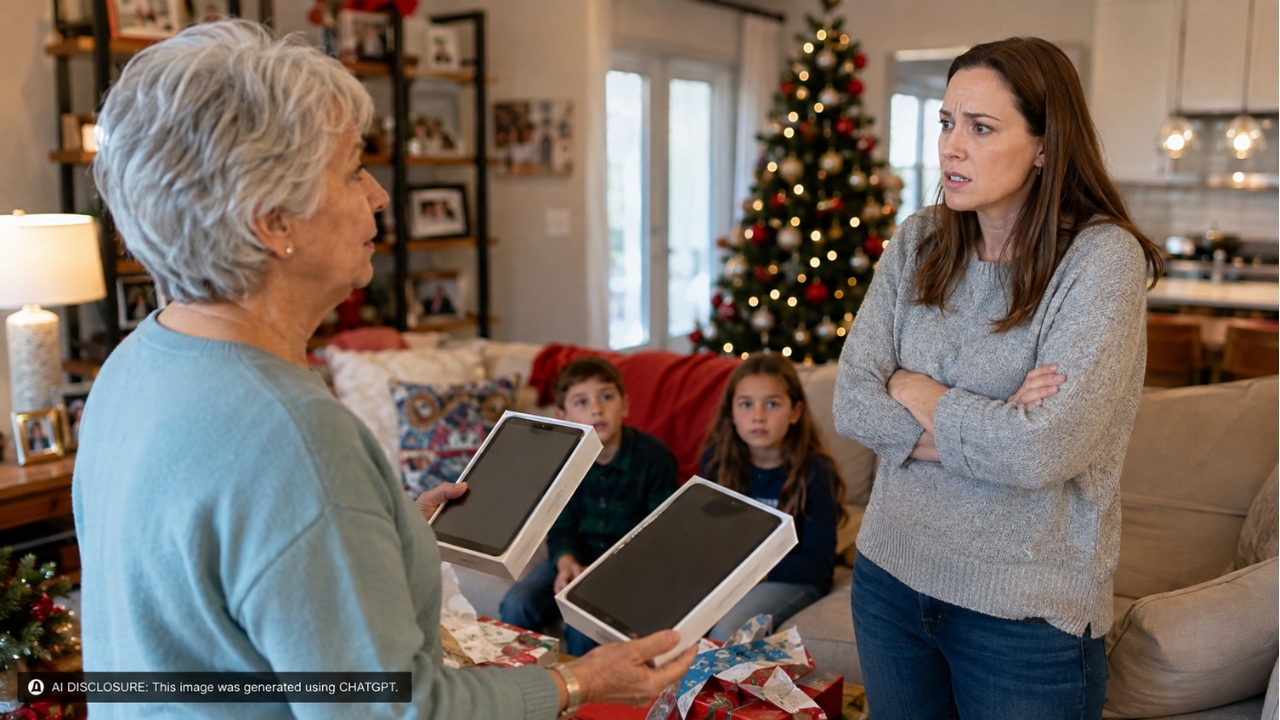
A grandmother thought she was doing something simple: buying her grandkids iPads for Christmas because their dad would be away working at sea. Instead, the purchase turned into a family blowup over trust, money, and who gets to control what happens inside a child’s home.
In the original post, the grandmother explained that she intentionally set the iPads up under her own account and locked the settings behind a password—specifically so the children’s mother couldn’t wipe the devices and resell them. The mother, Daisy, didn’t take it as a safeguard. She took it as another adult stepping into her lane.
The dad is gone for weeks, and the holidays aren’t getting easier
The grandmother’s son works on cargo ships and can be hard to reach. He’s gone for weeks or months at a time, and he won’t be home for the holidays. That leaves Daisy handling day-to-day life with the kids while also trying to get back on her feet financially.
The grandmother described the last two years as rough for the couple. Daisy became unemployed and hasn’t found work she says is flexible enough with the children’s schedules. With the father gone so often, childcare falls heavily on her.
But the grandmother also suggested there’s another piece to the financial pressure—how money is being spent. She said Daisy still gets her nails done every two weeks, which in her mind makes it harder to accept that the children’s belongings are being sold for cash.
“Only the expensive gifts” kept disappearing
The core grievance wasn’t one item. It was a pattern the grandmother said she’s watched repeat: when the kids get into trouble, Daisy sells their things online. And it isn’t random clutter or outgrown toys. The grandmother claimed it’s “expensive” gifts that get listed.
Her clearest example was a new Switch game that her granddaughter reportedly had for only two weeks before it was gone. Daisy told the grandmother the girl had been “playing too aggressively,” but when asked for examples, the grandmother said Daisy couldn’t provide any.
To the grandmother, the explanation didn’t line up with the outcome. A $70 game ended up on eBay. Daisy denied that money was the real reason, but the grandmother said she didn’t believe it—especially because she said similar sell-offs kept happening.
The iPads became a test of control, not a Christmas gift
Then Daisy asked the grandmother to buy two iPads for Christmas. The grandmother agreed, but with a condition: she would set them up herself and put a password on the Settings app. Her stated goal was simple—make it harder to wipe the devices, which would make them harder to sell.
She called Daisy ahead of time to explain what she’d done. Instead of appreciation, she got anger. Daisy was “pissed,” and soon the grandmother said she was getting constant texts accusing her of overstepping.
The grandmother framed it as the only way she felt comfortable buying expensive electronics. If the devices were going to end up as quick cash, she didn’t want to fund the cycle. But Daisy appears to have heard a different message: that her mother-in-law didn’t trust her and was setting rules inside her home.
Locking settings wasn’t the end—she locked down everything
After the initial argument, the grandmother added more detail about what she’d actually done. She said Daisy was locked out of “everything,” with the cloud account in the grandmother’s name and her own passcodes in place. She also said she had help setting it up so “no one else can get it.”
In her view, the lock was strong enough that Daisy couldn’t simply reset the iPads and start over. The grandmother claimed that unless Daisy had hacking skills “to rival” Apple engineers, she wouldn’t be able to wipe them.
That detail matters because it changes what the iPads represent. This wasn’t a normal gift that becomes a family’s shared device management problem. It was closer to a controlled device—functionally owned and administered by the grandmother, intended for the kids, but designed to be resistant to the parent who actually runs the household.
And the grandmother didn’t hide that she was thinking past Christmas morning. She said she only sees the kids about once every two weeks, but she wants them to have “nice stuff” at home and even be able to take it to a friend’s house—without it disappearing the moment discipline, money, or frustration hit.
The next move: keep the iPads at her house, treat them like a loan
The grandmother’s update showed she wasn’t backing down. She said she still planned to give the kids the iPads, but for the first few weeks they would stay at her place. After that, she’d let the children take them home—while she continued to monitor them.
She also planned to text Daisy and make it explicit that the iPads were a loan, not an unconditional gift. If Daisy sold them anyway, the grandmother said she would file a police report and pursue it, adding that she could see where the iPads were online.
That’s the moment where a messy family disagreement starts to look like a potential legal and custody-adjacent minefield. On one side, the grandmother believes she’s protecting property she paid for and protecting the kids from losing their belongings. On the other side, Daisy could see a grandparent threatening law enforcement over devices that would be in her home, used by her children, under her day-to-day supervision.
Even the language the grandmother used made clear how personal it had become. She said the kids “deserve to have nice things at home” regardless of how she felt about their mother, and she described Daisy’s behavior as something that needs to stop.
Most reactions centered on trust, receipts, and what “gifts” really mean
The post itself labeled the grandmother “Not the A-hole,” reflecting that many readers accepted her premise: expensive items keep getting sold, and this was a practical way to prevent it. In that framing, the password isn’t about controlling Daisy. It’s about ensuring the children actually get to keep what’s meant for them.
But even when people agree with the motive, the method raises real-world complications. A locked-down device can become a flashpoint during normal parenting moments—screen-time rules, app permissions, school accounts, forgotten passcodes, broken screens, and bedtime fights. If the parent can’t access settings, the parent can’t fully parent the device.
And then there’s the “loan” claim. Calling it a loan may feel like protection to the grandmother, but it also signals she expects conflict. Once you’re talking about police reports and tracking devices, it stops being a holiday surprise and starts being a power struggle with paperwork attached.
For now, the iPads are still slated to be given to the kids—just with strings, passwords, and monitoring built in. The bigger question is whether that setup actually protects the children’s belongings long-term, or whether it simply moves the battle from sold items on eBay to a constant argument over who’s allowed to control what happens in their home.
Check out more from Now Rundown:
- A Party of 12 Came Back a Month Later Demanding Their $80 Tip Refunded — My Restaurant Made Me Pay It
- Her Coworker Kept Filing the Same Complaint About Her After Being Warned — Then She Filed a Counter-Report With Every Email Documented
- Siblings Demanded Half of Their Sister’s $11 Million Inheritance — She Refused Because They Never Visited
- The Kid I Bullied in Middle School Just Interviewed for a Job on My Team — He Bombed It and I Didn’t Hire Him

Abbie Clark is the founder and editor of Now Rundown, covering the stories that hit households first—health, politics, insurance, home costs, scams, and the fine print people often learn too late.