Female Applicants Said a Trucking Company Threw Their Applications in the Trash — It Paid $5.5 Million to Settle the Federal Suit
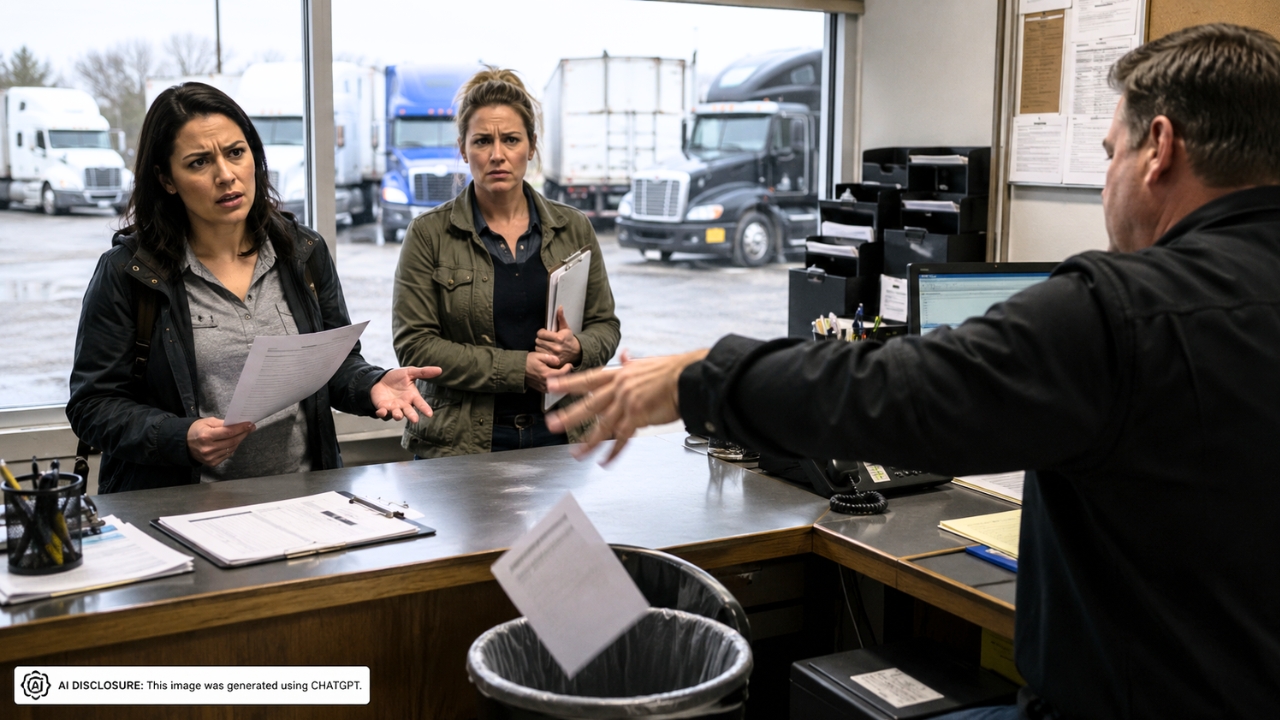
Photo credit: AI-generated image created using ChatGPT.
For some women applying to drive trucks for Central Transport, the rejection wasn’t subtle or politely worded. The federal government says applicants watched their paperwork get handled differently than men’s—and in some cases, they said employees literally tossed their applications into the trash.
Now the nationwide trucking company has agreed to pay $5.5 million to resolve a federal sex-discrimination lawsuit brought by the U.S. Equal Employment Opportunity Commission, as detailed in the agency’s announcement. The settlement is locked into a consent decree signed in Arizona federal court, and it comes with policy changes meant to stop the same hiring pattern from repeating.
It wasn’t one bad terminal—EEOC says it was a decade-long pattern
Central Transport is based in Warren, Michigan and operates more than 200 regional and local facilities. The EEOC says the problem wasn’t limited to one manager having a bias or one office cutting corners; the suit alleged that for at least ten years the company intentionally refused to hire qualified female truck drivers across the country.
According to the lawsuit, qualified women repeatedly applied and got passed over while men were selected instead, including men who were allegedly less qualified or had less experience. The EEOC also said multiple female applicants reported being put through different hiring procedures than male applicants faced.
The details read like something applicants might try to brush off at first—until it keeps happening. If one terminal turns you away, maybe it’s timing. If multiple terminals do it for years, that starts to look like a rule, not an accident.
The “trash” allegation—and the places that stood out
One of the most striking claims in the case is how some applicants said their paperwork was treated. Several women reported observing Central Transport personnel throwing their job applications in the trash at local truck terminals, the EEOC said.
The agency also pointed to terminals where the numbers were hard to ignore. The Phoenix and El Paso locations allegedly did not hire any female truck drivers for a number of years, despite receiving numerous female applications.
And at a terminal in Dunbar, West Virginia, the EEOC said a dispatcher told a female applicant that corporate offices had instructed him not to hire any female truck drivers. It’s the kind of statement that, if said out loud, turns a “maybe” into something that sounds deliberate.
How the federal case moved from complaints to court
The EEOC framed the conduct as a violation of Title VII of the Civil Rights Act of 1964 and Title I of the Civil Rights Act of 1991, alleging intentional discrimination in hiring based on sex. The agency filed the suit—EEOC v. Central Transport, LLC, Case No. 2:26-cv-02201-JJT—in the U.S. District Court for the District of Arizona after attempting to resolve the matter through its administrative conciliation process.
During its investigation, the EEOC said it received reports of sex-based discrimination at terminals in Atlanta, Bartlett (Tennessee), Blue Springs (Missouri), Cheboygan (Michigan), Chicago, Detroit, Dunbar (West Virginia), Horn Lake (Mississippi), Memphis, North Jackson (Ohio), Phoenix, Portland, and Springfield (Illinois).
In other words, the agency’s map of complaints wasn’t a tight cluster. It spanned multiple regions, which is part of what made the allegations so serious—and why the resolution is described as nationwide.
The money is only part of it—this settlement also forces changes
The consent decree requires Central Transport to pay $5,500,000 to the four original complainants and a class of other qualified female truck drivers who applied but were not hired. For people who say they lost years of earning potential and opportunities, the cash matters—but the structure of the agreement suggests the EEOC was also focused on preventing repeat behavior.
Beyond the payments, the decree requires the company to allow affected applicants to apply for positions and participate in recruitment and hiring “free from sex-based discrimination and retaliation” for taking part in the lawsuit.
Central Transport must also bring in an outside consultant to review hiring policies, practices, and procedures for compliance with Title VII. And it must institute training on anti-discrimination policies, including training on recordkeeping obligations and the filing of EEO-1 reports as required by law.
There’s also oversight baked in. The decree requires the company to appoint a monitor who will review and verify implementation and report on compliance to the EEOC—essentially, someone whose job is to make sure the promised fixes aren’t just words on paper.
What people tend to focus on in cases like this: proof, paperwork, and patterns
The EEOC’s statements in the release hint at the kinds of practical details that often decide whether a hiring-discrimination complaint turns into something enforceable. Phoenix District Director Melinda Caraballo emphasized that employers need to retain applications and hiring records, particularly when they’ve received charges of discrimination.
That’s not just bureaucratic nagging. In a hiring fight, documentation is the difference between “they didn’t call me back” and “here’s the record showing who applied, who was interviewed, who was hired, and when.” The lawsuit’s claims about women being routed through different procedures—or allegedly seeing applications tossed—are the kinds of allegations that become far more explosive when records don’t exist or don’t match what the company says happened.
The reaction that follows these cases is usually less about abstract values and more about the nuts and bolts: whether a company can show consistent, fair screening; whether applicants can show they were qualified; and whether there’s a repeatable pattern across locations. This settlement, with its consultant review, training, and monitoring, is built around those pressure points.
A high-dollar resolution, and a company now under a microscope
EEOC regional attorney Mary Jo O’Neill called out a reality that women in male-dominated industries already know: sex discrimination in hiring still happens. She also said it’s illegal for employers to refuse to hire women because of their sex, and noted the agency appreciated Central Transport’s willingness to resolve the case early through settlement.
The company is now on the hook not only for millions in monetary relief, but also for a compliance process that will require sustained attention across a large network of terminals. A consent decree with monitoring isn’t a one-and-done promise; it’s a period where actions get checked.
For the women who say they were shut out—and for others who may apply now—the next test is whether the hiring pipeline actually changes on the ground, at the terminals, with real managers handling real applications. The money closes one chapter. The day-to-day hiring decisions will decide whether the story repeats.
Check out more from Now Rundown:
- A Party of 12 Came Back a Month Later Demanding Their $80 Tip Refunded — My Restaurant Made Me Pay It
- Her Coworker Kept Filing the Same Complaint About Her After Being Warned — Then She Filed a Counter-Report With Every Email Documented
- Siblings Demanded Half of Their Sister’s $11 Million Inheritance — She Refused Because They Never Visited
- The Kid I Bullied in Middle School Just Interviewed for a Job on My Team — He Bombed It and I Didn’t Hire Him

Abbie Clark is the founder and editor of Now Rundown, covering the stories that hit households first—health, politics, insurance, home costs, scams, and the fine print people often learn too late.