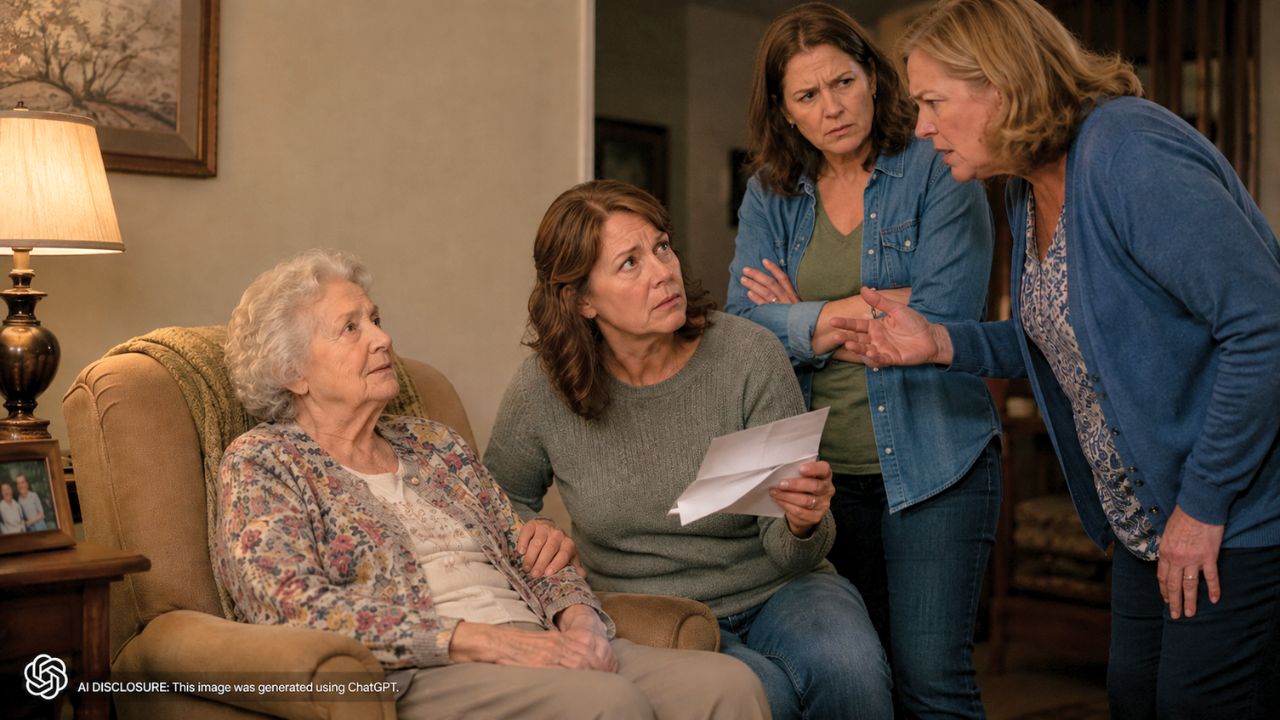
Family Caregiver Managing a Mother’s Alzheimer’s Diagnosis Is Set to Inherit More Than Their Siblings Under a New Will — Siblings Call the Split Unfair
Photo credit: AI-generated image created using ChatGPT. Illustrative only.
For years, one adult child has been living in their mother’s home and caring for her through a devastating Alzheimer’s diagnosis—feeding her, helping her move, and handling the daily realities that come with decline. Now, as their mother finalizes her estate plans, that caregiver is set to receive more than their siblings, and the family is splitting in a different way.
In the original post, the caregiver asked whether it’s wrong to think the uneven inheritance is fair. Their mother, who recently met with a lawyer, outlined a plan that would leave the caregiver the house plus “a little bit extra,” while the other siblings would split the remaining money between them.
Full-time care, with almost no breaks
The caregiver described themselves as the primary caretaker from the very first symptoms. They said they’ve been “24/7” with only a few half-day breaks here and there, and they expect the care to continue for years.
This isn’t a case where help is limited to reminders and appointments. The poster clarified their mother has posterior cortical atrophy (PCA), which they described as “not the memory sort” of Alzheimer’s. Their mother struggles to walk, feed herself, and manage basic bathroom needs—high-intensity care that makes leaving the house, keeping normal hours, or maintaining a job far harder.
On top of the physical demands, the caregiver framed the work as deeply personal. They said their mother’s biggest fear is ending up in a facility, “feeling alone and forgotten,” while losing her mind. The caregiver wrote they would do the work regardless, but they also believe their mother wants them compensated for the years they’ve put their own life on hold.
A will that rewards the caregiver—and alarms a sibling
The mother’s plan, as explained by the caregiver, is not a total disinheritance of anyone. Two siblings would still receive money. But one sibling is pushing back, saying the entire estate should be divided equally three ways.
In simplified terms, the caregiver said their mother’s plan amounts to a 2-1-1 split: the caregiver receives the house and additional money, and each sibling receives a smaller share of cash. The caregiver insisted they aren’t trying to renegotiate for more; they want the existing plan to remain intact.
To them, the reasoning is straightforward: they have been providing unpaid labor at a level that would otherwise require professional services, and they’ve sacrificed earning power while doing it. The caregiver wrote that their sibling has even acknowledged they put “their entire life on hold,” but still argues fairness means equal shares.
The career sacrifice that changed the stakes
Inheritance arguments often sound abstract until someone points to what they lost in real time. Here, the caregiver said they gave up their career to take care of their mother, and that the choice permanently changed their ability to work.
They didn’t identify the industry, but they described the fallout in blunt terms: they believe they are effectively blacklisted for leaving, “radioactive in hiring terms,” and unable to return to what they did before. That’s a huge part of why the house matters. The caregiver said they’re worried about what happens after their mother’s death—specifically, avoiding a situation where they end up without housing.
They also addressed a common assumption: that living in the home equals a free ride. The caregiver said they do not pay rent, but they do pay for some expenses out of pocket, citing an air-conditioning repair they couldn’t do themselves and payments related to their mother’s storage unit. Taken together, the caregiver’s message was that they’re not accumulating savings while caregiving; they’re bleeding time and money while their future job prospects narrow.
Competency, paperwork, and the fear of later accusations
Once a family starts fighting over a will, the next argument is often about how it was made. The caregiver anticipated that and tried to head it off.
They said their mother can still “speak intelligently” and is not considered mentally incompetent yet, though they expect that to change. They added that they have documentation from a doctor stating their mother is still mentally competent.
They also emphasized that the decision to see a lawyer was the mother’s, not theirs. The caregiver wrote they couldn’t force their mother to go, and it took time to convince her even to consider formal planning. Their focus early on, they said, was care—not locking down money.
Those details matter because uneven inheritances can trigger suspicions of pressure or manipulation, even when the intent is to repay a caregiver. The poster’s insistence that the lawyer and mother set the terms, combined with medical documentation of competency, reads like an effort to protect the will from future challenges—and to protect the caregiver from family allegations that can haunt people for years.
What people zeroed in on: document everything, and don’t negotiate against the patient
In the updates, the caregiver thanked people for supportive messages and said the feedback helped while they spend “99%” of their time in this caregiving role. They also clarified misunderstandings that kept popping up—especially the idea that they were trying to take more.
The most practical theme they highlighted was clarity: the mother already worked with a lawyer, and the caregiver wants that plan honored. The caregiver also stressed they have documentation of capacity, a detail that often becomes central when families argue about fairness after someone’s health declines.
Another point the caregiver returned to was the scale of the sacrifice: this isn’t just emotional strain, it’s lost employability and potential homelessness. Their sibling, in the caregiver’s telling, isn’t usually cruel or combative. They described loving their sibling and said this is their first major fight since their teen years—suggesting the disagreement is less about longstanding resentment and more about money, principle, and fear of being treated unfairly.
A family trying to measure care in dollars
The hardest part of the story is that both sides can claim a version of fairness. One sibling sees equal distribution as the cleanest rule. The caregiver sees equal distribution as ignoring years of unpaid labor and the risk they’ll be left financially stranded after doing the work no one else did.
For now, the mother’s plan stands: a larger share to the child providing day-to-day care, and smaller shares to the siblings who are not. But the tension is already in the open, and that’s often when families start keeping score—who visited, who paid for what, who took time off, who didn’t.
The caregiver’s last note was telling: they don’t want to “win” against their siblings. They want to survive what comes next. And in a household already shaped by Alzheimer’s, the inheritance fight is becoming its own kind of slow-moving crisis—one that could outlast the will itself.
Check out more from Now Rundown:
- A Party of 12 Came Back a Month Later Demanding Their $80 Tip Refunded — My Restaurant Made Me Pay It
- Her Coworker Kept Filing the Same Complaint About Her After Being Warned — Then She Filed a Counter-Report With Every Email Documented
- Siblings Demanded Half of Their Sister’s $11 Million Inheritance — She Refused Because They Never Visited
- The Kid I Bullied in Middle School Just Interviewed for a Job on My Team — He Bombed It and I Didn’t Hire Him

Abbie Clark is the founder and editor of Now Rundown, covering the stories that hit households first—health, politics, insurance, home costs, scams, and the fine print people often learn too late.