Burial Supervisor Was Told to Keep His Crew Quiet About Race Complaints — One Went to Headquarters Anyway, and the Supervisor Was Fired, Regulators Say
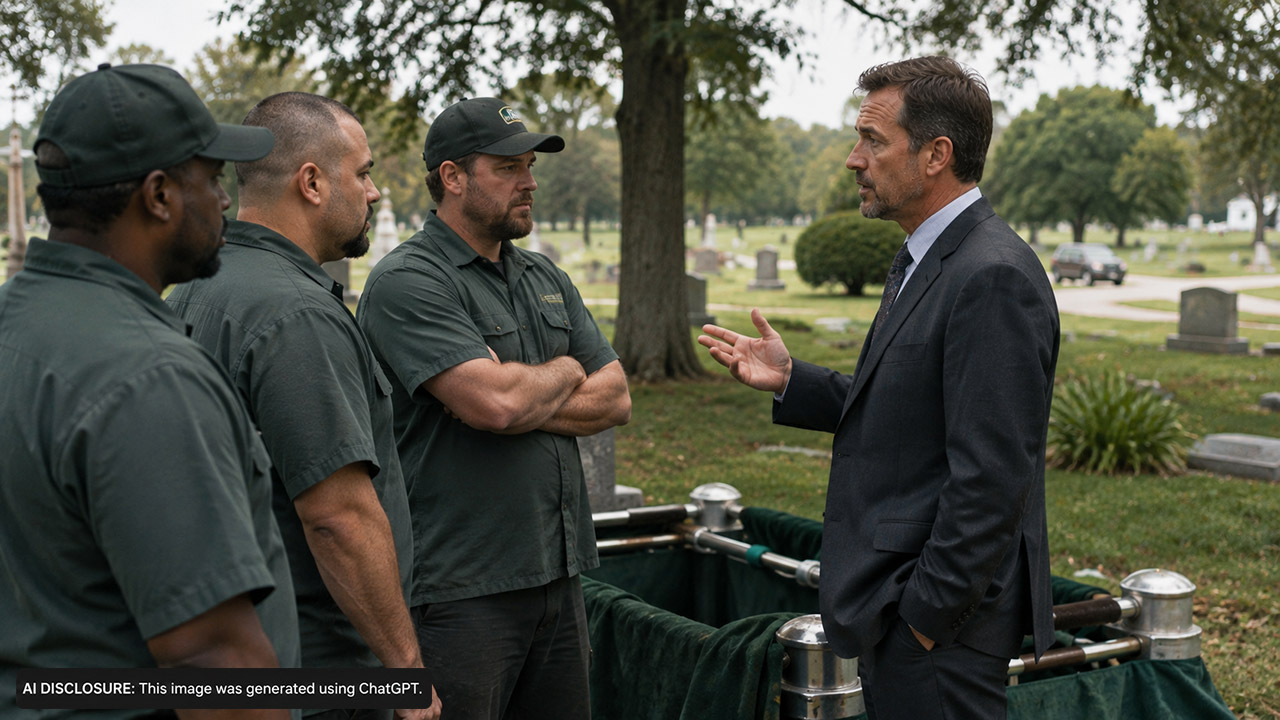
Photo credit: AI-generated image created using ChatGPT. Illustrative only
A burial crew at a Memphis-area cemetery job allegedly learned the hard way that some workplace rules aren’t written down on paper. In a federal lawsuit filed by the U.S. Equal Employment Opportunity Commission, managers for StoneMor, Inc. are accused of drawing a racial line in a basic everyday space—who gets to use the breakroom—and then trying to make a supervisor keep his team from taking complaints any higher.
The EEOC’s filing, summarized in the agency’s press release, says the pressure campaign didn’t work. A crew member went to corporate headquarters anyway, threatened to go to the EEOC next, and the supervisor who allegedly refused to muzzle the complaint ended up out of a job.
How a breakroom became the line everyone noticed
Most discrimination stories don’t start with a big, dramatic event. They start with ordinary routines—who eats where, who gets included, who gets told “not there.” According to the EEOC’s lawsuit, that’s exactly what happened at a StoneMor location in Memphis, where managers allegedly restricted all Black employees from using a breakroom while allowing white employees access.
It’s the kind of thing that doesn’t require a complicated policy memo to be felt. If you’re told you can’t step into the same room other coworkers use to sit down, cool off, or take a breath, the message lands immediately—especially when the dividing line is race.
The EEOC says this wasn’t a misunderstanding or a one-off. The claim is a blanket restriction: all Black employees excluded, white employees allowed. And once that’s part of the day-to-day, it turns into the sort of grievance that doesn’t stay quiet for long.
When the complaint moved up the chain, the pressure turned to the supervisor
The lawsuit describes the next stage as less about where people ate lunch and more about who was allowed to talk. The EEOC says a member of the burial supervisor’s crew complained to StoneMor’s corporate headquarters about “similar racial discrimination” and also threatened to complain to the EEOC.
That’s when, according to the agency, local managers allegedly tried to stop the complaint from gaining traction. The suit says StoneMor managers directed the burial supervisor to restrain his staffer from filing those complaints—essentially ordering him to keep the employee from contacting headquarters or federal regulators.
The alleged instruction didn’t come as a suggestion, either. The EEOC says managers threatened the supervisor with discharge if he failed to keep the worker from pushing the issue.
The quiet-part-out-loud moment: “Stop it, or you’re fired”
Workplace retaliation is often subtle: schedules get worse, opportunities vanish, people get iced out. The EEOC’s account is more direct. It alleges the company threatened to fire the supervisor if he didn’t suppress discrimination complaints coming from his crew.
In practical terms, that puts a supervisor in a corner. Either you help block the complaint—and potentially become part of the problem—or you refuse and risk your job. The EEOC is framing StoneMor’s alleged move as exactly the kind of retaliation federal civil rights laws are meant to deter: punishing someone for opposing discrimination or refusing to participate in efforts to silence it.
Acting EEOC General Counsel Catherine Eschbach put it bluntly in the release: “Segregating employees by race and pressuring supervisors to silence discrimination complaints strike at the core of federal civil rights law.”
One worker went to headquarters anyway—and the supervisor lost his job
Despite the alleged attempts to keep things contained, the EEOC says the complaint went forward. A crew member contacted corporate headquarters and threatened to go to the EEOC. After that, the lawsuit says, StoneMor fired the burial supervisor in May 2022.
The EEOC’s theory is that the supervisor’s termination wasn’t about performance or a reorganization. It was retaliation—because he failed to stop his employee from reporting what he believed was racial discrimination.
Delner Franklin-Thomas, director of the EEOC’s Memphis District Office, emphasized two points the agency wants the court to take seriously. First: “excluding employees from use of facilities based on race is unlawful.” Second: “Federal law also strictly prohibits retaliation against employees who refuse to participate in efforts to silence workers who report discrimination.”
Why regulators are treating it as more than a workplace dispute
The EEOC is suing under Title VII of the Civil Rights Act of 1964, the main federal law that bans employment discrimination based on race and bars retaliation tied to opposing unlawful discrimination. The lawsuit was filed as EEOC v. StoneMor, Inc., Case No. 2:26-cv-02122, in the U.S. District Court for the Western District of Tennessee.
Before filing, the EEOC says it attempted to resolve the matter through its administrative conciliation process—the pre-lawsuit settlement stage where the agency tries to reach an agreement with the employer. When that didn’t produce a resolution, the case moved into federal court.
That procedural detail matters because it signals this isn’t a quick PR flare-up. It’s the result of a formal investigation track that, at least from the agency’s perspective, ended with enough evidence or dispute to justify litigation.
What people tend to focus on in cases like this: proof, paper trails, and who said what
Even without a comment thread attached to the EEOC release, the practical chatter around cases like this usually circles the same pressure points: what was said, how it was communicated, and whether anyone documented it. Breakroom restrictions and threats to “restrain” an employee from reporting discrimination are the kind of allegations that can turn on details—who delivered the instruction, whether it was repeated, and whether it showed up in texts, emails, witness statements, or internal notes.
Another thing people fixate on is the supervisor’s position in the middle. Supervisors often get treated like they’re management when it’s convenient and like they’re expendable when it’s not. Here, the EEOC is essentially alleging the company tried to use the supervisor as the enforcement mechanism—then punished him when he didn’t successfully shut the complaint down.
The last focus point is the timeline: the employee goes to headquarters, threatens to go to the EEOC, and the supervisor is fired shortly after. In retaliation claims, that kind of sequencing becomes a big part of the story because it’s easy for a jury to understand.
For StoneMor, the lawsuit means the fight has shifted from an internal workplace dispute to federal court, with the EEOC arguing both racial discrimination and retaliation. For the workers described in the complaint, it’s a reminder that the most mundane spaces—like a breakroom—can become the clearest marker of who is treated as belonging, and what can happen when someone refuses to keep quiet about it.
Check out more from Now Rundown:
- A Party of 12 Came Back a Month Later Demanding Their $80 Tip Refunded — My Restaurant Made Me Pay It
- Her Coworker Kept Filing the Same Complaint About Her After Being Warned — Then She Filed a Counter-Report With Every Email Documented
- Siblings Demanded Half of Their Sister’s $11 Million Inheritance — She Refused Because They Never Visited
- The Kid I Bullied in Middle School Just Interviewed for a Job on My Team — He Bombed It and I Didn’t Hire Him

Abbie Clark is the founder and editor of Now Rundown, covering the stories that hit households first—health, politics, insurance, home costs, scams, and the fine print people often learn too late.