Widowed Father Won Sole Custody of His 10-Year-Old Daughter — a Judge Also Gave His Late Wife’s Mother Visitation and Made Him Share the Guardian’s Fees
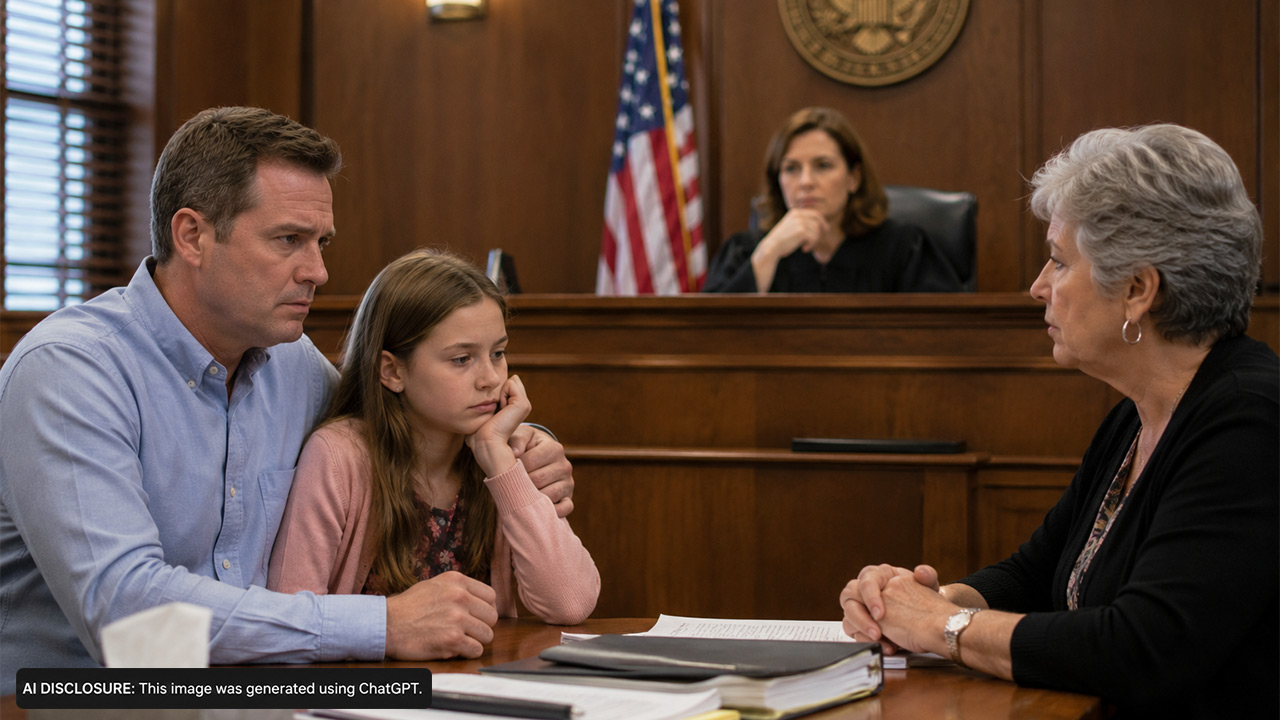
Photo credit: AI-generated image created using ChatGPT. Illustrative only
The night after his wife died, Samuel Garner drove to his mother-in-law’s home in Charlotte with police cars behind him, demanded his 10-year-old daughter, and left for Georgia with her clothes packed in a hurry. By the end of the day, the girl’s maternal grandmother, Faye Harvin, was in court asking a judge for emergency custody—arguing that the child had been living in her home and that the father’s behavior had turned unpredictable.
Three years of hearings, temporary orders, and a guardian ad litem investigation later, Georgia’s Court of Appeals upheld the final arrangement: Garner got sole legal and physical custody, but Harvin still got court-ordered visitation—and the father remained on the hook for a share of the guardian ad litem fees. The appellate decision is laid out in the court’s opinion.
The family was already split across states when the mom got sick
Garner and his wife, Atoya Garner, married in 2011 and had their daughter, Nia, in November 2014. After Atoya was diagnosed with Stage IV metastatic breast cancer, she relocated with Nia in August 2022 to Charlotte, North Carolina, moving into her parents’ home.
That same day, Garner filed for divorce in Georgia. A temporary consent order in November 2022 gave Atoya primary physical custody, joint legal custody, and final say on major decisions for Nia, while Garner got alternating-weekend visitation split between Georgia and North Carolina. He was also ordered to pay $627 a month in child support.
Then Atoya died on April 16, 2023. And the custody plan—already strained by distance, illness, and divorce—collapsed into something much more chaotic.
The police-assisted pickup set the tone for everything that followed
On April 17, the day after Atoya’s death, Garner contacted police, drove to Charlotte, and showed up unannounced at Harvin’s house with four police cars. The appeals court noted that this alarmed Nia. Garner demanded that Nia be handed over and waited while Harvin gathered clothes.
He then drove back to Georgia with the child. Without telling Harvin, he emailed Nia’s school in Charlotte and asked for her to be unenrolled.
Harvin filed a verified emergency petition the same day, seeking custody under Georgia law that can allow a nonparent relative to seek custody in certain circumstances. Two days later, at an April 20 hearing, the trial court entered a consent temporary custody order that put Nia primarily with Harvin in Charlotte and gave the grandmother final decision-making authority on major issues, while continuing the father’s twice-monthly weekend visitation.
The order also set up another major piece of the case: the appointment of a guardian ad litem (GAL), attorney Joy Edwards, to investigate and advise the court about what would best protect the child.
The guardian ad litem became a flashpoint, especially over money
At the time of Atoya’s death, the court found Garner owed $2,612 in unpaid child support. The temporary order required that amount be tendered to the GAL toward an initial $4,000 retainer, with Harvin paying the remainder. After that, the parties were ordered to split GAL costs equally.
But the money didn’t come smoothly. At a July 20, 2023 status conference, the trial court found Garner hadn’t made any payment to the GAL, which meant she couldn’t even begin her investigation. The court essentially kept the prior temporary terms in place: Harvin as primary caretaker in Charlotte, and the father traveling for two weekends a month.
Eventually, the father paid, and the GAL began investigating on October 5, 2023. By the time the case reached trial, Garner testified he had paid “right around $7,000” to the GAL and close to $9,000 in attorney fees.
In late 2024, the fee fight heated up again when the GAL asked the court for additional retainers—$1,000 from each side—after the initial retainer was exhausted. Garner also asked the court to retroactively change the GAL order so Harvin would pay all fees. The trial court denied that request and granted the GAL’s motion for additional fees.
At trial, everyone agreed the girl was loved—then disagreed on control
The bench trial took place April 11, 2025. The GAL testified that the evidence was “overwhelming” that Nia was loved, happy, and well-adjusted in both homes. But she also described a sharp mismatch in how the adults approached parenting and decision-making.
The GAL said the grandmother was more willing to make concessions, while the father “sits squarely in his space of, I am Nia’s biological father … and, as such, … everything should defer to him.” She also testified that teachers had concerns about the father putting “a lot of pressure on Nia to be perfect,” while the grandmother was “more encouraging and accepting.”
Even so, the GAL recommended Nia ultimately move to her father’s custody after the school year ended. The bigger concern, she told the court, was what would happen to Nia’s relationship with her maternal grandparents if the court didn’t mandate visitation. The GAL testified she felt “very strongly” that without a court order, the father would not permit it—and that Nia “will be devastated” if she were cut off.
Harvin testified Nia had been living with her for about two-and-a-half years, that she arranged grief counseling after Atoya’s death, and that Garner had not provided financial support for Nia since the mother died. She said she would accept the GAL’s recommendation and concede custody if she could still see her granddaughter regularly.
Garner testified Nia loved her grandmother and that the child communicated with him frequently while in North Carolina. But on cross-examination, he refused to call Harvin a “good” grandmother, settling on “fair” and “reasonable,” and admitted he had provided no financial support during the years Nia lived with Harvin. The trial court eventually threatened contempt because his answers were so evasive.
The final order: dad gets custody, grandma gets structured time
In a June 5, 2025 final order, the trial court denied Harvin’s request for custody and awarded Garner sole legal and physical custody beginning after the school year ended on June 10, 2025. But the court also found, “by clear and convincing evidence,” that Nia would suffer harm if she did not have visitation with her grandmother.
The trial court pointed to Nia’s extended residence with Harvin, the grandmother’s financial support for basic needs before Atoya died, a pattern of regular visitation and childcare, and a “substantial preexisting relationship.” Based on that, the court ordered a detailed visitation schedule, starting with one weekend per month for the first three months after the transition, then one weekend every other month, plus two non-consecutive summer weeks and specific holiday time—including Thanksgiving each year for Harvin.
The order also required at least weekly contact by phone or video and allowed Harvin to attend school events and extracurricular activities. The trial court denied the father’s request for attorney fees, noting it wasn’t clear what statute he was seeking them under and that there had been no notice for an award under Georgia’s fee-shifting statute. It also denied his renewed push to reassign all GAL fees to Harvin.
Garner appealed, challenging the visitation award and multiple procedural and financial rulings. The Court of Appeals affirmed across the board. It also criticized the structure of his appellate briefing, noting it failed to follow the court’s rules in ways similar to another recent case.
For Nia, the decision locks in a reality that a lot of families end up living: one home, one primary parent, and a court-crafted schedule designed to keep a second household from disappearing. It’s not the clean break Garner appeared to want, and it’s not the custody result Harvin originally sought—but after years of temporary orders and legal bills, it’s a final roadmap the adults now have to follow.
Check out more from Now Rundown:
- A Party of 12 Came Back a Month Later Demanding Their $80 Tip Refunded — My Restaurant Made Me Pay It
- Her Coworker Kept Filing the Same Complaint About Her After Being Warned — Then She Filed a Counter-Report With Every Email Documented
- Siblings Demanded Half of Their Sister’s $11 Million Inheritance — She Refused Because They Never Visited
- The Kid I Bullied in Middle School Just Interviewed for a Job on My Team — He Bombed It and I Didn’t Hire Him

Abbie Clark is the founder and editor of Now Rundown, covering the stories that hit households first—health, politics, insurance, home costs, scams, and the fine print people often learn too late.