Front Desk Clerk’s Chair Was Swapped for a Backless Stool While She Was Pregnant — She Asked to Sit Down and Was Fired, Regulators Say
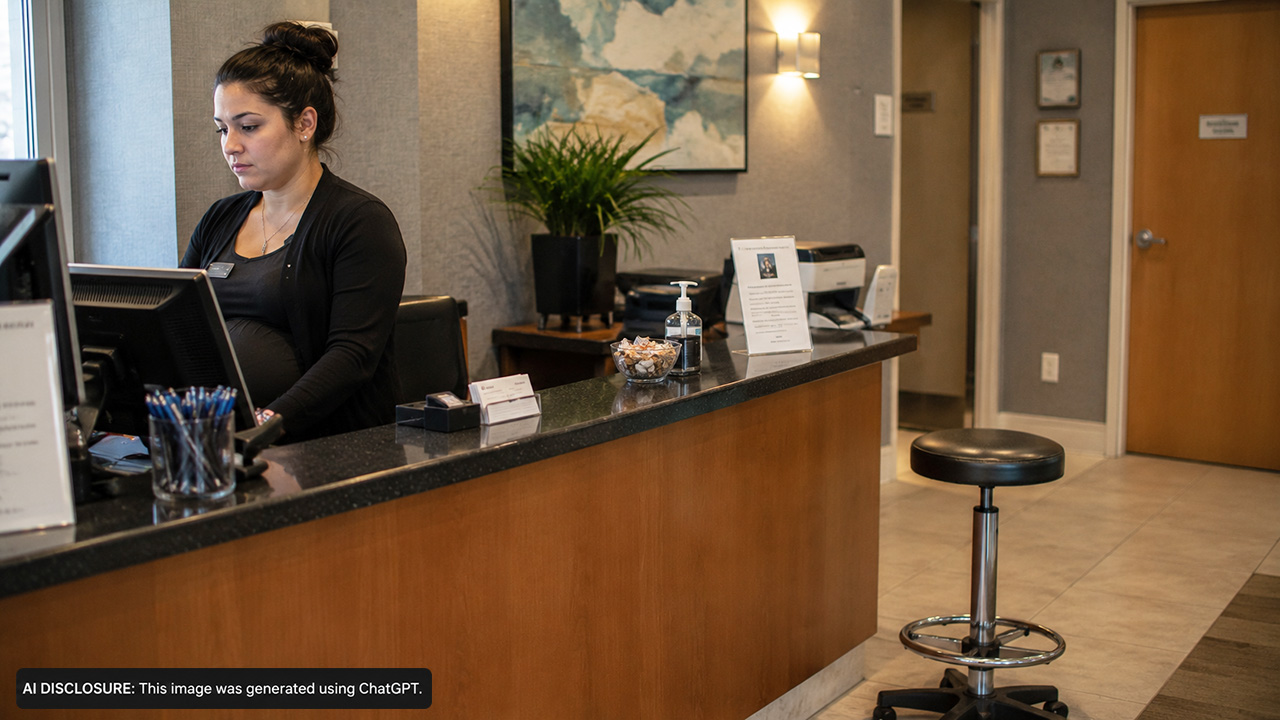
Photo credit: AI-generated image created using ChatGPT. Illustrative only
A front desk shift is already a job built around staying visible, staying polite, and staying on your feet. But in a new federal lawsuit, the EEOC says one pregnant hotel worker asked for something simple—being allowed to sit for medical reasons—and watched her workplace respond by taking away a proper chair, swapping in a backless stool, and then firing her soon after.
The allegations are laid out in the EEOC’s press release announcing a suit against Hotel Equities Group, LLC, tied to a Hilton-branded hotel in Oak Lawn, Illinois. The agency says the same location also retaliated against a second front desk clerk who requested a religious scheduling accommodation.
A chair showed up, and then management made it a problem
According to the EEOC, the first employee was pregnant in 2023 and asked to sit at the front desk rather than stand, citing medical needs related to her pregnancy. At first, it didn’t sound like a big battle: a coworker provided her with a suitable chair.
Then management stepped in, the EEOC says, and the tone changed. The chair was taken away and replaced with a small, backless stool. On top of that, the company allegedly discouraged her from using even that.
In service jobs, the front desk is the stage. The EEOC’s version of events paints a picture of an accommodation request turning into a power struggle, where the basic act of sitting became something the employee had to defend.
The escalation: from “can I sit?” to being out of a job
The timeline the EEOC describes is blunt. After the chair was removed and replaced with the stool, the company discharged the pregnant worker “shortly thereafter,” the lawsuit alleges.
The agency says the firing was retaliation for requesting a pregnancy-related accommodation. If proven, that’s not just an argument about comfort or workplace culture—it becomes a federal claim about an employer punishing a worker for asking for help they’re legally allowed to request.
The practical stakes are obvious even without extra details: losing a job during pregnancy can mean losing steady income, health insurance, and stability right when medical appointments and planning costs tend to rise.
A second front desk clerk asked for Sundays—and says he was punished too
The EEOC’s lawsuit doesn’t stop with the stool. It also accuses Hotel Equities of mishandling a religious accommodation request by a second front desk clerk at the same hotel in 2023.
That employee, the EEOC says, was also an assistant pastor at a Baptist church. He requested not to be scheduled for Saturday overnight shifts because it interfered with his ability to attend—and sometimes lead—Sunday morning services.
According to the lawsuit, the company expressed approval of his request. But in practice, the EEOC says, he kept getting scheduled for Saturday nights anyway, even after he objected. Then, “not long after,” the company allegedly retaliated by cutting his hours.
In other words, the suit claims the worker got a verbal yes that didn’t translate into actual scheduling changes—and that continuing to push back came with a cost to his paycheck.
What the EEOC says the law requires—and what it says happened instead
The EEOC frames both allegations as more than isolated workplace disputes. It says the conduct violates the Pregnant Workers Fairness Act (PWFA) and Title VII of the Civil Rights Act of 1964.
Under the PWFA, the EEOC notes, employers must provide reasonable pregnancy-related accommodations to qualified employees who need them, unless doing so would create an undue hardship for the employer. Under Title VII, the agency says, employers must reasonably accommodate an employee’s religious beliefs, observance, or practice unless it would impose an undue hardship.
Both laws also prohibit retaliation against employees who ask for accommodations. That retaliation claim is the connective tissue in the EEOC’s telling: one worker asked to sit, and the EEOC says she was fired; another asked for a schedule change for religious practice, and the EEOC says his hours were cut after he persisted.
The case is filed as EEOC v. Hotel Equities Group, LLC, Case No. 1:26-cv-01217, in U.S. District Court for the Northern District of Illinois. The agency says it attempted to resolve the matter through its administrative conciliation process before filing suit.
The reactions people tend to have to stories like this
Even without a long thread of public comments attached to the EEOC release, this kind of front desk accommodation story usually zeroes people in on the same real-world pressure points: documentation, consistency, and leverage.
When a chair is swapped out for a backless stool and the worker is then “discouraged” from using it, people tend to ask what was said, who said it, and whether it was put in writing. In workplaces where schedules, shift notes, and supervisor instructions change quickly, paper trails can become the difference between a clean narrative and a muddled one.
On the religious scheduling side, the predictable question is how an employer can say “approved” and then keep scheduling the same shifts anyway. People often focus on whether the worker flagged each improper schedule as it happened, whether the request was documented, and whether the hours cut came immediately after objections—because timing is often the beating heart of a retaliation claim.
And for anyone currently working a similar job, the human reaction is simpler: if a company fights this hard over sitting or a shift adjustment, it makes workers wonder what other basic needs will be treated as negotiable—or punishable.
Where it leaves the hotel—and the workers who had to push the issue
The EEOC is clear about why it brought the case. “Employees have a right to request and receive religious and pregnancy-related accommodations in the workplace without fear of retaliation,” said Catherine Eschbach, acting EEOC General Counsel. “When employers deny lawful accommodations and retaliate against workers for speaking up, the EEOC will take action.”
The lawsuit now puts those allegations in a forum where the details matter: what was requested, what alternatives were offered, what communications happened, and why the employment actions—termination in one case and reduced hours in the other—occurred when they did.
For the workers at the center of it, the story already has the kind of grounding that’s hard to ignore. One asked to sit while pregnant, and the EEOC says she ended up with a backless stool and then no job. Another asked for a schedule that wouldn’t collide with his Sunday services, and the EEOC says he kept getting scheduled anyway and later lost hours. Whatever the court ultimately decides, the suit draws a bright line around a basic workplace reality: asking for an accommodation shouldn’t be what gets you pushed out.
Check out more from Now Rundown:
- A Party of 12 Came Back a Month Later Demanding Their $80 Tip Refunded — My Restaurant Made Me Pay It
- Her Coworker Kept Filing the Same Complaint About Her After Being Warned — Then She Filed a Counter-Report With Every Email Documented
- Siblings Demanded Half of Their Sister’s $11 Million Inheritance — She Refused Because They Never Visited
- The Kid I Bullied in Middle School Just Interviewed for a Job on My Team — He Bombed It and I Didn’t Hire Him

Abbie Clark is the founder and editor of Now Rundown, covering the stories that hit households first—health, politics, insurance, home costs, scams, and the fine print people often learn too late.