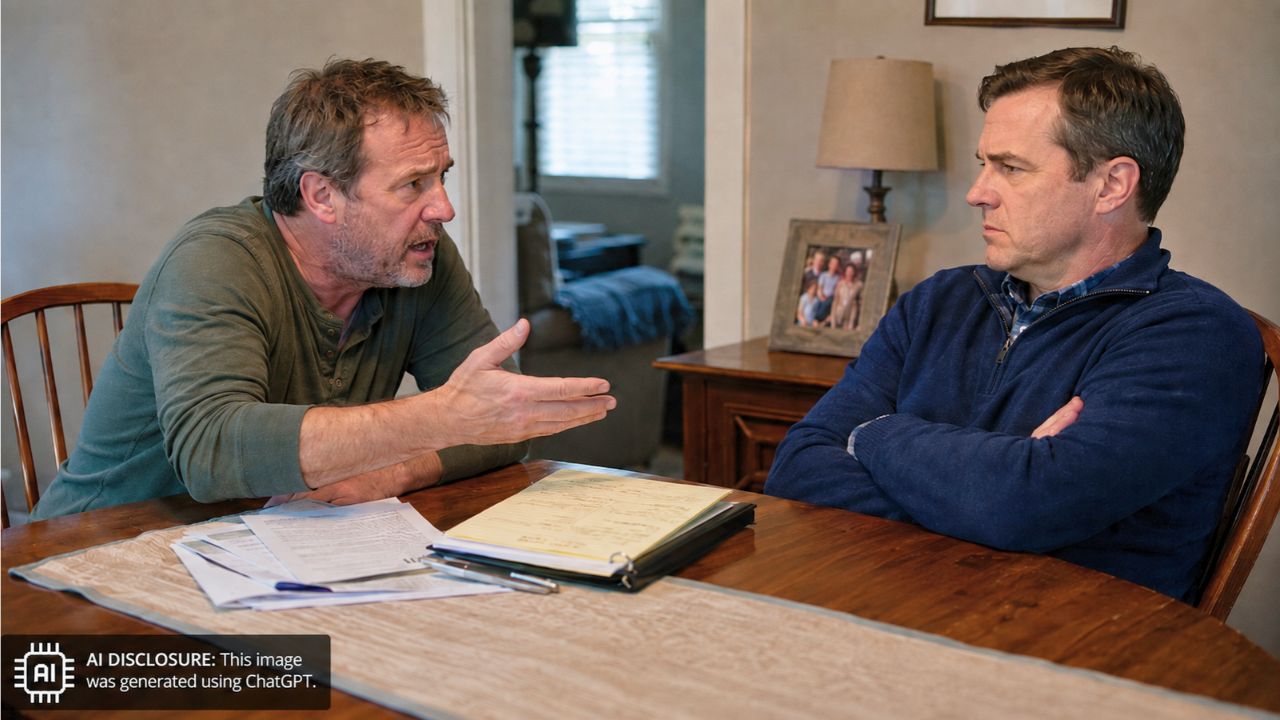
Man Voiced His Frustration Over His Absent Brother Getting Half of Their Parents’ Inheritance After He Handled All Their Care Alone
Photo credit: AI-generated image created using ChatGPT. Illustrative only.
For years, he says he watched his parents age while his older brother stayed a polite distance away—no fights, no blowups, just a steady absence. When his mother’s health declined and real caregiving began, he and his wife became the ones rearranging their home, coordinating help, and living the day-to-day reality of it. Then, in one conversation about housing and money, he learned his parents still planned to split everything evenly.
In the original post, the man laid out what felt like an unspoken family math problem: two sons on paper, but only one son showing up in practice. And once inheritance entered the discussion, he didn’t hide how bitter that made him.
Two sons, two very different levels of contact
The man described a long stretch of emotional distance between him and his older brother. They “never really had any sort of relationship,” he wrote, saying his brother married young and built a separate life early on. There wasn’t a dramatic falling-out, no big argument that fractured the family—just a consistent lack of effort.
Invitations to family meals were regularly rejected, and contact stayed minimal for roughly two decades. The poster noted that his brother occasionally hinted the distance might be influenced by his wife not liking their family much. The most striking detail: the only time they saw their brother’s child in person was a chance encounter at a shopping mall.
It’s the kind of estrangement that can be easy to ignore while everyone is healthy. But once a family needs hands-on help, the gap stops being theoretical.
Care needs rose, and the responsibility landed in one house
Over the past few years, the poster said his mother’s health worsened to the point that she needed surgery and extra care. Instead of waiting for a crisis to force a decision, he and his wife made a major move: they had his parents come live with them. They also brought in professional care services during the daytime.
That arrangement meant their home became the hub for medical recovery, daily supervision, and the emotional load that rides along with watching a parent decline. He said he updated his brother “from time to time” about their mother’s condition, but his brother still didn’t visit. The gestures he did make were occasional fruit baskets.
Over time, that imbalance can calcify into resentment—especially when caregiving affects space, work schedules, privacy, and finances. And it sounds like those pressures were already building when the inheritance conversation happened.
A house upgrade plan triggered the inheritance talk
The immediate spark wasn’t a demand for money. The poster said he and his wife were looking to sell their current house to finance upgrading to a bigger home in a better area—something that would presumably make multigenerational living easier, or at least more sustainable.
That’s when his father stopped him. According to the post, his parents said there was no need to sell because they could help finance an upgrade by selling off properties they owned. The poster emphasized his parents weren’t wealthy, describing them as middle-class people who bought properties when they were “dirt cheap.”
But as his parents discussed their plans, another detail came out: his older brother would be receiving half as well.
That’s when the conversation stopped being about logistics and turned into a referendum on who had actually carried the family through the hard years.
“Valued the same” was the part he couldn’t swallow
The poster said he got angry and questioned the decision, pointing directly to his brother’s lack of involvement over the past 20 years. His parents’ answer was simple and familiar: he is still their son, and splitting things evenly was “only fair.”
To the caregiver son, “fair” didn’t match reality. He argued that giving his brother half put him “at a disadvantage,” given what he’d done in recent years. He also told them he didn’t care about his brother’s half and urged them to consider donating that portion instead.
Underneath the money, the message he heard was more personal: after all the daily work and disruption, he was still being treated as equal to someone who had been functionally absent. He called that “extremely insulting,” saying that while people can argue value goes beyond money, “action speaks louder than words.”
His wife, however, didn’t like how he handled it. She chided him for being “so confrontational,” leaving him wondering if he’d crossed a line by saying the quiet part out loud.
What people focused on: fairness vs. choice, and the hidden costs of caregiving
The post itself was tagged “No A-holes here,” framing it as a messy family clash without a clear villain. That tone fits the tug-of-war at the center of the story: parents often want to avoid picking a “winner” between children, even when one child has been the default caregiver. Equal splits can feel like the least controversial route, even if they don’t reflect who showed up.
At the same time, the practical costs in the poster’s life were concrete. Moving parents into your home isn’t just emotional labor; it’s square footage, routines, stress, and the constant obligation of being the person on call. Even with daytime professionals, family members still manage the in-between moments and the decisions that don’t fit neatly into a service schedule.
In disputes like this, people often zoom in on two competing truths. One: it’s your parents’ money and they can distribute it however they want, including splitting it evenly to avoid a final act of favoritism. Two: “equal” isn’t always “equitable,” and families rarely calculate the value of years spent caregiving until the estate is being discussed—at which point it’s too late to make it feel clean.
The poster’s attempt to redirect his brother’s share to charity also signaled something important: he wasn’t only trying to get more. He wanted the split to communicate recognition. In families, money becomes shorthand for gratitude when the words haven’t been said clearly enough.
The tension now: gratitude, guilt, and what happens next
By confronting his parents, the poster turned a future issue into a present one. That can be risky. Inheritance conversations tend to linger, and once resentment is named, it can change how everyone interprets everyday decisions—especially when parents are dependent on the child they live with.
There’s also the unresolved relationship with the older brother. The post doesn’t describe a direct confrontation between the siblings, but the fault line is obvious: one sibling has been physically present for medical decline and household reshaping, while the other has remained a distant figure who checks in occasionally and sends gifts.
For now, the family appears stuck in an uncomfortable middle. The parents want to keep both sons equal in their planning. The caregiving son wants that plan to reflect reality, not biology. And his wife, caught close to the blast radius, seems to be urging him to keep things calmer—because once a family starts tallying who did what, it’s hard to stop.
The money may not change hands for years, but the meaning of it is already doing damage. And the hardest part is that everyone involved can believe they’re being reasonable at the same time.
Check out more from Now Rundown:
- A Party of 12 Came Back a Month Later Demanding Their $80 Tip Refunded — My Restaurant Made Me Pay It
- Her Coworker Kept Filing the Same Complaint About Her After Being Warned — Then She Filed a Counter-Report With Every Email Documented
- Siblings Demanded Half of Their Sister’s $11 Million Inheritance — She Refused Because They Never Visited
- The Kid I Bullied in Middle School Just Interviewed for a Job on My Team — He Bombed It and I Didn’t Hire Him

Abbie Clark is the founder and editor of Now Rundown, covering the stories that hit households first—health, politics, insurance, home costs, scams, and the fine print people often learn too late.