Woman Exposed Her Husband’s Infidelity to Family and Friends — His Relatives Turned Against Her and Accused Her of Overreacting
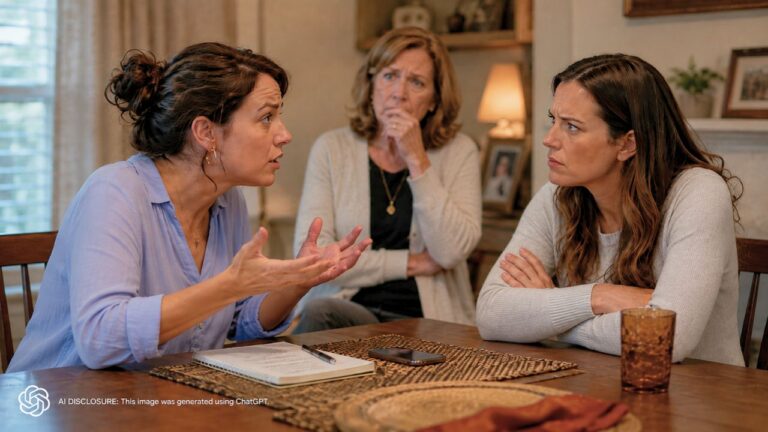
Photo credit: AI-generated image created using ChatGPT. Illustrative only.
It started with a discovery she says she couldn’t unsee: “undeniable evidence” that her husband was cheating. When she confronted him, she expected denial, excuses, anything—except what came next. He admitted it.
Still reeling, the woman laid out what happened in the original post, explaining that she chose to tell a small circle of trusted friends and relatives. She wasn’t trying to stage a public takedown, she said—she was trying to survive the betrayal without carrying it alone. What she didn’t expect was for the confession to turn into a family-wide backlash that ended with her and her children being pushed out.
She found proof, confronted him, and he didn’t deny it
The timeline she describes moves fast: she finds evidence, her world “came crashing down,” and she confronts her husband. Instead of a drawn-out argument about whether it happened, he admits to cheating on her.
That moment should have clarified who caused the rupture in the marriage. But in her telling, it didn’t. It simply shifted the next question onto her: what was she supposed to do with the truth now that it was confirmed?
She describes feeling devastated and heartbroken, but also clear-eyed about one thing—staying quiet felt impossible. Not because she wanted attention, but because the weight of the betrayal was too heavy to manage privately.
She confided in a few people—and the story didn’t stay small
Instead of blasting the situation publicly, she says she confided in a “few trusted friends and family members.” The intent, as she frames it, was support and safety: she needed people to know what she was dealing with.
But once those first conversations happened, word spread. The details of how it traveled aren’t spelled out, but the consequences are: her husband’s relatives found out, and their response wasn’t to hold him accountable. It was to turn on her.
The betrayal inside the marriage became a wider social fight. And in that fight, she says she was treated like the person who caused the damage—simply because she refused to keep it secret.
His family circled the wagons—and blamed her for his choices
Her husband’s relatives, she says, accused her of “overreacting.” Then it escalated into something sharper: claims that she “wasn’t a good enough wife to keep him satisfied.”
In her post, she describes it as blame-shifting that made her feel like the villain in someone else’s story. The cheating was real and admitted, yet the narrative she encountered focused on what she supposedly failed to do.
That kind of response can function like a warning: don’t talk, don’t name what happened, don’t disrupt the family’s image. And for her, it also seemed to come with punishment—social exile that hit her life in practical ways.
She says she was ostracized by people she once considered family. Invitations stopped. Contact dried up. And, in her words, they “even went as far as spreading rumors” about her, adding another layer of humiliation on top of the breakup.
The fallout didn’t stop with her—it reached the kids
The sharpest detail in her account is that the cold shoulder didn’t end with her. She says her husband’s family “turned their backs” on her children too.
That meant the consequences weren’t just emotional. Family gatherings and routine contact—things kids often depend on for stability—were suddenly gone. In her telling, her children were treated like collateral damage in an adult mess they didn’t create.
It also changed what “standing up for herself” looked like. This wasn’t only about confronting a spouse. It became about protecting her children from being scapegoated and from absorbing the message that silence is the price of belonging.
She notes that she was raised with traditionally conservative expectations—where women are expected to stay quiet, “almost like the husband’s accessory.” She adds that she doesn’t agree with those views and is trying to shield her kids from them, which helps explain why being told to hush up now feels like more than an insult. It feels like a repeat of a belief system she’s trying to break.
People fixated on whether she “should have stayed silent”
The question she’s wrestling with is painfully specific: was she wrong to expose the cheating because it triggered backlash? She frames it in practical terms—if she had kept quiet, would the family still be in her kids’ lives? Would she have avoided being smeared?
But she also asks the uncomfortable counterpoint: if she stayed silent, would she just be enabling him to “continue his betrayal unchecked”? In other words, does keeping the peace mean tolerating the behavior that broke the marriage in the first place?
Underneath that is a fear many people recognize: once a family chooses sides, the truth can stop mattering. The person who speaks up becomes the problem. The person who caused the harm gets protected as long as everyone agrees not to talk about it.
Her post reads like she’s trying to determine whether she made the situation worse by naming it—or whether the situation was already broken and the backlash simply revealed where she stood in that family’s hierarchy.
What readers focused on: support systems, boundaries, and shielding the children
Even without a detailed play-by-play of the aftermath, the practical pressure points are clear in her story: she and her children are now socially cut off from a side of the family that used to be part of their routine. That kind of exclusion can affect childcare help, holidays, and day-to-day emotional support.
A common reaction in stories like this is that the act of telling isn’t the wrongdoing—the cheating is. The decision by relatives to ostracize children is another choice entirely, and it’s one the woman can’t control, only respond to.
In that framework, “overreacting” becomes a label used to shut down accountability. Her husband admitted to cheating; she told trusted people; his relatives allegedly responded with shaming, isolation, and rumors. The sequence matters because it draws a line between starting the fire and pulling the alarm.
For the woman at the center of it, the path forward looks less like winning people back and more like building a safer perimeter—leaning on friends and family who didn’t turn on her, and setting firm limits around anyone who’s willing to punish the kids to defend an adult’s behavior.
She doesn’t present herself as perfect or untouched by doubt. She presents herself as someone trying to do the one thing she wasn’t raised to do: speak plainly about what happened, and protect her children from learning that betrayal is normal—and that the price of belonging is silence.
Check out more from Now Rundown:
- A Party of 12 Came Back a Month Later Demanding Their $80 Tip Refunded — My Restaurant Made Me Pay It
- Her Coworker Kept Filing the Same Complaint About Her After Being Warned — Then She Filed a Counter-Report With Every Email Documented
- Siblings Demanded Half of Their Sister’s $11 Million Inheritance — She Refused Because They Never Visited
- The Kid I Bullied in Middle School Just Interviewed for a Job on My Team — He Bombed It and I Didn’t Hire Him

Abbie Clark is the founder and editor of Now Rundown, covering the stories that hit households first—health, politics, insurance, home costs, scams, and the fine print people often learn too late.