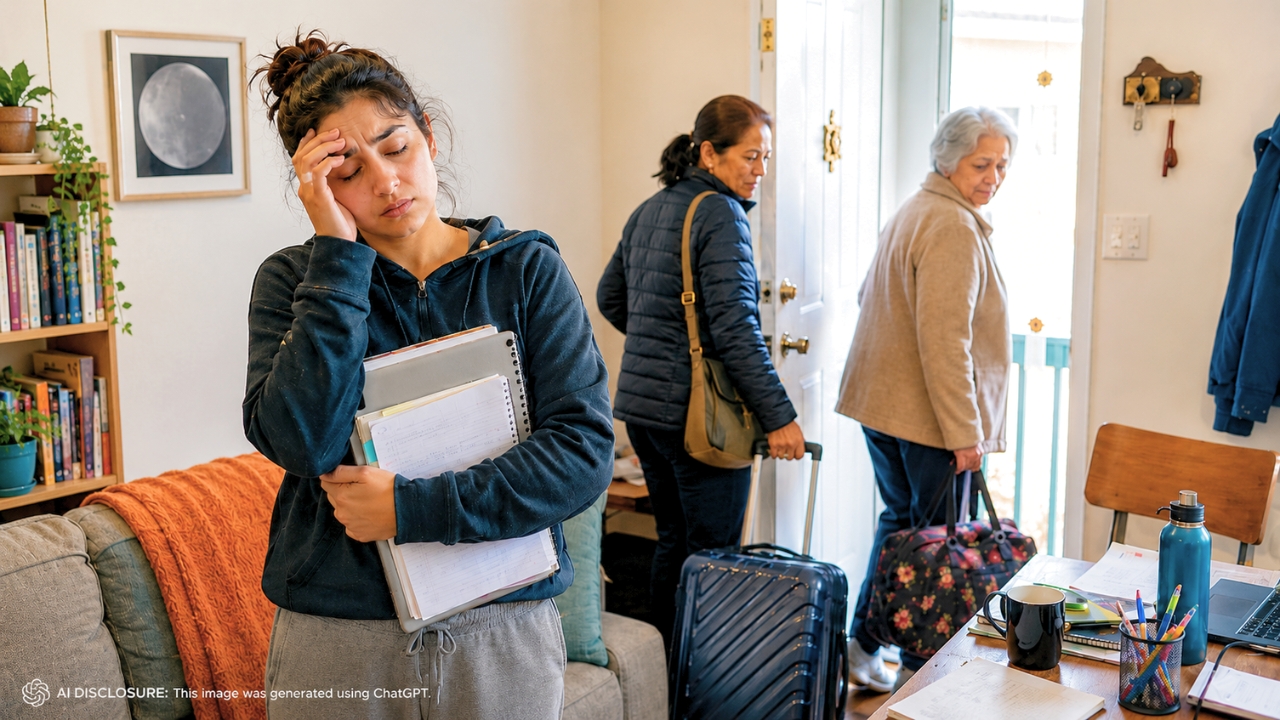
Graduate Student Sent Her Mother and Grandmother Home Early After a Two-Week Visit Left Her No Time to Rest
Photo credit: AI-generated image created using ChatGPT. Illustrative only.
By the time her exams were finally over, the graduate student thought she had a small window to breathe. Instead, she says her “break” turned into weeks of hosting, mediating, and following someone else’s rules inside her own home—until she decided she couldn’t do it anymore.
In the original post, the student, who’s studying for a master’s degree in a foreign country, described a summer that kept getting claimed by family visits. She’s introverted, already worn down by a demanding semester, and says she needed quiet time to decompress. What she got was a packed schedule of togetherness—and a mother who didn’t want to leave.
Her “rest days” disappeared before they even started
The student said her semesters “usually wipe me out,” and this one was especially challenging. After finishing exams, she expected at least a short stretch to reset. Instead, her mother planned a visit that began after only two days of being alone.
That might sound manageable on paper, but the student framed it as the start of a pattern: whenever she has a few free weeks between semesters, her mother often visits and fills that time. With few friends nearby and no easy escape, she felt like her free time automatically became family time—without her getting much say.
At first, she told herself she “usually” doesn’t mind. But after a stressful term, the lack of downtime left her walking into a visit already depleted, which set the tone for everything that followed.
Two weeks of company turned into two weeks of being managed
This time, her mother didn’t come alone. She brought the student’s grandmother, and the student said she was responsible for keeping them company for two weeks. She emphasized that she loves them, but that constant interaction is draining for her.
What made it worse, she wrote, was the dynamic in her home. She described her mother and grandmother as controlling, saying they decide “what to eat, where to go, when to wash, when to clean” when they visit. In her telling, it didn’t feel like she was sharing space with guests—it felt like she was being overruled in her own apartment.
The control wasn’t subtle, either. The student said it made her feel like a child with “no authority over my own place,” and that alone created frustration and stress. Add in the fact that her mother and grandmother “create friction together,” and she said the entire stretch became a constant battle to keep the peace.
Then the visit didn’t really end—it reset and started again
After the two-week stay, the student’s mother left for a few days to bring the grandmother home. That should have been the moment the student finally got her space back.
But the break didn’t last. The mother returned “straight back” with the student’s father and stayed another two weeks. The student described that as even more emotionally exhausting, not because her father was necessarily the problem, but because her mother spent much of that time “bashing him for the smallest mistakes.”
In the student’s view, there were no calm moments to recover. The household energy stayed tense, with her mother quick to argue and hold grudges. By the time the calendar finally reached the planned departure date, the student was counting on a specific reward: two uninterrupted weeks alone before she’d have to travel back to her hometown and be around her family again.
The last-minute request that made her feel cornered
Then came the twist. The day before her mother was supposed to leave with the father, the mother told her she didn’t want to go. She wanted to stay in the country longer because she “loves this country,” and because, in her words, she can’t relax back home.
The mother also blamed the people waiting for her there: her own mother bothers her, her husband gets on her nerves, and being in the student’s country is “the only place where she can relax.” The student heard it as emotional pressure—especially after giving up “MOST” of her summer already.
What her mother was asking for wasn’t a small extension. The student said her mother was begging to stay the rest of the month, until mid-August. For the student, that would wipe out the remaining quiet time she had been clinging to, right before she’d be back in her hometown and immersed in family life again.
That’s when the student reached her breaking point. She said her instincts told her to create distance, even though she felt guilty and confused about it.
Guilt, control, and a student who can’t bring herself to say no
The student didn’t paint herself as someone eager to kick family out. She described herself as a “total pushover,” someone who feels a “physical ache” at the thought of saying no. That matters here, because it helps explain why the visits kept expanding and why the mother’s request landed so hard.
She also spelled out the emotional bind: “She is my mother,” she wrote, and she felt like she “shouldn’t” be exhausted by her. But exhaustion wasn’t the only issue. The student said her mother switches “on a dime,” is quick to argue, and will “bash anybody that ticks her off for long stretches of time.”
To the student, the mother’s claim that she “couldn’t relax at all” during the recent stay didn’t add up, because the mother herself created much of the tension. That contradiction made the student feel manipulated, like she was being asked to sacrifice her remaining downtime so her mother could escape problems back home.
Underneath it all is a simple need the student kept repeating: she wants time alone in a quiet room, to lay in bed and recover. And she felt like even that basic request was being framed as rejection.
People focused on boundaries and the reality of living space
The post itself was labeled “Not the A-hole,” signaling that many readers saw her decision as reasonable given what she described. The themes that stood out were less about blaming anyone for wanting a vacation and more about the practical reality that the student’s home isn’t a hotel, and her academic breaks aren’t community property.
From the student’s perspective, the core issue wasn’t one visit—it was the way visits became extended takeovers, with her mother and grandmother running the household, choosing routines, and leaving her drained. The last-minute attempt to stay longer felt like pushing past an already clear limit.
There’s also a safety-and-stability angle that people often raise in these kinds of family standoffs: when one person consistently controls the space and emotions, the quieter person can end up shrinking in their own home. For a graduate student already running on fumes, losing the ability to rest can ripple into school performance, mental health, and the basic ability to function day to day.
The student didn’t describe an explosive confrontation so much as a slow, painful line she was trying to draw. She wanted her mother to go home as planned, even “against her wishes,” because staying would come at the cost of the student’s remaining recovery time.
In the end, the student’s post reads like someone realizing that love and access aren’t the same thing. She wasn’t trying to punish her mother; she was trying to reclaim a few quiet weeks before the next round of family time begins—without having to fight for permission to rest.
Check out more from Now Rundown:
- A Party of 12 Came Back a Month Later Demanding Their $80 Tip Refunded — My Restaurant Made Me Pay It
- Her Coworker Kept Filing the Same Complaint About Her After Being Warned — Then She Filed a Counter-Report With Every Email Documented
- Siblings Demanded Half of Their Sister’s $11 Million Inheritance — She Refused Because They Never Visited
- The Kid I Bullied in Middle School Just Interviewed for a Job on My Team — He Bombed It and I Didn’t Hire Him

Abbie Clark is the founder and editor of Now Rundown, covering the stories that hit households first—health, politics, insurance, home costs, scams, and the fine print people often learn too late.