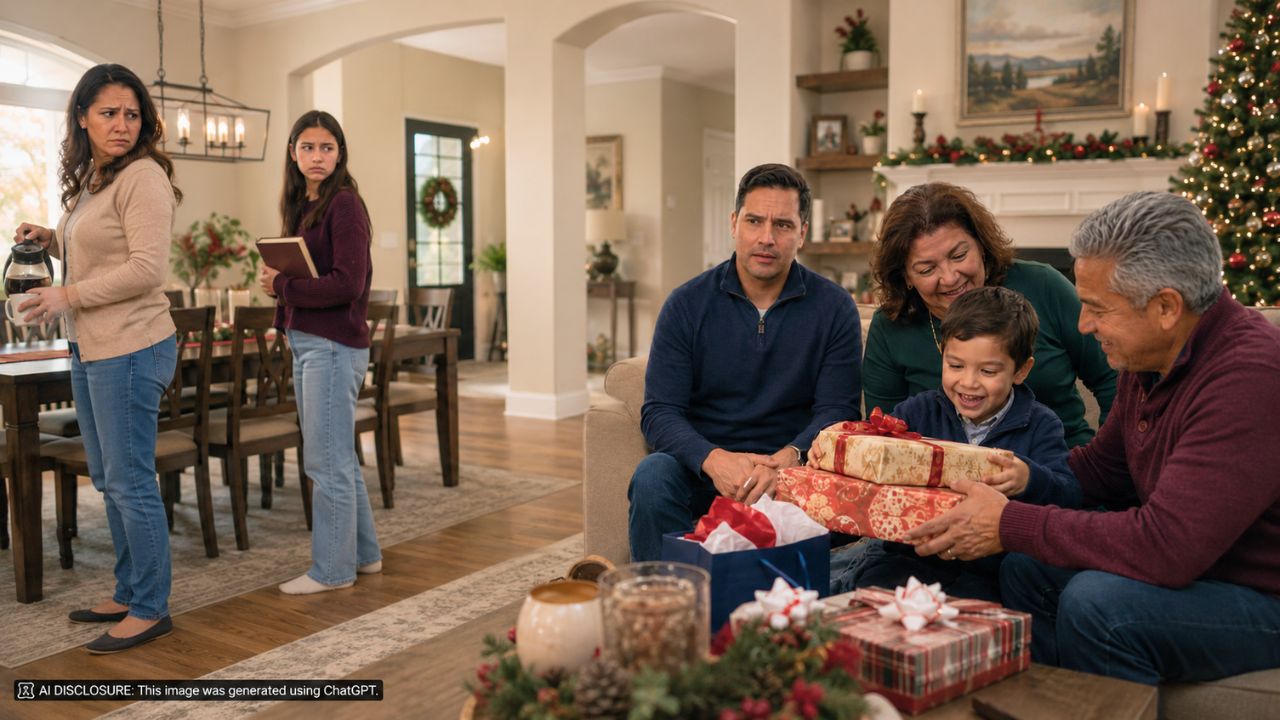
Woman Was Hurt After Her Husband’s Family Bought Expensive Gifts for His Biological Kids but Nothing for Hers
Photo credit: AI-generated image created using ChatGPT. Illustrative only.
It started as a familiar holiday-style sting: one set of kids getting showered with attention while another is left watching from the sidelines. A mom said she reached her limit after years of watching her husband’s relatives make it clear—through trips, outings, and gifts—that they see her son as “theirs” and her daughter as optional.
In the original post, the woman explained that her daughter is now 14 and has been raised with her husband in a full-time dad role since the girl was 4. The couple also shares a 5-year-old son. The problem, she said, is that her husband’s family treats the two kids like they belong to different worlds.
They were “fine” with her daughter—until the baby came
According to the mom, things didn’t always feel this sharp. Before her son was born, her husband’s family “treated [her daughter] ok,” she wrote. But once they had a biological grandchild in the picture—and as her daughter got older—the separation became harder to ignore and harder to excuse.
Most of her husband’s side of the family is “mostly single, never married, no kids,” she said, which means they have time and money to plan experiences. And they’ve used that freedom in a way that lands like a message: they invite the 5-year-old to go places and do fun things, but not the 14-year-old.
The mom’s frustration wasn’t about one missed invitation. It was about a pattern that kept repeating until it felt like a family policy.
The invites and the gifts drew a line in the sand
In her telling, relatives regularly ask to take her son on trips and outings. But her daughter isn’t included, even though she’s part of the household and has known these people for most of her life. The mom said that, to her, the message is obvious: her daughter isn’t seen as fully family.
That’s where the emotional “injury” landed—less like a single cruel moment and more like repeated reminders that a child is being ranked lower. The mom described herself as protective and said she’d rather avoid the relatives altogether than keep letting her daughter absorb the comparison.
“We’re married and are one family,” she wrote. “We don’t do things separate.” That boundary became her response: if both kids aren’t welcome, then no one goes.
Mom’s boundary: package deal, or no deal
The mom said she has started refusing invitations for her son when the invite doesn’t include her daughter. She framed it as a family unity issue, but also as a way to prevent ongoing hurt. In her view, letting her son go along with the unequal treatment teaches both kids the wrong lesson—one learns he’s “more” family, and the other learns she’s “less.”
Her stance has created friction, especially with her mother-in-law. The mom said her MIL “gets pretty upset” when she says no, but she also believes her MIL contributes to the separation herself.
And the more the family pushes, the more dug in she becomes. At this point, she wrote, she doesn’t want anything to do with them. Not because she’s trying to punish anyone, but because she doesn’t see a way to maintain a relationship without letting the favoritism keep happening.
Why this hits harder in their house
The daughter’s background adds another layer. The mom said the girl has no relationship with her biological father and never has. He was “never interested,” she wrote, and the daughter believes the mom’s husband is her dad because he’s been the only consistent father figure in her life.
That makes the husband’s family’s behavior feel even colder: these are the relatives connected to the only dad she’s known, yet they’re the ones drawing the bloodline boundary.
The mom also pointed to her own upbringing for contrast. She said her extended family has historically folded in kids from outside relationships—cousins, nieces, nephews—and didn’t treat anyone differently. So watching her husband’s relatives create categories for the kids in her home feels both unfamiliar and unacceptable.
The side argument people fixated on
After she shared her story, the mom added an edit addressing a criticism she said kept coming up: the fact that her daughter believes her husband is her biological father. She clarified she never told her daughter that—her husband simply became “dad” in practice because the biological father has never been involved.
She also said that due to her daughter’s mental health struggles, she and her husband have decided—along with the girl’s therapist—that it is not the right time to explain that her biological father “never gave” any care or attention. She emphasized that she has professional support around that issue and that it wasn’t the point of her post.
That edit matters because it shows how many pressures are colliding at once: a teen already navigating mental health challenges, a younger sibling being singled out for special treatment, and a mom trying to keep the family narrative stable while outsiders keep poking at weak points.
The practical stakes: what happens next time there’s an invite
This isn’t the kind of problem that stays theoretical. Every new trip, every outing, every holiday gift exchange forces the same decision: let the son go and hope the daughter shrugs it off, or say no and deal with the blowback from relatives who insist it’s not personal.
In the short term, her boundary means her son misses experiences his grandmother and other relatives want to give him. That can create resentment in a different direction—especially as he gets older and starts noticing that the “no” always comes when a particular person isn’t included.
In the long term, the mom seems to be bracing for a wider rupture. She’s already leaning toward cutting contact because, in her view, the family isn’t just being thoughtless—they’re actively defining who counts. And she doesn’t want her daughter spending her teen years learning to tolerate that inside her own family.
For now, the tension is sitting right where most family conflicts live: at the intersection of money, access, and belonging. The relatives can call it “just a trip” or “just gifts,” but the mom is reading it as a rule being enforced over and over. And unless the adults on her husband’s side change how they show up for both kids, she’s made it clear she’s willing to keep choosing the package deal—even if it costs them the relationship.
Check out more from Now Rundown:
- A Party of 12 Came Back a Month Later Demanding Their $80 Tip Refunded — My Restaurant Made Me Pay It
- Her Coworker Kept Filing the Same Complaint About Her After Being Warned — Then She Filed a Counter-Report With Every Email Documented
- Siblings Demanded Half of Their Sister’s $11 Million Inheritance — She Refused Because They Never Visited
- The Kid I Bullied in Middle School Just Interviewed for a Job on My Team — He Bombed It and I Didn’t Hire Him

Abbie Clark is the founder and editor of Now Rundown, covering the stories that hit households first—health, politics, insurance, home costs, scams, and the fine print people often learn too late.