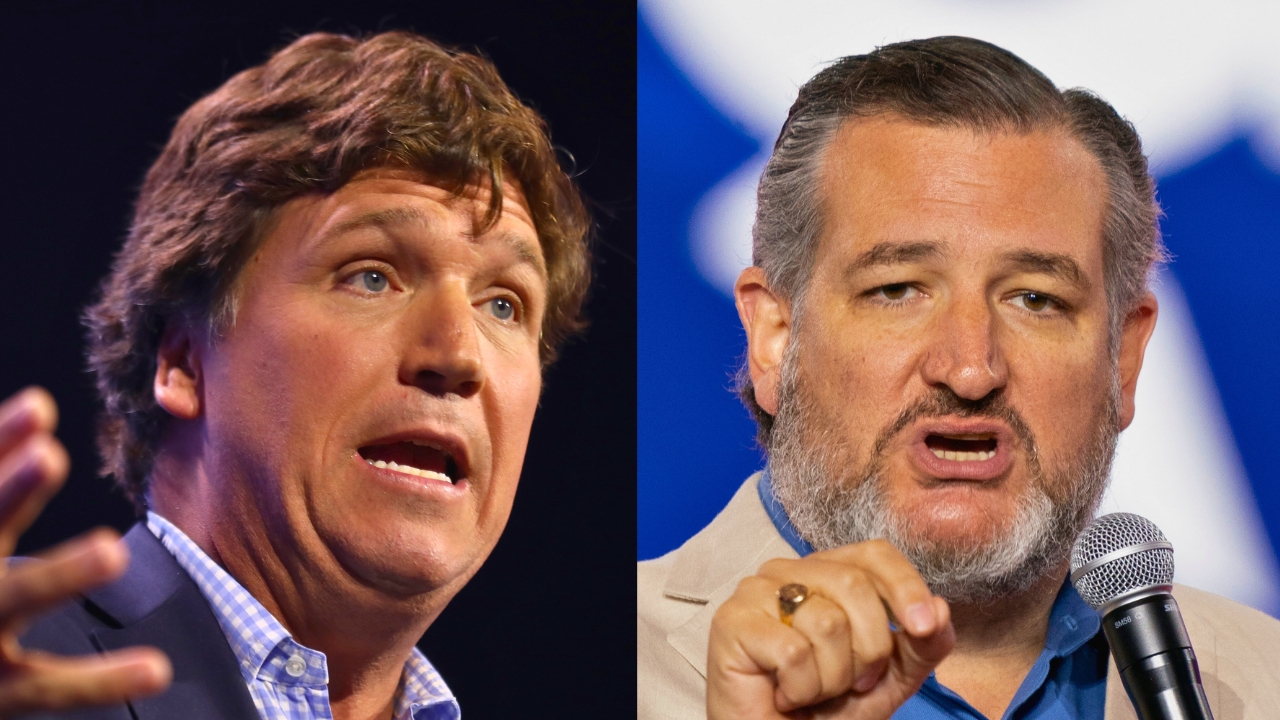
Ted Cruz calls Tucker Carlson “the single most dangerous demagogue in this country” as GOP feud deepens
Photo credit: Gage Skidmore from Surprise, AZ, United States of America, CC BY-SA 2.0, via Wikimedia Commons and lev radin/Shutterstock.com
WASHINGTON — Sen. Ted Cruz sharply escalated his long-running fight with Tucker Carlson on Tuesday, calling the conservative commentator “the single most dangerous demagogue in this country” during a Washington symposium on antisemitism. Cruz said he had decided to confront Carlson directly, accusing him of helping spread antisemitism on the American right and of platforming guests who distort World War II history.
Cruz’s remarks did not come out of nowhere. They are part of a broader split inside the Republican coalition that has been building for months, especially over Israel, Iran and the direction of the “America First” movement. Reuters and Politico have both described the Cruz-Carlson clash as a fight between a more hawkish, interventionist wing of the GOP and a more isolationist, populist wing that is deeply skeptical of new foreign entanglements.
On the core foreign-policy divide, Cruz has argued that Iran is a major threat and has supported a hard-line posture toward Tehran and strong backing for Israel. Carlson, by contrast, has warned that U.S. involvement in a wider Iran conflict would drag the country into another Middle East war and betray the anti-intervention instincts of many Trump voters. Reuters described Carlson as part of the faction urging Trump not to get the United States pulled into a new war, while Cruz publicly defended a tougher line.
That helps explain why Cruz is against Carlson. It is not just personal dislike. Cruz appears to believe Carlson is moving a large right-wing audience toward a worldview that is anti-interventionist in a way Cruz sees as reckless, and, more recently, toward rhetoric Cruz says crosses into antisemitism. At Tuesday’s event, Cruz said antisemitism on the right has become a serious problem and singled Carlson out as its most influential amplifier.
Cruz also pointed to Carlson’s platforming choices. In the remarks circulating online, Cruz criticized Carlson for featuring people who argued Winston Churchill was the villain of World War II and others who said there was a case America should have sided with Nazi Germany. Those comments refer to controversies around Carlson interviews with revisionist guests that drew backlash from historians, Jewish groups and some conservatives.
Carlson and his defenders see the fight differently. Carlson has rejected accusations that criticism of Israel or opposition to foreign wars is antisemitic. In late 2025, he said, “Just because I don’t want to bow to the will of a foreign leader does not make me an antisemite,” and added that he considers antisemitism immoral. That response captures Carlson’s broader position: he frames himself as opposing endless wars and foreign-policy orthodoxy, not attacking Jews as a group.
So why does Cruz think Tucker is dangerous? Based on Cruz’s public comments, the answer has two parts. First, Cruz appears to think Carlson is dangerous because he has a huge audience and can move conservative opinion on war, Israel and nationalism. Second, Cruz argues Carlson is normalizing ideas and voices that go beyond ordinary foreign-policy disagreement and into antisemitic or historically revisionist territory. AP reported in late 2025 that the Carlson controversy had become a flashpoint inside the conservative movement over where criticism of Israel ends and antisemitic rhetoric begins.
The cleanest way to understand the feud is this: Cruz represents a wing of conservatism that is strongly pro-Israel, confrontational toward Iran and alarmed by the rise of antisemitic rhetoric on the right. Carlson represents a wing that is suspicious of foreign intervention, hostile to what it sees as moral blackmail around Israel, and eager to challenge old Republican foreign-policy assumptions. The fight between them is really a fight over what the post-Trump right is supposed to be.