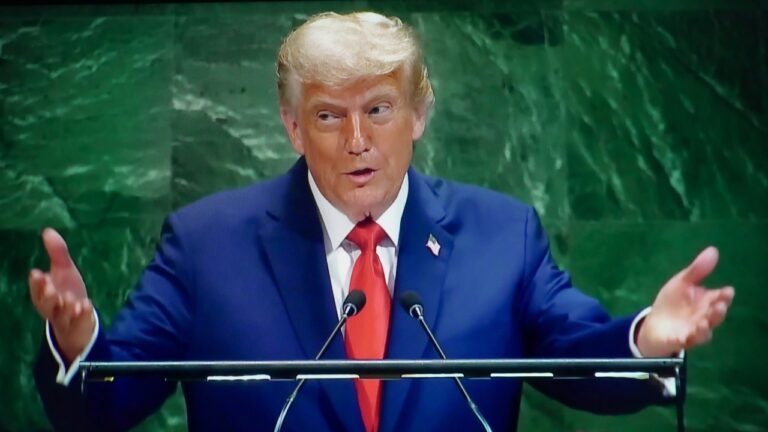
“I can do anything I want” Trump says as Cuba rhetoric turns even more aggressive
Photo credit: Evan El-Amin/Shutterstock.com
President Donald Trump sharply escalated his rhetoric toward Cuba on Monday, saying he believed he would have the “honor” of “taking Cuba in some form” and adding, “I can do anything I want” when asked about what the United States could do with the island nation. The comments, delivered at the White House, came at a moment of acute strain for Cuba, which has been grappling with a severe economic crisis, widespread fuel shortages and repeated power failures. Reuters reported that Trump’s remarks landed as U.S.-Cuba talks were underway and as Cuba’s government tried to steady a worsening domestic situation.
The remarks stood out even in the context of Trump’s often blunt foreign-policy style because they suggested an extraordinary degree of presidential freedom over a neighboring country with which the United States has a long, difficult and highly sensitive history. Trump did not spell out exactly what he meant by “taking Cuba in some form,” and the White House had not detailed any legal basis for a possible intervention. That ambiguity immediately became part of the story, because the statement was broad enough to invite speculation about whether Trump meant economic domination, political leverage, regime change pressure or something more coercive.
What makes the moment more significant is that it did not come out of nowhere. Cuba has been under growing pressure as fuel imports have tightened and its aging electric grid has repeatedly buckled, contributing to blackouts and deeper public frustration. Reuters reported several days earlier that Cuban President Miguel Díaz-Canel acknowledged the country had opened talks with the United States amid the crisis, while also saying Havana wanted any dialogue to proceed on the basis of equality, respect for both political systems and recognition of sovereignty and self-determination. Trump’s comments therefore landed in the middle of a delicate period in which diplomacy, pressure and public instability were all colliding at once.
The economic backdrop matters here because Cuba is not dealing with a normal downturn. Reuters reported that the country has been suffering under a broader crunch tied to shortages, sanctions pressure and the fallout from disruptions in imported fuel. That pressure has fed a visible sense of fragility around the Cuban state, including blackouts serious enough to become part of the international conversation. Trump’s description of Cuba as weakened fits that reality politically, but it also shows why his words triggered such attention: statements about “taking” a struggling country carry a very different weight when that country is already facing internal hardship.
The timing also intersected with reporting that the administration’s pressure on Havana may be tied to broader U.S. objectives in the region. After Trump’s remarks, The New York Times reported that removing Díaz-Canel from office was a key U.S. objective in ongoing bilateral contacts, though Reuters itself said the White House had not provided legal or policy details to explain what an intervention would mean in practice. That gap between rhetoric and policy matters. It is one thing for a president to speak aggressively about an adversarial government; it is another for the administration to leave unclear whether the remarks are mainly political theater, a negotiating tactic or an early signal of a more concrete shift.
Díaz-Canel, for his part, had already been signaling that Cuba would not accept talks on terms that compromised the island’s political independence. He said any discussions should be conducted with mutual respect and without interference in Cuba’s sovereignty. That framing is a reminder that, for Havana, even exploratory talks with Washington must be presented domestically as dialogue between equals rather than submission under pressure. Trump’s language made that balancing act much harder. It handed Cuban officials a fresh example of the kind of U.S. rhetoric they have long used to justify distrust of Washington, while also underscoring just how weak their negotiating position may now be.
There is also a larger historical reason these comments resonated so strongly. While many U.S. presidents over decades have opposed Cuba’s Communist government and criticized its human-rights record, Washington has long honored its pledge not to invade Cuba or support an invasion as part of the settlement that resolved the 1962 Cuban missile crisis. That history does not mean the United States has avoided pressure tactics; far from it. But it does mean that language about “taking Cuba” crosses into one of the most loaded areas in U.S.-Cuba relations, because it brushes up against a central post-crisis understanding that has shaped the hemispheric balance for more than six decades.
For that reason, the reaction to Trump’s statement is likely to be shaped not just by what he meant, but by what listeners heard. Supporters may interpret it as another example of maximalist negotiating language, the kind of chest-thumping style Trump often uses to project dominance before or during sensitive talks. Critics are far more likely to hear it as a reckless statement about a sovereign country, especially given the history of U.S. intervention in Latin America and the still-potent symbolism of the Cuban missile crisis.
Cuba’s internal economic desperation adds another layer. Havana has now moved to allow nationals living abroad to own businesses on the island, a major shift aimed at bringing in investment and reviving parts of the struggling economy. That move would have been difficult to imagine just a few years ago, given the Cuban government’s long suspicion of exiles and foreign-linked private enterprise. The fact that such a change is happening now underscores how much pressure the island is under. It also suggests that the Cuban government is searching for economic escape valves even while facing escalating political pressure from Washington.
That economic opening may look contradictory beside Trump’s threats, but in practice the two developments are connected. A government under severe strain is more likely to test pragmatic openings it once resisted. Reporting has described the new business-ownership policy as a notable attempt to attract capital from Cubans abroad, including Cuban Americans, even though U.S. law still imposes major barriers through the longstanding embargo. In other words, Havana is trying to widen its options at the exact same time Washington appears interested in tightening leverage. Trump’s rhetoric therefore arrived in a context where both sides are probing for advantage, though from very different positions of strength.
The legal and strategic uncertainty around Trump’s words should not be understated. Reuters said the White House had not laid out the legal basis for intervention, and that matters because military action, overt regime-change efforts or even direct coercive measures against a neighboring state would carry major international and domestic consequences. Without a policy framework, the comments function less as a concrete announcement than as a destabilizing signal. That can still have real consequences. Markets, diplomats, allies and adversaries all watch presidential language for clues, and ambiguity from the Oval Office can alter behavior even before any formal policy is announced.
There is also the issue of credibility. Trump’s supporters often argue that his unpredictability is an asset because it keeps adversaries off balance and forces them to take U.S. threats seriously. Critics counter that such rhetoric can create confusion, undercut alliances and make serious crises harder to manage. Cuba is one of those cases where both interpretations may be operating at once. Havana cannot easily dismiss a U.S. president saying he can do “anything” he wants, especially while the island is vulnerable. But neither can outside observers assume that a provocative phrase reflects a fully formed strategy. Reuters’ reporting leaves that ambiguity intact, because the administration itself has not clarified it.
Another reason the story has traction is that it taps into an older American debate about what presidential power should look like in the Western Hemisphere. Trump’s statement was not simply anti-Castro-style rhetoric recycled for a modern audience. It sounded much broader, more personalized and more unilateral, as if the limits were set mainly by presidential will rather than law, diplomacy or international norms. That is a different tone from standard sanctions talk. Reuters’ summary emphasized the line “I can do anything I want,” and that line is likely to remain the focal point because it speaks not only to Cuba policy but also to how Trump publicly conceives of executive power.
For Cuba, the immediate challenge is practical as much as political. The government needs fuel, stability and enough domestic calm to keep basic systems functioning. Díaz-Canel has been trying to present the country as open to dialogue while insisting that Cuba’s political order is not up for negotiation. Reuters reported that he framed the talks in terms of bilateral differences that should be addressed through dialogue, not external dictate. Trump’s rhetoric threatens that posture by making the negotiations look less like problem-solving and more like pressure backed by a public threat. Even if no intervention follows, the statement complicates Havana’s effort to show strength while bargaining from weakness.

Abbie Clark is the founder and editor of Now Rundown, covering the stories that hit households first—health, politics, insurance, home costs, scams, and the fine print people often learn too late.